What are the Forex trading hours?
Forex trading hours refer to the specific times during the week when the global foreign exchange market is open for trading. The Forex market operates 24 hours a day, five days a week, from 22:00 UTC on Sunday to 22:00 UTC on Friday, as trading moves across major financial centres in different time zones.
There are 4 primary Forex trading sessions:
Sydney Forex session
Tokyo Forex session
London Forex session
New York Forex session
When is the Sydney Forex session?
The Sydney Forex session runs from 22:00 to 07:00 UTC (17:00 to 02:00 EST) and is the first session to open each week. Sydney is the primary interbank centre for AUD and NZD liquidity, and RBA and RBNZ rate decisions fall within this window when scheduled. This is the lowest-liquidity major session of the trading day, with wider spreads and range-bound price action outside of central bank announcements. The first hour of the Sunday open (22:00 to 23:00 UTC) is the thinnest stretch of the entire trading week, where gaps from weekend news are common.
When is the Tokyo Forex session?
The Tokyo Forex session runs from 00:00 to 09:00 UTC (19:00 to 04:00 EST) and is centred on Japan's financial markets, the largest Forex trading centre in Asia. BOJ rate decisions, Japanese GDP, and Tankan surveys drive USD/JPY, EUR/JPY, and GBP/JPY during this window. Chinese economic data, including manufacturing PMI and trade balance figures, also falls within this session and affects AUD/USD and NZD/USD through risk sentiment. Liquidity is higher than Sydney but lower than London and New York, and the session overlaps briefly with both.
When is the London Forex session?
The London Forex session runs from 08:00 to 17:00 UTC (03:00 to 12:00 EST) and is the largest Forex trading session by volume. London is the world's leading interbank Forex centre, and institutional participation is high from the open. Eurozone GDP, manufacturing PMI, and BOE rate decisions drive EUR and GBP pairs in the early session, while ECB interest rate decisions at 13:15 UTC (08:15 EST) are one of the highest-impact scheduled events for EUR/USD. Spreads on major pairs are tighter than any other single session and compress further when the New York overlap begins at 13:00 UTC (08:00 EST).
When is the New York Forex session?
The New York Forex session runs from 13:00 to 22:00 UTC (08:00 to 17:00 EST) and is the second-largest interbank Forex centre globally. The first four hours overlap with London, creating the highest-liquidity period of the trading day. NFP, CPI, and retail sales releases at 13:30 UTC (08:30 EST) produce the sharpest short-term moves across USD pairs, and FOMC decisions at 19:00 UTC (14:00 EST) extend volatility into the late session. Once London closes at 17:00 UTC (12:00 EST), liquidity drops, spreads widen, and directional moves shorten in duration.
When are the best times for trading Forex?
The best times for trading Forex are the hours when two major trading sessions overlap. These overlap windows increase market liquidity, tighten spreads, and create stronger price movement.
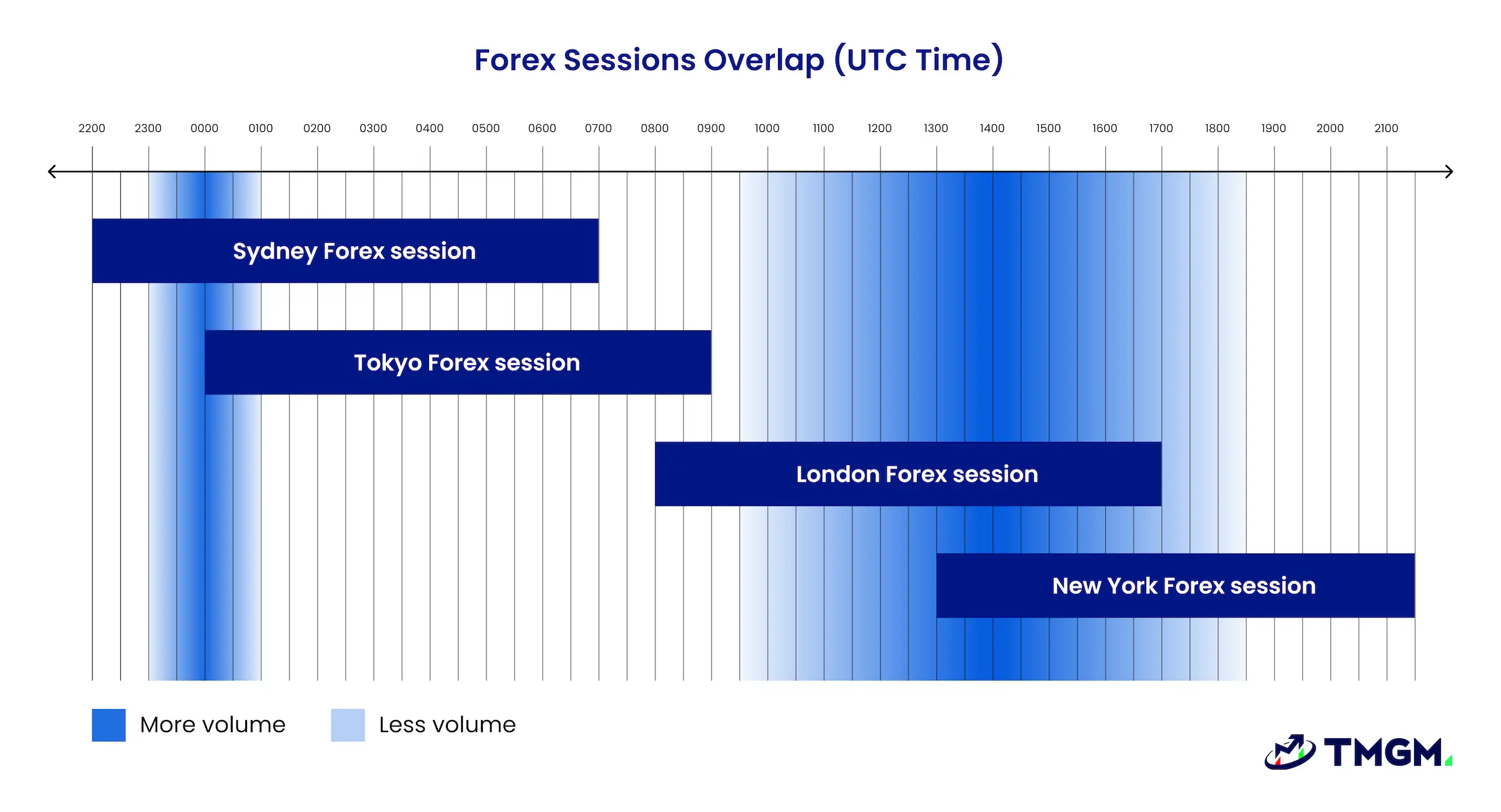
The best time to trade Forex falls within 4 time windows, ordered from highest to lowest activity:
London-New York overlap
London session
New York session (post-overlap)
Asian session (Sydney, Tokyo)
The ranking is based on liquidity in the Forex market. High liquidity produces tighter spreads, faster order execution, and more consistent price movements. These conditions reduce trading costs and lower the risk of slippage on entry and exit.
Liquidity in the Forex market is not evenly distributed across the trading day. It concentrates around the opening and closing of major financial centres, and peaks when two sessions run simultaneously.
Each window carries a different liquidity profile, spread behaviour, and set of price drivers.
The liquidity ranking above is driven by 3 session overlaps during the trading day. Each overlap concentrates activity in different currency pairs:
Sydney-Tokyo Forex session overlap
The Sydney–Tokyo overlap occurs when both the Sydney session and the Tokyo session are open simultaneously, from 00:00 to 02:00 UTC (19:00 to 21:00 EST).
The most actively traded currency pairs during this overlap include AUD/JPY, AUD/USD, NZD/USD and USD/JPY. Trading activity is concentrated in AUD and JPY pairs as Japanese institutions enter the market while Australian markets remain open.
Tokyo-London Forex session overlap
The Tokyo–London overlap occurs when both the Tokyo session and the London session are open simultaneously, from 08:00 to 09:00 UTC (03:00 to 04:00 EST).
The most actively traded currency pairs during this overlap include EUR/JPY, GBP/JPY, USD/JPY and EUR/USD. Trading activity increases in JPY crosses as European traders enter the market and respond to price levels established during the Asian session.
London-New York Forex session overlap
The London–New York overlap occurs when both the London session and the New York session are open simultaneously, from 13:00 to 17:00 UTC (08:00 to 12:00 EST).
The most actively traded currency pairs during this overlap include EUR/USD, GBP/USD, USD/JPY and USD/CHF. Trading activity is highest during this window because European and US institutions participate at the same time, which increases liquidity and tightens spreads in major currency pairs.
What economic events affect Forex trading?
Five categories of economic events move Forex prices significantly, regardless of which session they fall in:
US Federal Reserve (FOMC) decisions
US Non-Farm Payrolls (NFP)
US inflation data (CPI)
European Central Bank (ECB) interest rate decisions
Geopolitical events
1. US Federal Reserve (FOMC) decisions
FOMC interest rate decisions are the single largest scheduled catalyst for Forex markets. The Federal Reserve sets the US federal funds rate, which directly influences the value of the USD against all other currencies.
Rate hikes strengthen the USD and pressure non-dollar pairs lower.
Rate cuts weaken the USD and support non-dollar pairs.
Decisions are released at 19:00 UTC (14:00 EST), with press conferences following at 19:30 UTC (14:30 EST). Forward guidance in the press conference can extend volatility across USD pairs for the remainder of the New York session.
2. US Non-Farm Payrolls (NFP)
NFP is released on the first Friday of each month at 13:30 UTC (08:30 EST). It measures the net change in US employment and is the most closely watched labour market indicator in Forex.
Strong employment figures strengthen the USD by raising expectations for tighter Federal Reserve policy.
Weak figures weaken the USD by signalling economic slowdown.
NFP deviations from consensus forecasts produce the sharpest short-term moves of the month across EUR/USD, GBP/USD, USD/JPY, and USD/CHF.
3. US inflation data (CPI)
The US Consumer Price Index is released monthly at 13:30 UTC (08:30 EST). CPI measures the rate of price change across a basket of consumer goods and services.
Rising inflation increases the probability of Federal Reserve rate hikes, which strengthens the USD.
Falling inflation reduces that probability and weakens the USD.
CPI releases consistently produce sharp directional moves in all major USD pairs within minutes of publication.
4. European Central Bank (ECB) interest rate decisions
ECB interest rate decisions are released 8 times per year at 13:15 UTC (08:15 EST), with press conferences following at 13:45 UTC (08:45 EST). The ECB sets monetary policy for the eurozone, and its rate decisions directly affect EUR/USD, EUR/GBP, and all EUR crosses. Rate divergence between the ECB and Federal Reserve is one of the primary drivers of EUR/USD direction over multi-week periods.
5. Geopolitical events
Wars, sanctions, trade disputes, and financial crises drive demand for safe-haven currencies such as USD, JPY, and CHF, and weaken risk-sensitive currencies such as AUD, NZD, and emerging market pairs. These events are unscheduled and can produce significant price moves during any session, including the Asian session where liquidity is low and resistance to sharp moves is minimal.
All 5 categories share one common effect: they concentrate volume and volatility around a specific timestamp or event, temporarily overriding the session-based liquidity patterns described above. Forex traders should check the economic calendar before opening positions, particularly during lower-liquidity sessions where a data release or headline can move prices sharply with less resistance.
Which days of the week are best for trading Forex?
Wednesday and Thursday are the best days of the week to trade Forex. The breakdown below covers what drives activity on each trading day.
Forex trading on Monday
Monday is the lowest-volume day of the trading week. Institutional traders re-enter the market after the weekend and spend the early session assessing geopolitical and macroeconomic developments that occurred while markets were closed. Price movements are present but lack the sustained directional momentum seen mid-week. Spreads can be slightly wider in the early Monday session before full liquidity returns, particularly during the Sydney and early Tokyo hours.
Forex trading on Tuesday
Tuesday is the first day of the week where full institutional participation resumes across all four sessions. Volume increases relative to Monday and price movements become more consistent. European PMI releases between 08:00 and 10:00 UTC (03:00 and 05:00 EST) can move EUR and GBP pairs. US consumer confidence data, released at 15:00 UTC (10:00 EST), affects USD sentiment and feeds through to all major pairs.
Forex trading on Wednesday
Wednesday is the most active day of the trading week for Forex. FOMC interest rate decisions and meeting minutes are released on Wednesdays when scheduled, making this the highest-impact day for USD pairs. US ADP employment data, released at 13:15 UTC (08:15 EST) on the first Wednesday of each month, moves major pairs ahead of the Friday NFP release. The EIA Weekly Petroleum Status Report at 15:30 UTC (10:30 EST) can also affect commodity-linked currencies such as CAD through its impact on oil prices.
Forex trading on Thursday
Thursday maintains high activity levels. US jobless claims data is released weekly at 13:30 UTC (08:30 EST) and produces consistent short-term moves across USD pairs by signalling the health of the US labour market. European Central Bank interest rate decisions are scheduled on Thursdays when applicable, directly affecting EUR/USD and EUR crosses. Positioning from Wednesday's FOMC-related moves often extends into Thursday as traders adjust.
Forex trading on Friday
Friday activity depends on the scheduled calendar. Non-Farm Payrolls are released at 13:30 UTC (08:30 EST) on the first Friday of each month, producing the single largest scheduled weekly move across all major USD pairs. NFP figures that deviate from consensus forecasts can shift USD sentiment for the remainder of the session.
Outside of NFP Fridays, activity tapers in the latter half of the New York session as traders reduce exposure ahead of the weekend market close at 22:00 UTC (17:00 EST). Liquidity thins noticeably after 20:00 UTC (15:00 EST), and spreads widen as the weekly close approaches.
How do I take advantage of the Forex trading sessions overlap?
Apply these 6 steps to take advantage of the Forex trading sessions overlap:
Know exactly when the overlap starts
Track overlap times in UTC and convert them to your local time. The 3 key overlaps are: Sydney–Tokyo, Tokyo–London, and London–New York. Enter the market after the overlap begins, not before liquidity builds.
Check the economic calendar before trading
FOMC decisions, NFP, CPI, and ECB rate announcements override session-based liquidity patterns and produce the sharpest short-term moves across major pairs. Check the economic calendar before every session to identify scheduled releases. Knowing when these events fall prevents entering a position just before a sharp, unpredictable move and allows you to plan entries around the volatility rather than being caught inside it.
Focus on high-volatility windows
Trade during the period when two major trading sessions are open simultaneously. This increases order flow and price movement. The London–New York overlap generally produces the strongest volatility.
Trade currency pairs most active during that overlap
Select currency pairs that are naturally active in the overlapping sessions. Higher participation usually leads to tighter spreads and smoother execution.
Use a reliable Forex trading platform during peak liquidity
You need stable pricing, competitive spreads, and fast order execution during overlap hours. Using a reliable forex trading platform allows you to trade major currency pairs and execute positions efficiently when two sessions are open at the same time.
Avoid unnecessary exposure outside optimal windows
Do not force trades during low-liquidity periods between sessions. Liquidity drops and spreads can widen when only one session is active. Trade selectively during overlap windows and step aside when conditions weaken.
Trade Forex with TMGM worry-free.
Open a Forex trading accountOr try our free demo account (no deposit required).