

Trade The World
USD/INR drops on positive US-India trade talks
By Sagar Dua
Date Published: 14 Jan 2026 | Date Modified: 14 Jan 2026


POPULAR ARTICLES

The Indian Rupee (INR) trades higher against the US Dollar in the opening session on Wednesday. The USD/INR pair drops to near 90.30 as the Indian Rupee gains on the outcome of trade talks between the United States (US) and India on Tuesday.
- The Indian Rupee rises against the US Dollar as hopes of a US-India trade deal have improved.
- India’s External Affairs Minister Jaishankar said that trade talks with US Secretary of State Rubio were good.
- India's Wholesale CPI grew strongly by 0.83% in December.
The Indian Rupee (INR) trades higher against the US Dollar in the opening session on Wednesday. The USD/INR pair drops to near 90.30 as the Indian Rupee gains on the outcome of trade talks between the United States (US) and India on Tuesday.
India’s External Affairs Minister Subrahmanyam Jaishankar stated in a post on X, formerly known as Twitter, that trade discussions with US Secretary of State Marco Rubio were good and will continue discussing issues. ”Just concluded a good conversation with @SecRubio. Discussed trade, critical minerals, nuclear cooperation, defence, and energy. Agreed to remain in touch on these and other issues,” Jaishankar posted.
In response, US Ambassador to India, Sergio Gor, stated in a post on X that it was a “positive call” and the next meeting is very likely to be in February.
Easing trade frictions between the US and India is favorable for the Indian Rupee, which turned out to be Asia’s worst-performing currency in 2025 due to the steepest tariffs by Washington on imports from New Delhi. The US raised tariffs on India to 50%, added 25% punitive tariffs for buying oil from Russia.
Meanwhile, foreign investors continue to dump their stake in the Indian stock market amid a trade stalemate between the US and India. So far in January, Foreign Institutional Investors (FIIs) have remained net sellers in eight out of nine trading days, and have offloaded their stake worth Rs. 16,925.03 crore.
Meanwhile, India's WPI Inflation data for December has back in black by rising 0.83% at an annualized pace. Inflation at the wholesale level declined to 0.31% in November, while it was expected to come in positive at 0.3%.
The table below shows the percentage change of Indian Rupee (INR) against listed major currencies today. Indian Rupee was the strongest against the US Dollar.
| USD | EUR | GBP | JPY | CAD | AUD | INR | CHF | |
|---|---|---|---|---|---|---|---|---|
| USD | -0.03% | -0.12% | 0.03% | 0.00% | -0.28% | -0.14% | -0.03% | |
| EUR | 0.03% | -0.10% | 0.06% | 0.06% | -0.26% | -0.11% | 0.02% | |
| GBP | 0.12% | 0.10% | 0.17% | 0.14% | -0.16% | -0.04% | 0.11% | |
| JPY | -0.03% | -0.06% | -0.17% | -0.02% | -0.31% | -0.14% | -0.04% | |
| CAD | -0.00% | -0.06% | -0.14% | 0.02% | -0.29% | -0.13% | -0.02% | |
| AUD | 0.28% | 0.26% | 0.16% | 0.31% | 0.29% | 0.16% | 0.27% | |
| INR | 0.14% | 0.11% | 0.04% | 0.14% | 0.13% | -0.16% | 0.12% | |
| CHF | 0.03% | -0.02% | -0.11% | 0.04% | 0.02% | -0.27% | -0.12% |
The heat map shows percentage changes of major currencies against each other. The base currency is picked from the left column, while the quote currency is picked from the top row. For example, if you pick the Indian Rupee from the left column and move along the horizontal line to the US Dollar, the percentage change displayed in the box will represent INR (base)/USD (quote).
Daily digest market movers: US Dollar capitalizes on steady US inflation data
- The Indian Rupee rises against the US Dollar, even as the latter trades firmly against its other peers, following the release of the US Consumer Price Index (CPI) data for December. During the press time, the US Dollar Index (DXY), which tracks the Greenback’s value against six major currencies, holds onto gains near a monthly high around 99.25.
- On Tuesday, US Bureau of Labor Statistics (BLS) showed that inflationary pressures remained steady, keeping hopes for the Federal Reserve (Fed) to maintain interest rates at their current levels intact. On an annualized basis, the US headline and core CPI came in at 2.7% and 2.6%, respectively.
- Richmond Federal Reserve President Tom Barkin called December’s inflation data "encouraging," adding that he expects price pressures to remain at modest levels in the next couple of months, Reuters reported.
- US President Donald Trump welcomed steady inflation figures and extended its force on Fed Chair Jerome Powell to reduce interest rates further. We have very low inflation. That would give ’too late Powell’ the chance to give us a nice beautiful big rate cut," Trump told reporters at Detroit, Reuters reported.
- Meanwhile, Fed’s Powell is facing criminal charges for cost overruns in the renovation of the Fed's Washington headquarters, which he called a “pretext” for not taking monetary decisions as per the president’s preferences. The event has raised concerns over the Fed’s independence.
- In response, chiefs from global central banks have shown support for Fed’s Powell, citing that “independence of central banks is a cornerstone of price, financial and economic stability in the interest of the citizens that we serve.”
- In Wednesday’s session, investors will focus on the US Producer Price Index (PPI) data for October and November, and Retail Sales data for November, which will be published at 13:30 GMT.
Technical Analysis: USD/INR consolidates around 20-day EMA for almost a month
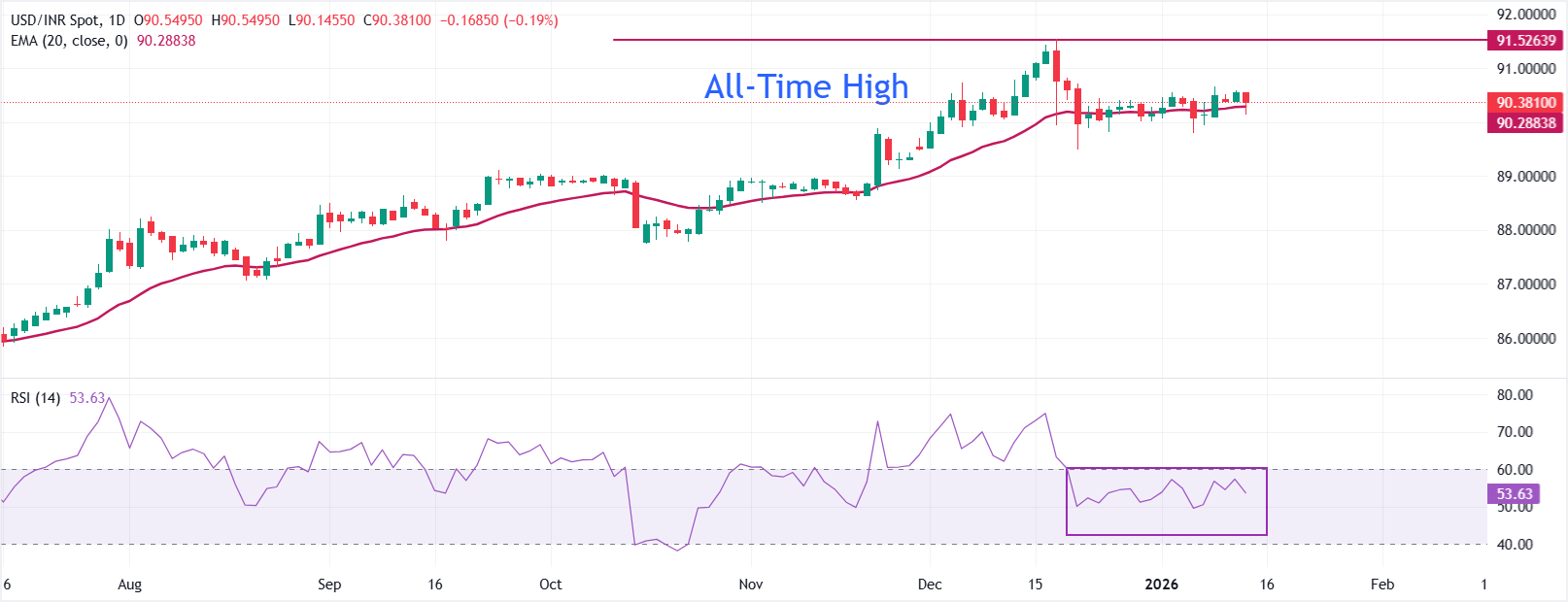
USD/INR trades lower near 90.3810 as of writing. Price holds above the 20-day Exponential Moving Average (EMA) at 90.29, sustaining a short-term upward bias. The 20-day EMA is edging higher, supporting the path of least resistance to the upside.
The 14-day Relative Strength Index (RSI) at 53 (neutral) has eased from prior readings, confirming moderated momentum.
As long as the pair holds above the rising 20-day EMA, the bias stays positive and dips remain supported, while a daily close below that gauge could open room for a deeper retracement. RSI hovering near the midline suggests balanced conditions; a further fade in momentum would favor consolidation, whereas a pickup could underpin an extension of the advance.
(The technical analysis of this story was written with the help of an AI tool.)
Tariffs FAQs
Tariffs are customs duties levied on certain merchandise imports or a category of products. Tariffs are designed to help local producers and manufacturers be more competitive in the market by providing a price advantage over similar goods that can be imported. Tariffs are widely used as tools of protectionism, along with trade barriers and import quotas.
Although tariffs and taxes both generate government revenue to fund public goods and services, they have several distinctions. Tariffs are prepaid at the port of entry, while taxes are paid at the time of purchase. Taxes are imposed on individual taxpayers and businesses, while tariffs are paid by importers.
There are two schools of thought among economists regarding the usage of tariffs. While some argue that tariffs are necessary to protect domestic industries and address trade imbalances, others see them as a harmful tool that could potentially drive prices higher over the long term and lead to a damaging trade war by encouraging tit-for-tat tariffs.
During the run-up to the presidential election in November 2024, Donald Trump made it clear that he intends to use tariffs to support the US economy and American producers. In 2024, Mexico, China and Canada accounted for 42% of total US imports. In this period, Mexico stood out as the top exporter with $466.6 billion, according to the US Census Bureau. Hence, Trump wants to focus on these three nations when imposing tariffs. He also plans to use the revenue generated through tariffs to lower personal income taxes.

FXStreet
More than a million users rely on FXStreet for real-time market data, charting tools, expert insights, and forex news. Its comprehensive economic calendar and educational webinars help traders stay informed and make calculated decisions. FXStreet is supported by a team of about 60 professionals, split between the Barcelona headquarters and various global regions.
Read More








