What Does CFD Trading Mean?
CFD stands for contract for difference. A CFD is a derivative agreement between a trader and a provider to settle in cash the difference between the price at which a position opens and the price at which it closes. The trader does not own the underlying asset. Instead, the contract tracks the price movement of that market.
Every CFD position has two sides: the trader and the provider. When the trade closes, the party on the losing side pays the other the price difference. This is why CFDs are described as over-the-counter derivatives. The contract is not exchange-traded, and it does not give the trader shareholder rights, physical delivery, or ownership of the underlying market.
Because the trader does not own the asset, a CFD can be opened in either direction. Going long means the trader expects the market to rise. Going short means the trader expects it to fall. Both directions are available across a wide range of instruments, including forex, shares, indices, precious metals, oil, and cryptocurrencies.
How CFD trading works
CFD trading works by opening a contract based on the price movement of an underlying market. The trader chooses whether to buy or sell, decides the position size, manages margin, and closes the trade when the position reaches the planned exit or risk limit. Traders who want the full execution process can read TMGM’s step by step guide on how to trade CFDs.
Going long and going short
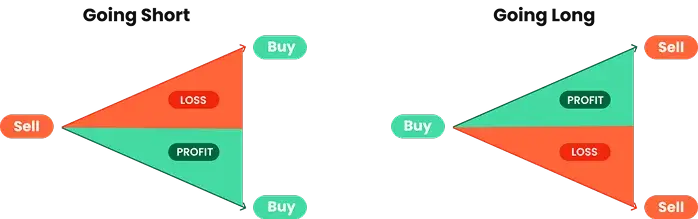
In CFD trading, going long means opening a buy position because the trader expects the market price to rise. Going short means opening a sell position because the trader expects the market price to fall. Because the trader does not own the underlying asset, a CFD can be opened in either direction. In both cases, profit or loss depends on the difference between the opening price and the closing price, multiplied by the contract size.
This is one of the main differences between CFDs and direct asset ownership. A trader does not need to buy first and wait for the market to rise. With CFDs, the trader can also sell first when expecting a decline, then close the position later if the market moves in the expected direction.
| Position type | Opening action | Expected market move | Result if correct |
|---|---|---|---|
| Going long | Buy | The market rises | The trader profits from the increase in price |
| Going short | Sell | The market falls | The trader profits from the decrease in price |
For example, if a trader opens a buy CFD on an index at 4,500 and closes it at 4,550, the trader gains 50 points. If a trader opens a sell CFD on the same index at 4,500 and closes it at 4,450, the trader also gains 50 points. If the market moves in the opposite direction in either case, the trade records a loss instead.
Leverage and margin in CFD trading
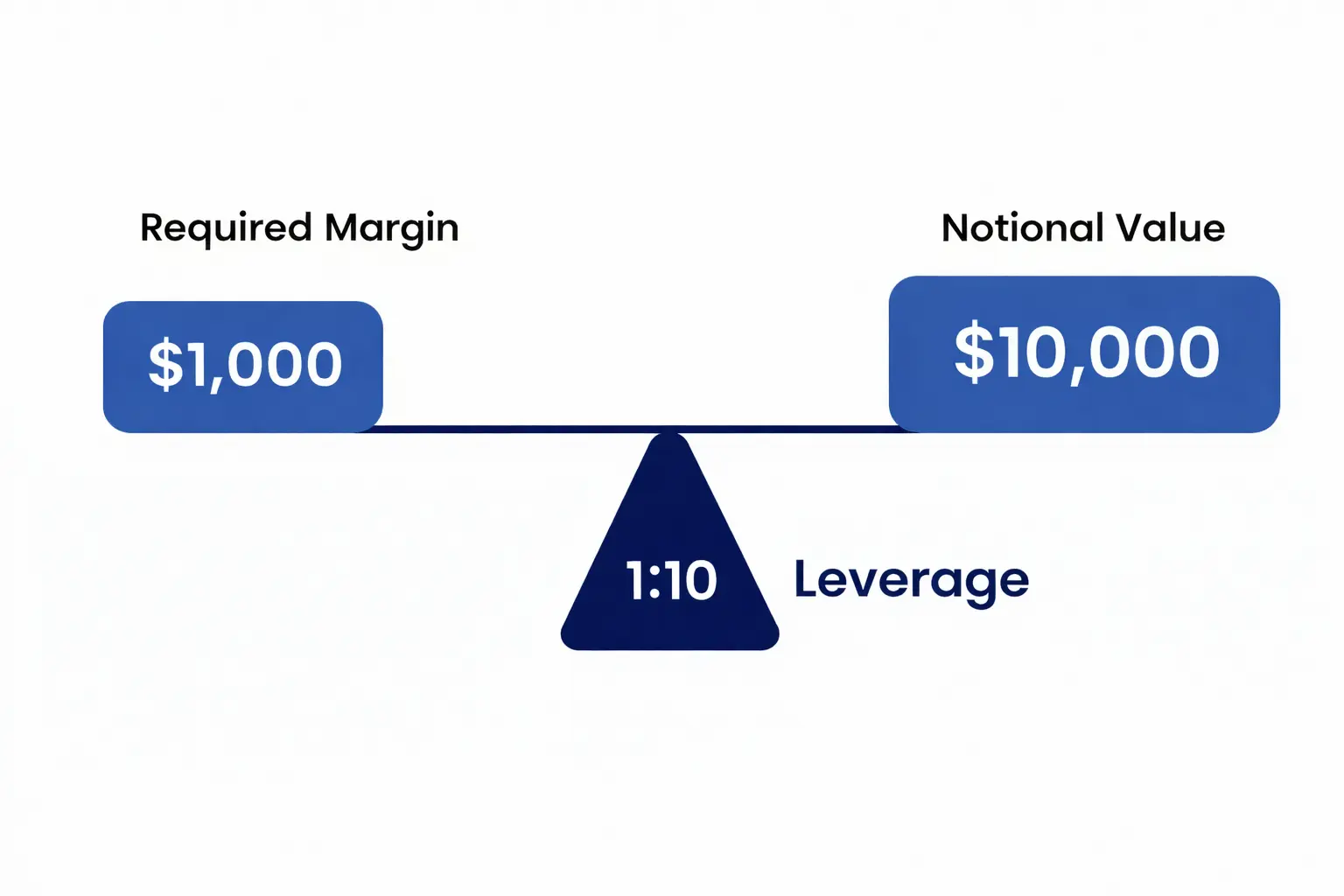
CFDs are usually traded on margin. Margin is the amount a trader needs to deposit to open a position, while leverage is what allows that deposit to control a larger market exposure. Leverage is often shown as a ratio such as 1:10, which means every $1 of margin can control $10 of market value. This means a trader can open a position with only a fraction of the full trade value rather than paying the entire amount upfront.
For example, if a trader uses 10:1 leverage, a $1,000 margin deposit can control a $10,000 position. If the market moves 1% in the trader’s favour, the gain is based on the $10,000 exposure, not just the $1,000 deposit. The same applies if the market moves against the trade, which is why leverage can increase both opportunity and risk. Traders who want a more detailed explanation can read more about CFD leverage and margin.
How CFD profit and loss is calculated
Profit or loss in CFD trading comes from the difference between the opening price and the closing price, multiplied by the size of the position. If the market moves in the trader’s favour, the position shows a gain. If the market moves against the trader, the position shows a loss. The final net result then changes once trading costs such as spread, commission, or overnight funding are included.
Can CFD trading be profitable?
CFD trading can be profitable when the market moves in the trader’s favour and the position is sized correctly. However, profits are never guaranteed. The same leverage that can increase upside can also increase downside, and trading costs can reduce the final return. Profitability depends on market direction, entry and exit quality, risk control, holding time, and discipline.
A simple CFD trading example
A CFD trade can be easier to understand when the trade is broken into position value, margin, price movement, and position size. The example below shows a simple long CFD trade before spreads, commissions, or overnight funding are included.
Example setup
• A trader expects a share CFD to rise.
• The trader buys 200 share CFDs at $50 per unit.
• The full position value is $10,000 because 200 x $50 = $10,000.
• With 1:10 leverage, the required margin is $1,000.
• Each $1 price movement equals $200 because the position size is 200 CFDs.
| Scenario | Market movement | Calculation | Gross result |
|---|---|---|---|
| The price rises | The share CFD moves from $50 to $52 | $2 gain x 200 CFDs | $400 gross profit |
| The price falls | The share CFD moves from $50 to $48 | $2 loss x 200 CFDs | $400 gross loss |
This example shows why leverage matters in CFD trading. The trader only deposits $1,000 as margin, but profit and loss are calculated on the full $10,000 position value. A $400 gross profit would equal 40% of the margin deposit before costs, while a $400 gross loss would also equal 40% of the margin deposit before costs.
The trader does not own the share. The trader is trading the price difference between the opening price and the closing price. The final net result may be lower than the gross result once spreads, commissions, or overnight funding are included. For more worked scenarios, see TMGM’s CFD trading examples.
What markets can traders access with CFDs?
One of the main reasons CFD trading is widely used is that it provides access to a broad range of financial markets from one account. At TMGM, traders can explore a wide range of cfd markets, which helps explain why CFDs are often used as a flexible instrument rather than as a single market product.
| Market | What the CFD tracks |
|---|---|
| Forex | The price movement of currency pairs such as EUR/USD or GBP/JPY |
| Shares | The price movement of individual company shares without direct ownership |
| Indices | The value of stock market indices such as the US 500 or Nasdaq related benchmarks |
| Precious metals | The price movement of products such as gold and silver |
| Oil | The price movement of oil products such as Brent crude oil and WTI crude oil |
| Crypto | The price movement of cryptocurrencies without holding coins in a wallet |
What are the advantages and risks of CFD trading?
CFDs are popular because they combine access, flexibility, and leverage in one instrument. The same features that make CFDs attractive can also increase risk. Looking at both sides together gives a more balanced answer to what CFD trading really involves.
| Advantages | Risks |
|---|---|
| Access to a wide range of global markets from one account | Leverage can magnify losses as well as gains |
| Ability to go long or short depending on market direction | Fast markets can move against a position very quickly |
| Lower initial capital outlay because the trade is margined | Spreads, commissions, and overnight funding can reduce returns |
| Useful flexibility for short term trading and tactical positioning | Margin pressure can force a trader to add funds or close positions |
| Tax treatment can differ by jurisdiction when compared with owning the underlying asset directly | Availability and regulation vary by jurisdiction, so CFDs are not offered on the same terms in every region |
For a more focused look at the upside case, traders can also read TMGM’s guide to the benefits of CFD trading. However, the full picture always includes both opportunity and risk.
What does CFD trading cost?
Spread
The spread is the difference between the buy price and the sell price. It is one of the most common transaction costs in CFD trading. A market needs to move far enough in the trader’s favour to cover this cost before the position turns net profitable.
Commission
Some CFD markets are priced mainly through the spread, while others may also include a commission. The exact structure depends on the market, the platform, and the account type being used. This is why traders should review the pricing model before opening a position rather than assuming all instruments are charged the same way.
Overnight funding
When a rolling cash CFD stays open overnight, a financing adjustment may apply. This cost becomes more important the longer the position is held. Some futures based CFDs work differently because more of the carry cost is reflected in the price structure rather than through the same daily funding model used by cash CFDs. Cost structures vary by product and provider, which is why checking TMGM’s trading conditions before entry matters.
What to check before opening a CFD position
Margin requirement
Before placing a trade, the trader should know how much margin is required and how that margin fits within total account risk. A low margin requirement does not mean the trade is low risk. It only means the position can be opened with less upfront capital.
Contract size and value per point
Every CFD instrument has a contract size, and every price movement has a cash value. A trader needs to know exactly what one point, one pip, or one unit of movement means in monetary terms before opening the position. This helps prevent a trade that looks small on the chart from becoming too large in account terms.
Trading hours and market conditions
Not every CFD market trades under the same session structure. Liquidity, volatility, and spread behaviour can change sharply around opens, closes, economic releases, and holidays. Reviewing TMGM’s trading hours helps a trader understand when price may move more erratically.
Risk controls before entry
A sound CFD trade should have a clear entry level, an invalidation point, and a defined maximum loss before it is opened. Stop loss and take profit orders can help structure the trade, but they do not replace position sizing discipline. A more methodical approach usually starts with clear CFD trading strategies rather than impulse decisions.
What can affect a CFD position after it is open
Price movement and volatility
Once the trade is live, the first driver of the result is simple price movement. However, the speed of that movement matters as much as the direction. Volatile markets can move through levels quickly, widen spreads, and increase the chance of sharp unrealised gains or losses.
Overnight funding and holding time
A position held for longer may accumulate funding charges, especially when the product is a rolling cash CFD. This means time itself can influence the result, even when the market price has not moved very far. That is one reason CFDs are often used more for short term positioning than for long term asset ownership.
Margin pressure and close out risk
Because CFD trading uses leverage, the account equity must stay strong enough to support the open position. If the market moves against the trader and account equity falls, the trader may need to add funds, reduce exposure, or close the trade. This is why margin management remains important even after the position is already open.
Product specific adjustments where relevant
Some markets may involve product specific adjustments such as contract rollovers, cash adjustments, or dividend related effects on share CFDs. These details do not change the core meaning of CFD trading, but they can affect the live position and should be understood before the trade is held through relevant events.
Is CFD trading right for traders?
CFDs are not automatically suitable or unsuitable. Suitability depends on a trader’s objective, time horizon, capital, and understanding of leveraged products. A neutral way to assess fit is to compare what CFDs are good at with the situations where another approach may be more appropriate.
| CFDs may suit traders who... | CFDs may not suit traders who... |
|---|---|
| Need flexible exposure to rising and falling markets | Prefer direct ownership of the asset being traded |
| Want access to multiple markets from one account | Prefer unleveraged, long term holding without funding costs |
| Understand margin, leverage, and short term trade management | Are not comfortable with leveraged risk or active monitoring |
| Use structured risk controls and clear trade plans | Need a passive product with low involvement after entry |
How to get started with CFD trading
Choose a CFD broker
A trader should compare product range, pricing model, platform quality, execution, risk tools, and support before choosing a provider. Account structure matters as well, because spreads, commissions, and available markets can differ by account type. Traders who want to review available setups can explore TMGM’s account types.
Practise on a demo account
A demo account helps a trader learn order entry, chart reading, and position sizing without live market risk. It is also useful for testing whether a strategy behaves as expected under real time prices before real capital is placed at risk.
Understand order types and risk controls
Before trading live, the trader should understand the purpose of market orders, limit orders, stop loss orders, and take profit orders. It also helps to work from a repeatable method rather than from random setups. Clear rules before entry often matter more than reacting emotionally after the trade is already open.
Ready to start trading CFDs?
Open a live trading account with TMGM or practise first with a demo account before trading live markets.
Open a trading accountOr try our demo account first.
How CFDs compare with other trading instruments
CFDs are one way to take market exposure. They are not the same as owning shares, trading in the spot forex market, or using exchange traded derivatives. The main differences are ownership, leverage, contract structure, and holding costs.
CFDs vs stocks
Stocks represent ownership in a company. A stock CFD tracks the price of that stock without transferring ownership rights such as voting. CFDs can offer leverage and easier short exposure, but longer holding periods may become more expensive because of funding. Traders who want a more detailed comparison can read CFDs vs stocks.
CFDs vs forex
Forex can be traded through CFDs, but forex and CFDs are not the same thing. Forex refers specifically to the currency market, while CFDs are a contract structure that can be used to trade forex as well as shares, indices, commodities, and other markets. Traders who want a closer look at the differences can read CFD vs forex.
CFDs vs futures
Futures are standardised exchange traded contracts with fixed expiries. CFDs are over the counter contracts offered by a broker and often provide more flexible sizing. Both can offer leveraged exposure, but the way pricing, expiry, margin, and holding costs work can differ materially. Traders who want a deeper breakdown can read CFDs vs futures.
CFDs vs options
Options include strike prices, expiry, time value, and non linear payoff structures. CFDs usually move more directly with the underlying market because profit and loss change point for point with price movement. Traders comparing the two should think about complexity, strategy goals, and whether they need direct price exposure or a defined option based structure. For a fuller comparison, read CFDs vs options.
Important note: This material is general information only and does not constitute personal financial advice. CFD trading involves risk and may not suit every trader. A trader should assess objectives, financial situation, and risk tolerance before trading.