

Bitcoin Price Forecast: BTC struggles below $90,000 amid easing risk appetite, increasing bearish pressure
By Manish Chhetri
Date Published: 21 Jan 2026 | Date Modified: 21 Jan 2026


POPULAR ARTICLES

Bitcoin (BTC) struggles below $90,000 at the time of writing on Wednesday after falling more than 8% over the past 6 days. The bearish price action in the Crypto King was fueled by rising geopolitical tensions and turmoil in Japan’s bond market.
- Bitcoin price hovers around $89,000 on Wednesday, after falling 8.79% over the past 6 days.
- Risk appetite continues to fade amid turmoil in Japan’s bond market and renewed geopolitical tensions between the US and the EU.
- Traders should keep a watchful eye on the US President Donald Trump’s speech at Davos, which could add fresh volatility.
Bitcoin (BTC) struggles below $90,000 at the time of writing on Wednesday after falling more than 8% over the past 6 days. The bearish price action in the Crypto King was fueled by rising geopolitical tensions and turmoil in Japan’s bond market. However, investors are awaiting US President Donald Trump’s address at Davos on Wednesday for cues on evolving macro risks.
Bitcoin behaves like a high-beta risk asset
Bitcoin price started the week on a negative note, following weekend news that US President Donald Trump threatened to impose tariffs on eight European nations that opposed his plan to take Greenland.
The bearish price action further strengthened on Tuesday, with BTC reaching a low of $87,895 as geopolitical uncertainty intensified after Trump posted on his Truth Social account that he had spoken with Mark Rutte, the Secretary General of the North Atlantic Treaty Organization (NATO), regarding Greenland. Trump explained in his post that Greenland is “imperative for national and world security” and confirmed plans for discussions involving multiple parties at the upcoming World Economic Forum in Davos, Switzerland.
In addition, Japanese bond market news further escalated risk-off sentiment, as 10-year Japanese bond yields rose to around 2.29%, levels not seen since 1999. Rising bond yields triggered a risk-off move, pressuring Bitcoin as investors unwind leverage and retreat from risk assets, while prompting a move toward safe-haven assets such as Gold (XAU) and Silver (XAG), whose prices hit fresh all-time highs while Bitcoin and Stocks pull back sharply.
QCP’s Capital report on Wednesday states that BTC is trading like a high-beta risk asset rather than behaving as a hedge, and is highly sensitive to rates, geopolitics, and cross-market volatility.
The analyst explained that risk appetite has faded amid the shock from Japan and renewed geopolitical tensions, pushing markets into defensive mode. US equities fell over 2% at the lows, while global debt markets sold off.
Fading institutional demand
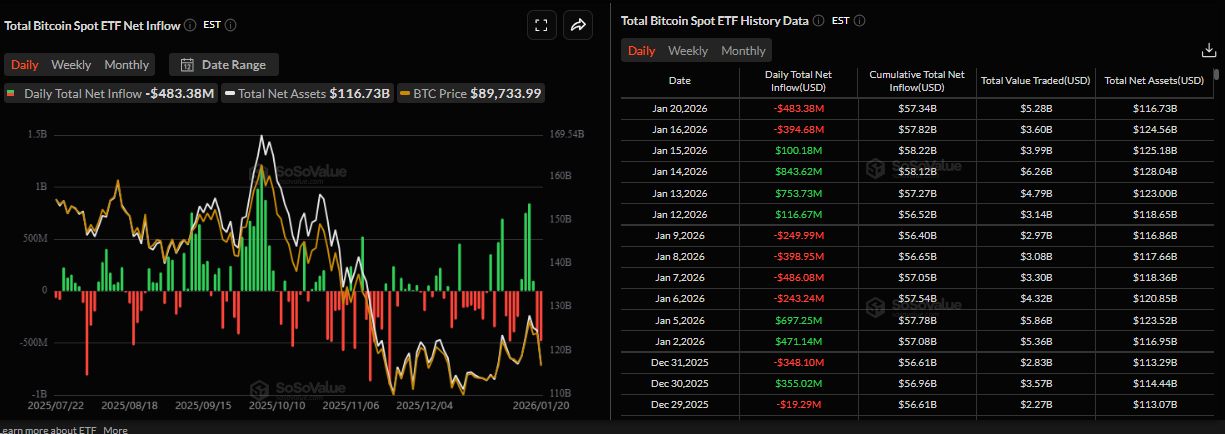
Institutional demand shows early signs of weakness. SoSoValue data shows that spot Bitcoin ETFs recorded an outflow of $483.38 million on Tuesday, after an outflow of $394.68 million on Friday. Tuesday’s withdrawals were the highest negative flow since January 7, indicating falling demand. If these outflows continue and intensify, BTC could see further correction.
Some signs to watch
Traders should be cautious as they closely watch US President Donald Trump’s speech at the World Economic Forum (WEF) in Davos on Wednesday.
“Trump’s speech will be closely watched by financial market participants as it will indicate what other measures the White House has at its disposal to intensify pressure on European Union (EU) members, who oppose Washington’s plans to acquire Greenland,” reports FXStreet.
More aggressive rhetoric from Trump on tariffs and the annexation of Greenland could further fuel risk-off sentiment, increasing the likelihood of a deeper correction in Bitcoin. Conversely, more measured comments on the Greenland issue could help ease geopolitical tensions, revive risk appetite, and support a recovery in BTC.
Bitcoin Price Forecast: Weakening in momentum indicators
Bitcoin price closed below the 61.8% Fibonacci retracement level (drawn from the April low of $74,508 to October’s all-time high of $126,199) at $94,253 on Sunday and declined 5.6% over the next two days, closing below key support levels: the 50-day Exponential Moving Average (EMA) at $92,123 and the previously broken upper consolidation boundary at $90,000. As of Wednesday, BTC is rebounding slightly after retesting the midpoint of the horizontal parallel channel at $87,787.
If BTC continues its correction and closes below the immediate support at $87,787, it could extend the fall toward the lower consolidation boundary at $85,569, which coincides with the 78.6% Fibonacci retracement level.
The Relative Strength Index (RSI) on the daily chart reads 42, below the neutral level of 50, indicating bearish momentum gaining traction. The Moving Average Convergence Divergence (MACD) indicator also showed a bearish crossover on Tuesday, further supporting the downward view.
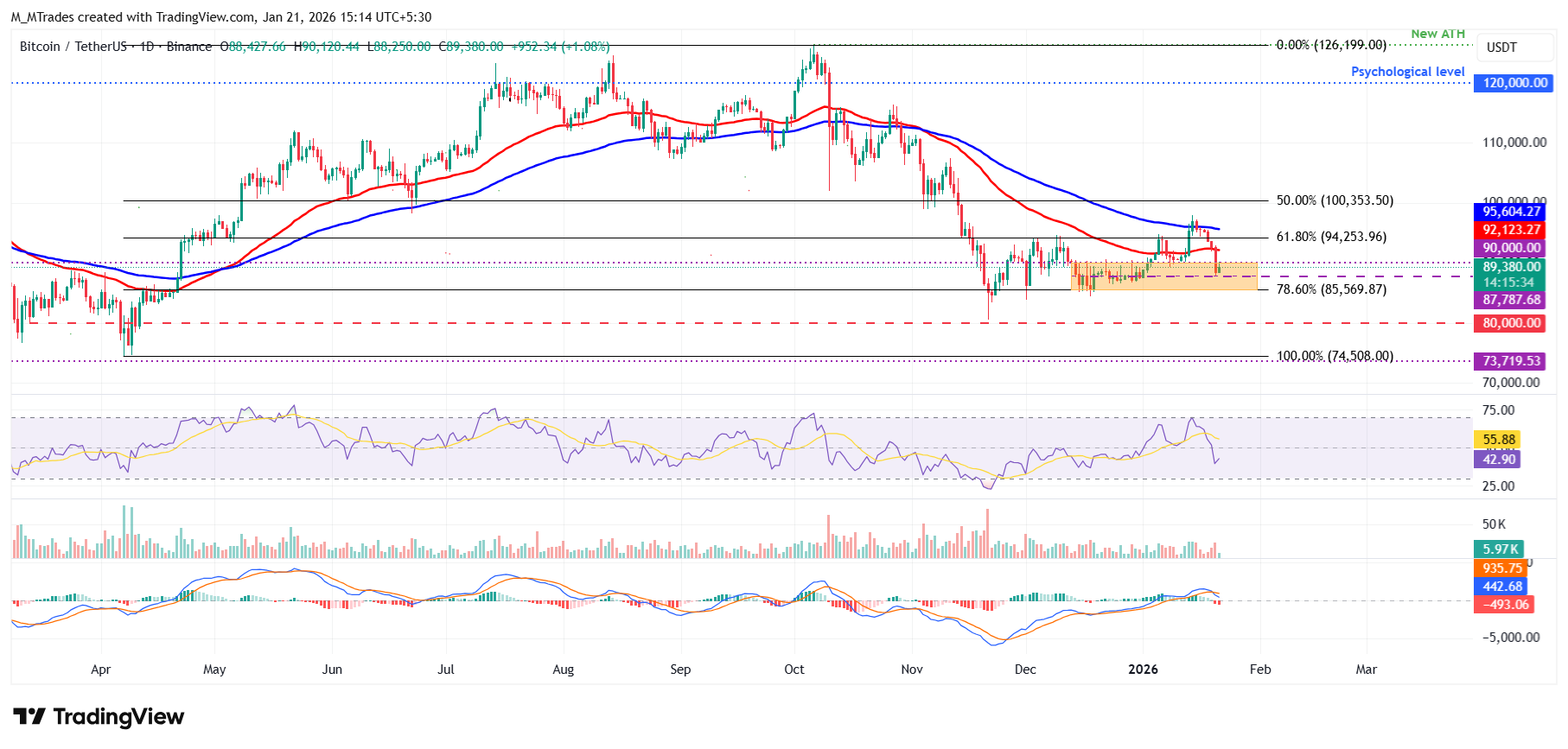
On the other side, if BTC recovers, it could extend the advance toward the 61.8% Fibonacci retracement level at $94,253.
Bitcoin, altcoins, stablecoins FAQs
Bitcoin is the largest cryptocurrency by market capitalization, a virtual currency designed to serve as money. This form of payment cannot be controlled by any one person, group, or entity, which eliminates the need for third-party participation during financial transactions.
Altcoins are any cryptocurrency apart from Bitcoin, but some also regard Ethereum as a non-altcoin because it is from these two cryptocurrencies that forking happens. If this is true, then Litecoin is the first altcoin, forked from the Bitcoin protocol and, therefore, an “improved” version of it.
Stablecoins are cryptocurrencies designed to have a stable price, with their value backed by a reserve of the asset it represents. To achieve this, the value of any one stablecoin is pegged to a commodity or financial instrument, such as the US Dollar (USD), with its supply regulated by an algorithm or demand. The main goal of stablecoins is to provide an on/off-ramp for investors willing to trade and invest in cryptocurrencies. Stablecoins also allow investors to store value since cryptocurrencies, in general, are subject to volatility.
Bitcoin dominance is the ratio of Bitcoin's market capitalization to the total market capitalization of all cryptocurrencies combined. It provides a clear picture of Bitcoin’s interest among investors. A high BTC dominance typically happens before and during a bull run, in which investors resort to investing in relatively stable and high market capitalization cryptocurrency like Bitcoin. A drop in BTC dominance usually means that investors are moving their capital and/or profits to altcoins in a quest for higher returns, which usually triggers an explosion of altcoin rallies.

Acuity Trading is a London-based fintech company founded in 2013 that specializes in AI-powered alternative data and sentiment analysis for trading and investments. They revolutionized the online trading experience by introducing visual news and sentiment tools, and today they continue to lead the fintech market with alpha-generating alternative data and highly engaging trading tools using the latest AI research and technology.
Read More








