





- EUR/USD climbs to daily highs, consolidating between 1.1650 and 1.1700.
- Federal Reserve cuts rates by 25 basis points, sparking broad Dollar sell-off.
- Powell says policy is now neutral, with future moves dependent on economic data.
EUR/USD surged over 0.59% on Wednesday as the Federal Reserve cut rates as expected, in a perceived “dovish hold” which prompted traders to ditch the Dollar and buy the shared currency. At the time of writing, the pair trades near daily highs of 1.1695, after bouncing off daily lows of 1.1620.
Dollar weakens as Powell signals pause, Euro advances on bullish momentum
Earlier, the Fed reduced rates by 25 basis points, with three dissenters including Governor Stephen Miran, who preferred a 50-basis-point cut. Two Regional Fed Presidents, Jeffrey Schmid and Austan Goolsbee, voted to maintain current rates.
The monetary policy statement remained largely unchanged, noting that employment risks lean toward the downside while inflationary pressures continue to be elevated. Fed Chair Jerome Powell acknowledged this tension between the central bank’s dual mandate during his press conference.
Across the pond, in the Eurozone the docket was empty, yet European Central Bank (ECB) member Makhlouf said that he is confident that inflation in the medium-term will be at 2%, according to Bloomberg.
Earlier, ECB President Christine Lagarde said that policy is in a good place and that the bank could upgrade their projections in December.
Euro Price This week
The table below shows the percentage change of Euro (EUR) against listed major currencies this week. Euro was the strongest against the Japanese Yen.
| USD | EUR | GBP | JPY | CAD | AUD | NZD | CHF | |
|---|---|---|---|---|---|---|---|---|
| USD | -0.39% | -0.39% | 0.47% | -0.27% | -0.51% | -0.69% | -0.49% | |
| EUR | 0.39% | 0.03% | 0.89% | 0.16% | -0.07% | -0.26% | -0.06% | |
| GBP | 0.39% | -0.03% | 0.88% | 0.13% | -0.10% | -0.29% | -0.09% | |
| JPY | -0.47% | -0.89% | -0.88% | -0.72% | -0.95% | -1.13% | -0.93% | |
| CAD | 0.27% | -0.16% | -0.13% | 0.72% | -0.22% | -0.42% | -0.22% | |
| AUD | 0.51% | 0.07% | 0.10% | 0.95% | 0.22% | -0.19% | 0.00% | |
| NZD | 0.69% | 0.26% | 0.29% | 1.13% | 0.42% | 0.19% | 0.20% | |
| CHF | 0.49% | 0.06% | 0.09% | 0.93% | 0.22% | -0.01% | -0.20% |
The heat map shows percentage changes of major currencies against each other. The base currency is picked from the left column, while the quote currency is picked from the top row. For example, if you pick the Euro from the left column and move along the horizontal line to the US Dollar, the percentage change displayed in the box will represent EUR (base)/USD (quote).
Daily digest market movers: Euro’s advance as Powell weakens the Dollar
- The US Dollar Index (DXY) edges lower, down 0.58% to 98.68, as the Greenback weakens broadly against major peers.
- Powell stated that the central bank is “well positioned” to “wait and see” how the economy develops, following a total easing of 75 basis points this year. He mentioned that the Fed funds rate is near the upper end of estimates for neutrality and that they will await economic data, which may be “distorted.”
- After cutting rates by 175 basis points, Powell said, “we have moved our policy back down to a level that is certainly not strongly restrictive at this point,” adding, “I think it is sort of in the range of neutral.”
- The Summary of Economic Projections (SEP) included the “dot plot,” indicating that most members expect the fed funds rate to be around 3.4% next year, suggesting a possible 25 basis point cut. For the longer term beyond 2028, Fed policymakers anticipate neutral rates near 3%.
Technical analysis: EUR/USD rangebound below 1.1650, eyes on FOMC meeting
EUR/USD hovers around 1.1650 for a sixth consecutive session, carving out a narrow consolidation band between 1.1650 and 1.1600. Momentum seems to remain bullish, as depicted by the Relative Strength Index (RSI), but buyers need to reclaim 1.1700 so they can challenge 1.1800 and the year-to-date high at 1.1918.
On the flip side, if EUR/USD tumbles below 1.1650, the 50-day Simple Moving Average (SMA) is near 1.1604. A decisive break beneath this zone would expose the 20-day SMA at 1.1599, followed by the 1.1500 psychological level.
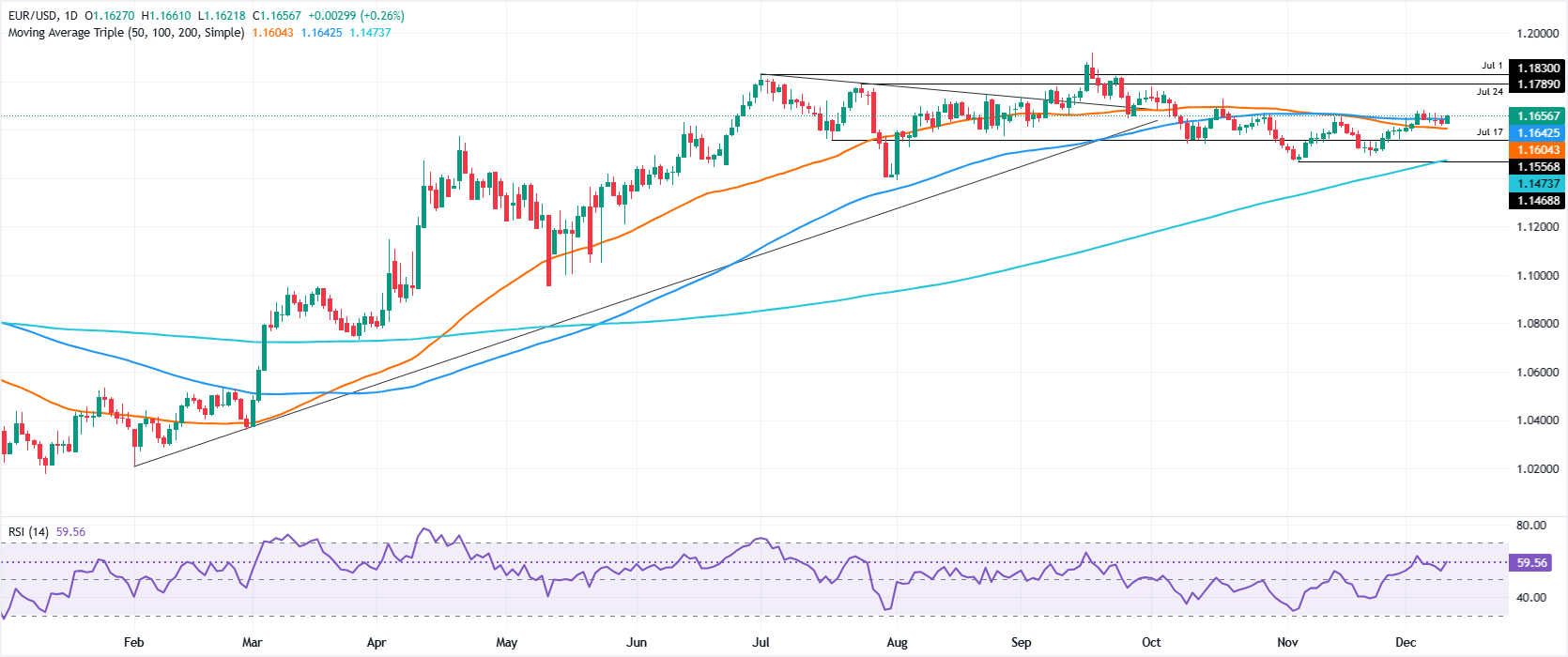
(This story was corrected on December 10 at 19:00 GMT to fix in the first bullet point the date of the Fed meeting and to correct the surname of the Fed Governor Christopher Waller)
Euro FAQs
The Euro is the currency for the 20 European Union countries that belong to the Eurozone. It is the second most heavily traded currency in the world behind the US Dollar. In 2022, it accounted for 31% of all foreign exchange transactions, with an average daily turnover of over $2.2 trillion a day. EUR/USD is the most heavily traded currency pair in the world, accounting for an estimated 30% off all transactions, followed by EUR/JPY (4%), EUR/GBP (3%) and EUR/AUD (2%).
The European Central Bank (ECB) in Frankfurt, Germany, is the reserve bank for the Eurozone. The ECB sets interest rates and manages monetary policy. The ECB’s primary mandate is to maintain price stability, which means either controlling inflation or stimulating growth. Its primary tool is the raising or lowering of interest rates. Relatively high interest rates – or the expectation of higher rates – will usually benefit the Euro and vice versa. The ECB Governing Council makes monetary policy decisions at meetings held eight times a year. Decisions are made by heads of the Eurozone national banks and six permanent members, including the President of the ECB, Christine Lagarde.
Eurozone inflation data, measured by the Harmonized Index of Consumer Prices (HICP), is an important econometric for the Euro. If inflation rises more than expected, especially if above the ECB’s 2% target, it obliges the ECB to raise interest rates to bring it back under control. Relatively high interest rates compared to its counterparts will usually benefit the Euro, as it makes the region more attractive as a place for global investors to park their money.
Data releases gauge the health of the economy and can impact on the Euro. Indicators such as GDP, Manufacturing and Services PMIs, employment, and consumer sentiment surveys can all influence the direction of the single currency. A strong economy is good for the Euro. Not only does it attract more foreign investment but it may encourage the ECB to put up interest rates, which will directly strengthen the Euro. Otherwise, if economic data is weak, the Euro is likely to fall. Economic data for the four largest economies in the euro area (Germany, France, Italy and Spain) are especially significant, as they account for 75% of the Eurozone’s economy.
Another significant data release for the Euro is the Trade Balance. This indicator measures the difference between what a country earns from its exports and what it spends on imports over a given period. If a country produces highly sought after exports then its currency will gain in value purely from the extra demand created from foreign buyers seeking to purchase these goods. Therefore, a positive net Trade Balance strengthens a currency and vice versa for a negative balance.







