





- EUR/USD dips 0.16% to 1.1722 as markets digest benign US inflation and resilient jobless claims data.
- ECB keeps rates unchanged, with Lagarde signaling a meeting-by-meeting stance and hinting the easing cycle may be over.
- Traders shift focus to US Core PCE and Michigan sentiment for fresh clues on Fed’s 2026 policy path.
EUR/USD retreated on Thursday after a busy economic docket on both sides of the Atlantic. A benign inflation print in the US and the European Central Bank (ECB) keeping interest rates unchanged at the last meeting of the year, barely moved the needle for the single currency. At the time of writing the pair trades at 1.1722, down 0.16%.
Euro edges lower after a packed data day, with soft US inflation and a steady-handed ECB failing to spark momentum
Delayed data from the US revealed that November’s inflation figures, both headline and core, dipped to their lowest level since early 2021, revealed the US Bureau of Labor Statistics (BLS). Even though this opens the door for further ease, a double whammy looms as jobless claims for the last week, improved, exceeding economists’ estimates.
Across the pond in Brussels, the ECB held ratees unchanged as expected, and a Bloomberg sources article hinted that the cycle of rate cuts is “most likely over,” read the headline. ECB’s President Christine Lagarde said that the decision was unanimous, and that they would stick to its “meeting-by-meeting approach.”
After the data and the ECB’s decision, the EUR/USD remained at around familiar levels, unchanged.
Traders focus shifts to the release of the Fed’s favorite inflation gauge, the Core Personal Consumption Expenditures (PCE) Price Index along with the University of Michigan Consumer Sentiment Index for its final release. In Europe, traders would eye speeches of ECB’s Mario Cipollone, Martin Kocher, and Current Account data for October.
Daily digest market movers: Thin liquidity keeps the Euro unmoved
- US inflation cooled further in November, with the Consumer Price Index (CPI) rising 2.7% YoY, easing from 3.0% print in September and undershooting market expectations of a 3.1% increase, revealed the US Bureau of Labor Statistics (BLS). Core inflation, which strips out food and energy, slowed to 2.6% YoY from 3.0%, reinforcing signs that the disinflation process resumed.
- At the same time, the number of Americans filling for unemployment benefits, dipped, revealed the Department of Labor. Initial Jobless Claims for the week ending December 13 rose by to 224K, down from the downwardly revised 237K prior reading and below estimates of 225K.
- Given the backdrop, expectations that the fed will reduce rates in January remained unchanged at 2.4%. However, money markets had priced in 60 basis points of easing towards the end of 2026, with the first reduction eyed in June.
- Expectations that the Fed will cut rates at the next meeting on January 28 remain unchanged at 24%, according to Capital Edge Rate probability data. Nonetheless, for the full year ahead, investors had priced 60 basis points if easing, with the first cut expected in June.
- Chicago’s Fed President Austan Goolsbee said that the inflation print is “encouraging,” and that a “clearer understanding of declining inflation,” could lead to further reductions of interest rates. Despite these remarks, he remained mildly hawkish, saying that he is “unease regarding premature rate reductions.”
- The European Central Bank held interest rates steady for a fourth straight meeting, keeping the Deposit Facility at 2.00%, the Main Refinancing Operations rate at 2.15%, and the Marginal Lending Facility at 2.40%, in line with market expectations.
Technical outlook: EUR/USD treads water despite remaining bullish
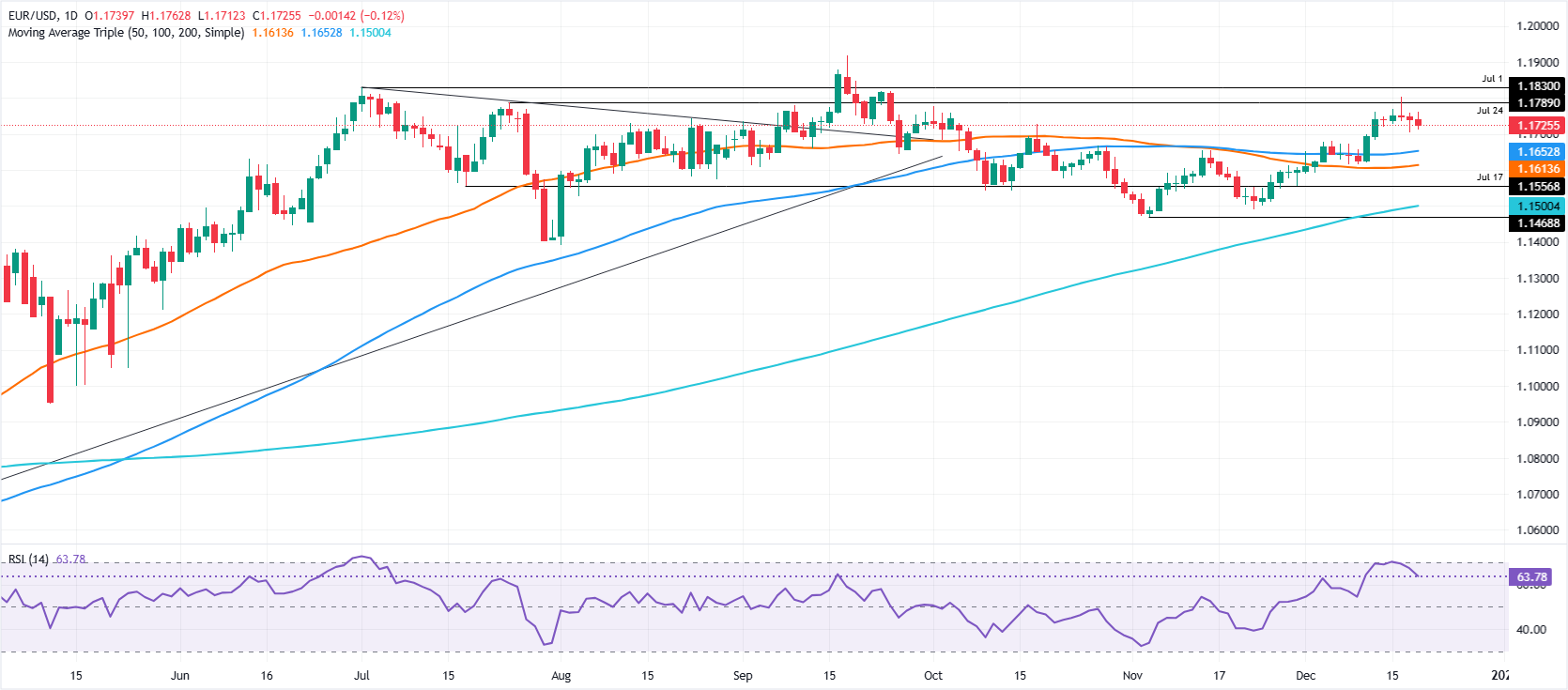
For fifth straight day, the EUR/USD consolidates in the mid-range of the 1.1700-1.1800 area, as price action turns subdued and liquidity dries as traders brace for Christmas holidays.
The Relative Strength Index (RSI) shows that momentum favors bulls, but it has turned flattish amid low volume trading.
For a bullish continuation, traders must clear the 1.1750 area and surpass the 1.1800 mark. A breach of the latter will expose 1.1850 and the year-to-date (YTD) high at 1.1918. On further weakness, if EUR/USD slides below 1.1700, it opens the door to test the 100-day Simple Moving Average (SMA) near 1.1652, ahead of the 1.1600 handle.
Euro FAQs
The Euro is the currency for the 20 European Union countries that belong to the Eurozone. It is the second most heavily traded currency in the world behind the US Dollar. In 2022, it accounted for 31% of all foreign exchange transactions, with an average daily turnover of over $2.2 trillion a day. EUR/USD is the most heavily traded currency pair in the world, accounting for an estimated 30% off all transactions, followed by EUR/JPY (4%), EUR/GBP (3%) and EUR/AUD (2%).
The European Central Bank (ECB) in Frankfurt, Germany, is the reserve bank for the Eurozone. The ECB sets interest rates and manages monetary policy. The ECB’s primary mandate is to maintain price stability, which means either controlling inflation or stimulating growth. Its primary tool is the raising or lowering of interest rates. Relatively high interest rates – or the expectation of higher rates – will usually benefit the Euro and vice versa. The ECB Governing Council makes monetary policy decisions at meetings held eight times a year. Decisions are made by heads of the Eurozone national banks and six permanent members, including the President of the ECB, Christine Lagarde.
Eurozone inflation data, measured by the Harmonized Index of Consumer Prices (HICP), is an important econometric for the Euro. If inflation rises more than expected, especially if above the ECB’s 2% target, it obliges the ECB to raise interest rates to bring it back under control. Relatively high interest rates compared to its counterparts will usually benefit the Euro, as it makes the region more attractive as a place for global investors to park their money.
Data releases gauge the health of the economy and can impact on the Euro. Indicators such as GDP, Manufacturing and Services PMIs, employment, and consumer sentiment surveys can all influence the direction of the single currency. A strong economy is good for the Euro. Not only does it attract more foreign investment but it may encourage the ECB to put up interest rates, which will directly strengthen the Euro. Otherwise, if economic data is weak, the Euro is likely to fall. Economic data for the four largest economies in the euro area (Germany, France, Italy and Spain) are especially significant, as they account for 75% of the Eurozone’s economy.
Another significant data release for the Euro is the Trade Balance. This indicator measures the difference between what a country earns from its exports and what it spends on imports over a given period. If a country produces highly sought after exports then its currency will gain in value purely from the extra demand created from foreign buyers seeking to purchase these goods. Therefore, a positive net Trade Balance strengthens a currency and vice versa for a negative balance.







