

EUR/USD remains pinned to one-month lows despite a softer US Dollar
By Guillermo Alcala
Date Published: 16 Jan 2026 | Date Modified: 16 Jan 2026


POPULAR ARTICLES

EUR/USD is trading right above 1.1600 at the time of writing on Friday, practically flat on the daily chart and on track to complete a three-week lowing streak.
- EUR/USD hovers right above 1.1600 after hitting six-week lows at 1.1593.
- Strong US employment and manufacturing figures boosted the US Dollar.
- Fed officials Bostic and Schmid warned against cutting interest rates further on Thursday.
EUR/USD is trading right above 1.1600 at the time of writing on Friday, practically flat on the daily chart and on track to complete a three-week lowing streak. The pair depreciated 0.34% the previous day, as strong US employment and manufacturing reports cemented the view that the Federal Reserve (Fed) will keep interest rates unchanged in the coming months.
Economic data released by the US Department of Labor on Thursday revealed that Initial Jobless Claims decreased against expectations to their lowest levels since November, easing some of the market's concerns about the labor market deterioration.
At the same time, releases of the New York Empire State Manufacturing Index and the Philadelphia Fed Manufacturing Survey showed readings well beyond expectations, highlighting a strong start to the year for the sector.
Eurozone figures released this Friday confirmed that German consumer Inflation eased to the European Central Bank's target of 2% YoY in December. In the US, the focus will be on December's Industrial Production data and the speeches from the Fed's Vice Chairs Michelle Bowman and Philip Jefferson.
Euro Price Today
The table below shows the percentage change of Euro (EUR) against listed major currencies today. Euro was the strongest against the US Dollar.
| USD | EUR | GBP | JPY | CAD | AUD | NZD | CHF | |
|---|---|---|---|---|---|---|---|---|
| USD | -0.05% | -0.18% | -0.28% | -0.03% | -0.10% | -0.40% | -0.19% | |
| EUR | 0.05% | -0.13% | -0.24% | 0.02% | -0.04% | -0.34% | -0.15% | |
| GBP | 0.18% | 0.13% | -0.11% | 0.18% | 0.09% | -0.20% | -0.01% | |
| JPY | 0.28% | 0.24% | 0.11% | 0.28% | 0.20% | -0.10% | 0.10% | |
| CAD | 0.03% | -0.02% | -0.18% | -0.28% | -0.08% | -0.38% | -0.17% | |
| AUD | 0.10% | 0.04% | -0.09% | -0.20% | 0.08% | -0.30% | -0.09% | |
| NZD | 0.40% | 0.34% | 0.20% | 0.10% | 0.38% | 0.30% | 0.21% | |
| CHF | 0.19% | 0.15% | 0.00% | -0.10% | 0.17% | 0.09% | -0.21% |
The heat map shows percentage changes of major currencies against each other. The base currency is picked from the left column, while the quote currency is picked from the top row. For example, if you pick the Euro from the left column and move along the horizontal line to the US Dollar, the percentage change displayed in the box will represent EUR (base)/USD (quote).
Daily Digest Market Movers: US Dollar remains supported by strong data
- The US Dollar Index (DXY) is trimming gains on Friday but maintains its broader bullish trend intact. Recent US economic reflects a stronger economy, with stubbornly high inflation, prompting investors to dial down their bets for Fed monetary easing in the near-term.
- US Initial Jobless Claims declined to 198K, in the week ending January 10, from 207K in the previous week, against the market expectations of an increase to 215K.
- The New York Empire State Manufacturing Index bounced up to a 7.7 reading in January following a 3.7 decline in December. This month's reading beat expectations of a more moderate improvement to 1, which shows a significant strengthening in the sector's business conditions.
- Likewise, the Philadelphia Fed Manufacturing Survey jumped to 12.6 in January from the -8.8 of the previous month, also beating expectations of a -2 reading. New orders and shipments moved higher, the employment index decreased, although showing an overall improvement from previous months, while prices remained above long-run averages.
- In this context, hawkish comments by Fed policymakers provided additional support to the US Dollar. Atlanta Fed President Raphael Bostic and Kansas Fed President Jeffrey Schmid reiterated the need to keep interest rates at restrictive levels as inflationary pressures remain high.
- In the Eurozone, on Friday, Germany's final Harmonized Index of Consumer Prices confirmed that inflation eased to 0.2% in December and to 2.0% in the previous 12 months, after -0.5 and 2.6% respective readings in November. The Euro ticked up from lows following the data release.
Technical Analysis: EUR/USD hovers at six-week lows with support at 1.1590
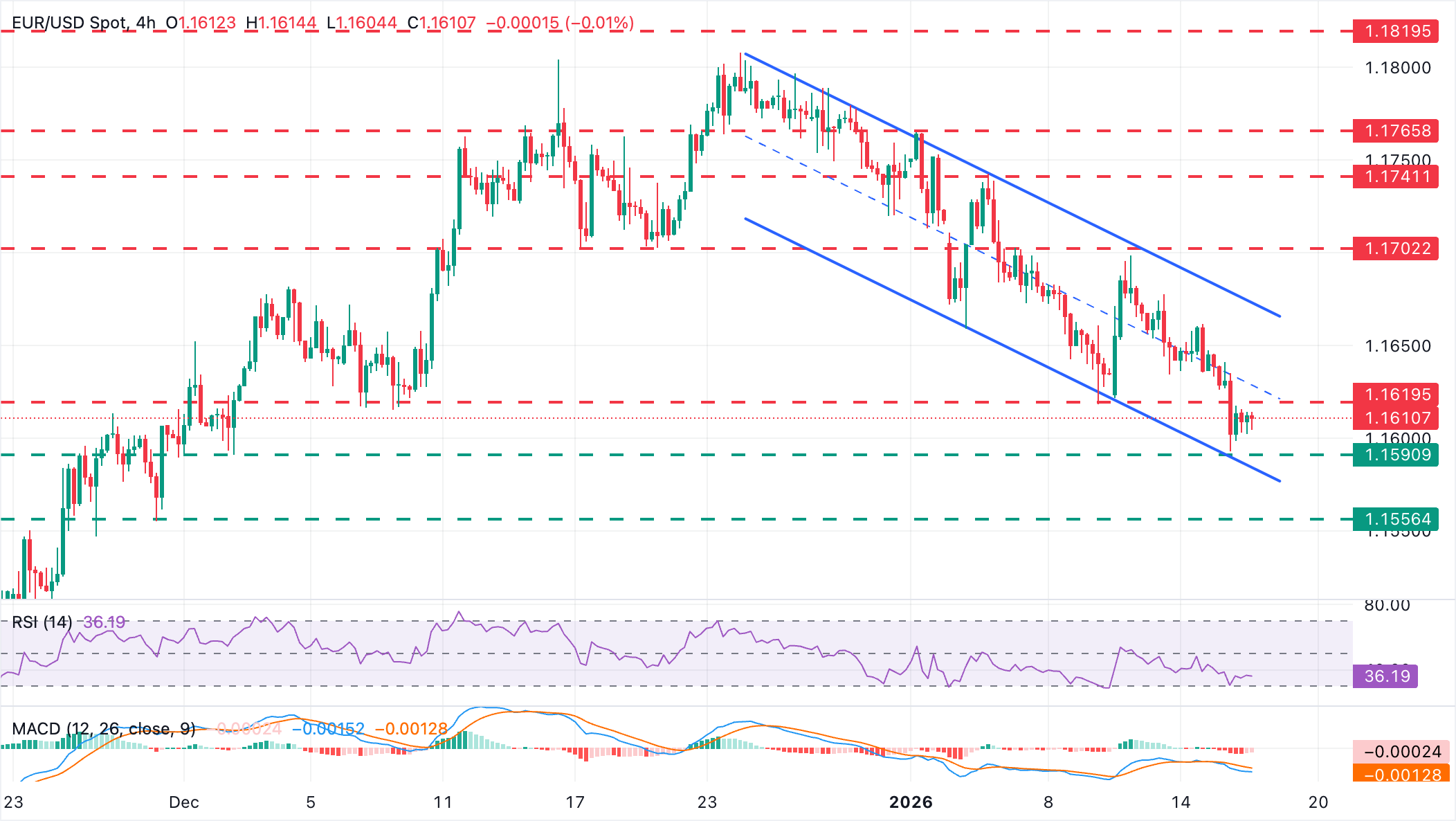
EUR/USD trades at 1.1610, hovering near the bottom of the descending channel from late December highs. The Moving Average Convergence Divergence (MACD) slips below the zero line on the 4-hour chart, fading momentum, and the Relative Strength Index (RSI) sits at 36 on the same time frame, underscoring the bearish trend.
Immediate support is at Thursday's low, near 1.1590, and the mentioned channel's bottom, now at the 1.1585 area. Further down, the target is the late-November lows near 1.1560. On the upside, previous support at 1.1621 (January 12 lows), is holding bulls for now ahead of the channel top in the 1.1670 area.
(The technical analysis of this story was written with the help of an AI tool.)
Euro FAQs
The Euro is the currency for the 20 European Union countries that belong to the Eurozone. It is the second most heavily traded currency in the world behind the US Dollar. In 2022, it accounted for 31% of all foreign exchange transactions, with an average daily turnover of over $2.2 trillion a day. EUR/USD is the most heavily traded currency pair in the world, accounting for an estimated 30% off all transactions, followed by EUR/JPY (4%), EUR/GBP (3%) and EUR/AUD (2%).
The European Central Bank (ECB) in Frankfurt, Germany, is the reserve bank for the Eurozone. The ECB sets interest rates and manages monetary policy. The ECB’s primary mandate is to maintain price stability, which means either controlling inflation or stimulating growth. Its primary tool is the raising or lowering of interest rates. Relatively high interest rates – or the expectation of higher rates – will usually benefit the Euro and vice versa. The ECB Governing Council makes monetary policy decisions at meetings held eight times a year. Decisions are made by heads of the Eurozone national banks and six permanent members, including the President of the ECB, Christine Lagarde.
Eurozone inflation data, measured by the Harmonized Index of Consumer Prices (HICP), is an important econometric for the Euro. If inflation rises more than expected, especially if above the ECB’s 2% target, it obliges the ECB to raise interest rates to bring it back under control. Relatively high interest rates compared to its counterparts will usually benefit the Euro, as it makes the region more attractive as a place for global investors to park their money.
Data releases gauge the health of the economy and can impact on the Euro. Indicators such as GDP, Manufacturing and Services PMIs, employment, and consumer sentiment surveys can all influence the direction of the single currency. A strong economy is good for the Euro. Not only does it attract more foreign investment but it may encourage the ECB to put up interest rates, which will directly strengthen the Euro. Otherwise, if economic data is weak, the Euro is likely to fall. Economic data for the four largest economies in the euro area (Germany, France, Italy and Spain) are especially significant, as they account for 75% of the Eurozone’s economy.
Another significant data release for the Euro is the Trade Balance. This indicator measures the difference between what a country earns from its exports and what it spends on imports over a given period. If a country produces highly sought after exports then its currency will gain in value purely from the extra demand created from foreign buyers seeking to purchase these goods. Therefore, a positive net Trade Balance strengthens a currency and vice versa for a negative balance.

Acuity Trading is a London-based fintech company founded in 2013 that specializes in AI-powered alternative data and sentiment analysis for trading and investments. They revolutionized the online trading experience by introducing visual news and sentiment tools, and today they continue to lead the fintech market with alpha-generating alternative data and highly engaging trading tools using the latest AI research and technology.
Read More








