

Gold rises but remains on track for weekly loss in five weeks
By Akhtar Faruqui
Date Published: 6 Mar 2026 | Date Modified: 6 Mar 2026


POPULAR ARTICLES

Gold price (XAU/USD) recovers its recent losses from the previous session on Friday. The yellow metal advances as the broader precious metals market rebounds on safe-haven demand.
- Gold rises but heads for a weekly loss as traders trim bets on Fed rate cuts.
- Dollar-denominated Gold faces pressure as the US Dollar gains on potential Fed rate hikes.
- Iran war entered its seventh day as Tehran launched missiles and drones across the Gulf, while Israel struck Tehran.
Gold price (XAU/USD) recovers its recent losses from the previous session on Friday. The yellow metal advances as the broader precious metals market rebounds on safe-haven demand. However, the yellow metal is on track for its first weekly decline in five weeks as escalating Middle East tensions push oil prices higher, fueling inflation concerns and reducing bets on Federal Reserve rate cuts.
The dollar-denominated Gold faces challenges as the US Dollar (USD) strengthens, as Federal Reserve (Fed) officials continue to consider the possibility of further rate hikes if inflation remains above target. It is worth noting that a weaker US Dollar makes the precious metal cheaper for buyers with foreign currencies, boosting demand.
The US-Israeli conflict with Iran entered its seventh day, with Iran launching missiles and drones across the Gulf on Thursday, striking an oil refinery in Bahrain, while Israel continued airstrikes on Tehran, and the US suspended operations at its embassy in Kuwait.
US President Donald Trump said that Iranian officials reached out to him in an attempt to reach an agreement to end the war, but he insisted it was too late and that the US is pushing to destroy Iran.
Iranian Foreign Minister Abbas Araghchi said Tehran has not sought a ceasefire and has no intention of negotiating, while Iran’s Islamic Revolutionary Guard Corps warned that retaliatory strikes would intensify in the coming days.
Traders await US labor data, including US Nonfarm Payrolls (NFP), where consensus expectations are around 59K for February, following January’s above-trend reading of 130K. Additionally, Retail Sales are expected to fall 0.3% month-over-month in January, after a flat reading in the previous month.
The US is also set to introduce a temporary 15% global tariff this week, replacing the 10% rate enacted after the Supreme Court of the United States struck down most of the earlier levies imposed by Donald Trump. Scott Bessent said the tariff could revert to previous levels within five months as new trade investigations move forward.
Gold tests nine-day EMA barrier near $5,150
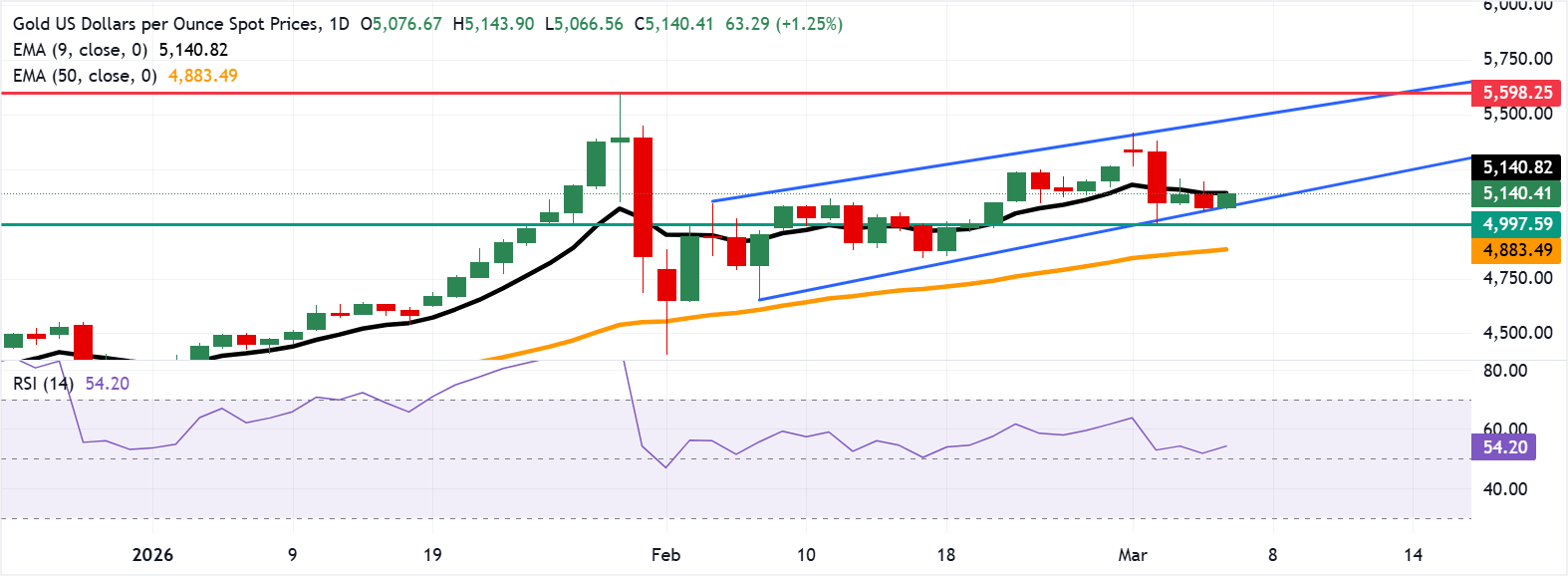
Gold price (XAU/USD) is trading around $5,130 at the time of writing. The technical analysis of the daily chart suggests an ongoing bullish bias as the metal price remains within the ascending channel pattern.
The near-term bias is mildly bullish as price holds above the rising 50-day Exponential Moving Average (EMA) and continues to respect the cluster of recent highs rather than extending the prior correction. The nine-day EMA flattens just above the spot, indicating moderating but still bearish short-term momentum. Additionally, the 14-day Relative Strength Index (RSI) at 53 stays above its midline, showing underlying buying pressure remains intact.
The XAU/USD pair is testing the immediate barrier at the nine-day EMA of $5,140. A break above the short-term average and support the pair to approach the upper boundary of the ascending channel at $5,480, followed by the all-time high of $5,598, reached on January 29. On the downside, the initial support lies at the lower boundary of the channel at $5,080. A break below the channel would expose the 50-day EMA at $4,883.
(The technical analysis of this story was written with the help of an AI tool.)
Interest rates FAQs
Interest rates are charged by financial institutions on loans to borrowers and are paid as interest to savers and depositors. They are influenced by base lending rates, which are set by central banks in response to changes in the economy. Central banks normally have a mandate to ensure price stability, which in most cases means targeting a core inflation rate of around 2%. If inflation falls below target the central bank may cut base lending rates, with a view to stimulating lending and boosting the economy. If inflation rises substantially above 2% it normally results in the central bank raising base lending rates in an attempt to lower inflation.
Higher interest rates generally help strengthen a country’s currency as they make it a more attractive place for global investors to park their money.
Higher interest rates overall weigh on the price of Gold because they increase the opportunity cost of holding Gold instead of investing in an interest-bearing asset or placing cash in the bank. If interest rates are high that usually pushes up the price of the US Dollar (USD), and since Gold is priced in Dollars, this has the effect of lowering the price of Gold.
The Fed funds rate is the overnight rate at which US banks lend to each other. It is the oft-quoted headline rate set by the Federal Reserve at its FOMC meetings. It is set as a range, for example 4.75%-5.00%, though the upper limit (in that case 5.00%) is the quoted figure. Market expectations for future Fed funds rate are tracked by the CME FedWatch tool, which shapes how many financial markets behave in anticipation of future Federal Reserve monetary policy decisions.

Acuity Trading is a London-based fintech company founded in 2013 that specializes in AI-powered alternative data and sentiment analysis for trading and investments. They revolutionized the online trading experience by introducing visual news and sentiment tools, and today they continue to lead the fintech market with alpha-generating alternative data and highly engaging trading tools using the latest AI research and technology.
Read More








