

AUD/USD Price Forecast: Likely extend decline below 0.6830
- AUD/USD trades mixed against its major peers, following the release of the RBA policy meeting minutes.
- The RBA kept the door open for further interest rate hikes.
- Investors await the US JOLTS Job Openings and the NFP data.
The Australian Dollar (AUD) reflects a mixed performance against its major currency peers during the European trading session on Tuesday, following the release of the Reserve Bank of Australia (RBA) monetary policy meeting minutes.
Australian Dollar Price Today
The table below shows the percentage change of Australian Dollar (AUD) against listed major currencies today. Australian Dollar was the strongest against the Swiss Franc.
| USD | EUR | GBP | JPY | CAD | AUD | NZD | CHF | |
|---|---|---|---|---|---|---|---|---|
| USD | 0.20% | 0.11% | 0.19% | 0.15% | 0.17% | -0.07% | 0.20% | |
| EUR | -0.20% | -0.07% | -0.02% | -0.08% | -0.04% | -0.29% | -0.01% | |
| GBP | -0.11% | 0.07% | 0.06% | 0.00% | 0.06% | -0.19% | 0.07% | |
| JPY | -0.19% | 0.02% | -0.06% | -0.05% | -0.04% | -0.25% | -0.01% | |
| CAD | -0.15% | 0.08% | -0.00% | 0.05% | 0.00% | -0.21% | 0.04% | |
| AUD | -0.17% | 0.04% | -0.06% | 0.04% | -0.00% | -0.21% | 0.05% | |
| NZD | 0.07% | 0.29% | 0.19% | 0.25% | 0.21% | 0.21% | 0.24% | |
| CHF | -0.20% | 0.01% | -0.07% | 0.00% | -0.04% | -0.05% | -0.24% |
The heat map shows percentage changes of major currencies against each other. The base currency is picked from the left column, while the quote currency is picked from the top row. For example, if you pick the Australian Dollar from the left column and move along the horizontal line to the US Dollar, the percentage change displayed in the box will represent AUD (base)/USD (quote).

The RBA policy minutes of the June meeting showed that policymakers are worried about higher inflationary pressures and downside growth risks in the wake of the Middle East conflicts and stated that the central bank won’t hesitate to raise interest rates to ensure price stability.
However, the signing of the memorandum of understanding (MoU) between the United States (US) and Iran has eased Middle East risks.
Meanwhile, strength in the US Dollar amid caution ahead of the US Nonfarm Payrolls (NFP) data for June is also hurting the pair. At press time, the US Dollar Index (DXY), which gauges the Greenback’s value against six major currencies, trades 0.2% higher to near 101.36.
In Tuesday’s session, investors will focus on the US JOLTS Job Openings data for May, which will be published at 14:00 GMT.
AUD/USD technical analysis
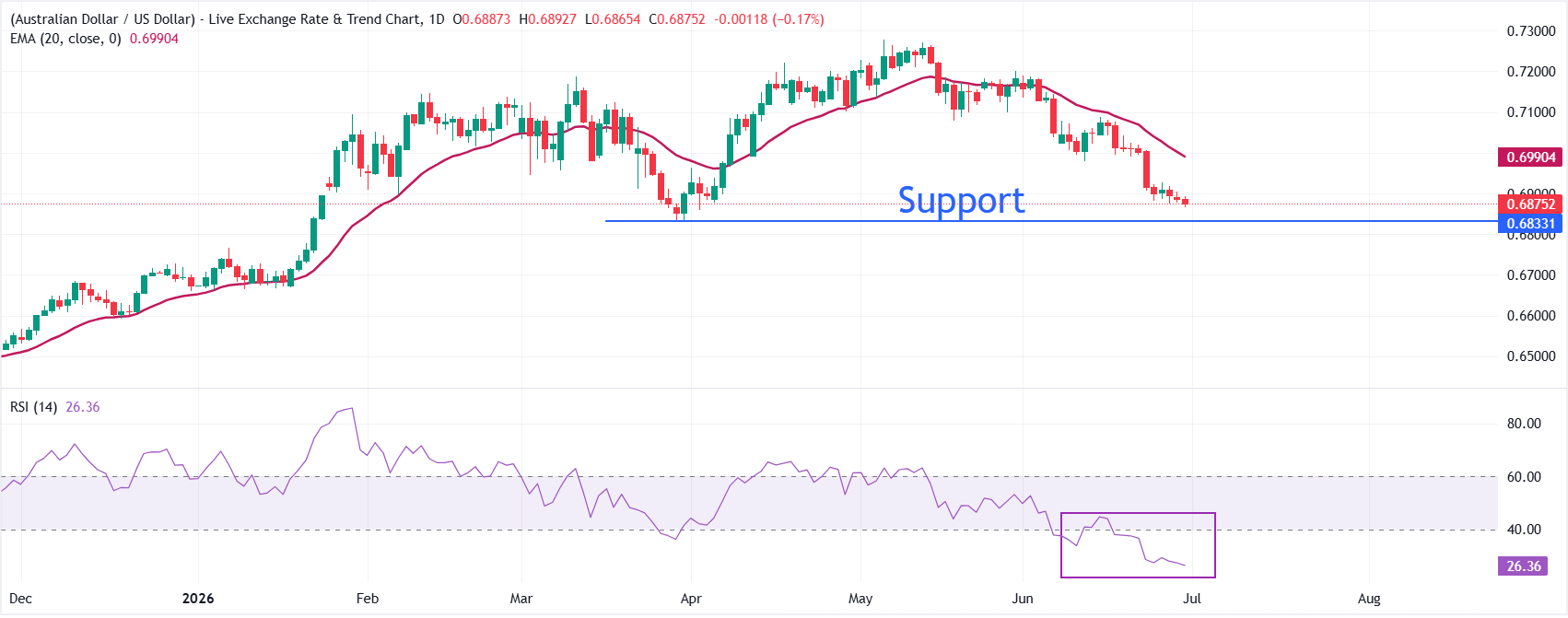
AUD/USD trades lower at around 0.6875, maintaining a bearish near-term bias as the price holds below the 20-period exponential moving average (EMA) at 0.6990. The pair has been sliding steadily, and the EMA now acts as immediate overhead supply, hinting that rebounds are likely to be capped while this barrier remains intact.
The Relative Strength Index (14) sits deep in oversold territory near 26, which suggests selling pressure is stretched but not yet signaling a confirmed reversal.
On the topside, initial resistance is located at the 20-day EMA around 0.6990, and a sustained break above this level would be needed to ease the current downside pressure and open the way for a corrective recovery towards 0.7100. Looking down, the pair could extend its decline towards 0.6800 and the January 7 high of 0.6766 if it drops below the March 30 low of 0.6833.
(The technical analysis of this story was written with the help of an AI tool.)
Economic Indicator
RBA Meeting Minutes
The minutes of the Reserve Bank of Australia meetings are published two weeks after the interest rate decision. The minutes give a full account of the policy discussion, including differences of view. They also record the votes of the individual members of the Committee. Generally speaking, if the RBA is hawkish about the inflationary outlook for the economy, then the markets see a higher possibility of a rate increase, and that is positive for the AUD.
Read more.Last release: Tue Jun 30, 2026 01:30
Frequency: Weekly
Actual: -
Consensus: -
Previous: -
Source: Reserve Bank of Australia
The Reserve Bank of Australia (RBA) publishes the minutes of its monetary policy meeting two weeks after the interest rate decision is announced. It provides a detailed record of the discussions held between the RBA’s board members on monetary policy and economic conditions that influenced their decision on adjusting interest rates and/or bond buys, significantly impacting the AUD. The minutes also reveal considerations on international economic developments and the exchange rate value.













