

Dow Jones Industrial Average tumbles as Iran situation broils
- The Dow dropped over 800 points on Thursday as an Iranian missile strike on an Oil tanker reignited fears of prolonged supply disruption through the Strait of Hormuz.
- West Texas Intermediate crude surged 6% to above $79 per barrel, its highest level since June 2025, while Brent crude topped $84.
- Broadcom rallied after posting a strong earnings beat, with AI chip revenue more than doubling year-over-year and a bullish $22 billion revenue guide for next quarter.
- Weekly jobless claims came in flat at 213K, slightly below expectations, keeping the labor market picture steady ahead of Friday's February employment report.

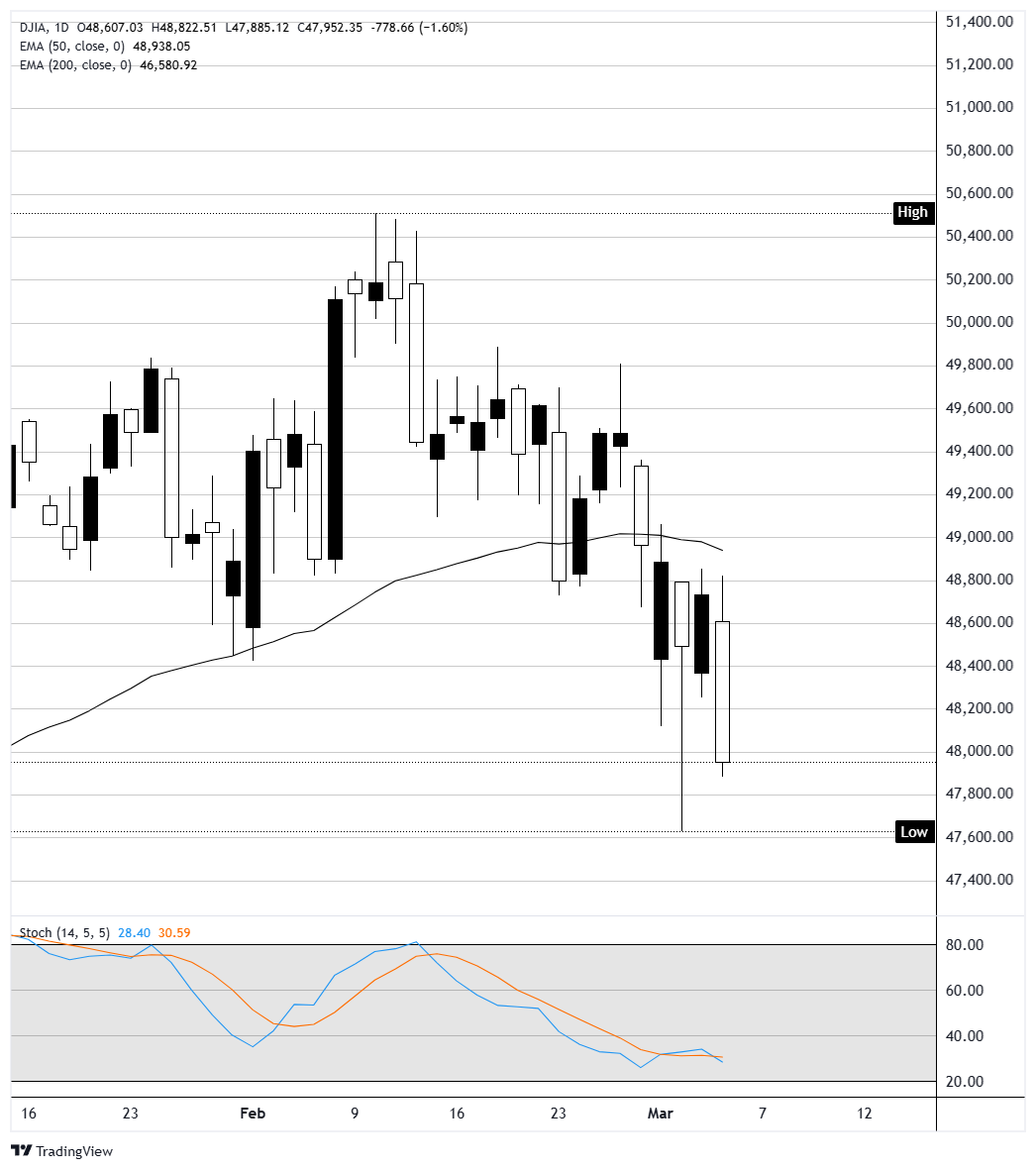
The Dow Jones Industrial Average was down 840 points, or 1.73%, to 47,885 at the time of writing, giving back all of Wednesday's gains and then some. The S&P 500 fell 0.82% to around 6,810, while the Nasdaq Composite dipped 0.50% to the 22,690 region. The Russell 2000 dropped 1.65% to land near 2,590, with small caps bearing the brunt of the risk-off shift. Thursday's selling was broad, but the Dow's underperformance was notable, dragged lower by defensive and consumer staple names including Merck (MRK), Johnson & Johnson (JNJ), and Walmart (WMT), all falling more than 2%.
Iran conflict sends Oil to nine-month highs
The catalyst for Thursday's selloff was a fresh escalation in the Middle East. Iran claimed it struck an Oil tanker with a missile, according to state media reports, while the British Navy confirmed a large explosion at a tanker at anchor in Iraqi territorial waters. West Texas Intermediate (WTI) crude futures surged 6% to trade above $79 per barrel — its highest since June 2025 — while Brent crude jumped 3% to over $84. Tanker traffic through the Strait of Hormuz has effectively ground to a halt since the US-Israeli war against Iran began last weekend, with Iran's Revolutionary Guard having ordered the strait's closure and threatened to attack any vessel that passes through. Around 20% of global Oil consumption is exported through the waterway. President Trump said earlier in the week that the US would provide political risk insurance for tankers and, if necessary, US Navy escorts, but the missile strike on Thursday undercut that reassurance.
Rate cut bets narrow as Oil-driven inflation fears build
The sharp move higher in crude is starting to filter into rate expectations. Traders are now positioning for just a single Federal Reserve (Fed) rate cut this year, down from expectations of multiple cuts as recently as last week. According to the CME FedWatch tool, there is roughly a 96% probability that the Fed holds rates steady at 3.50-3.75% at its March 18 meeting. The repricing reflects growing concern that a prolonged conflict could push energy costs sustainably higher, reigniting inflationary pressures just as the Personal Consumption Expenditures Price Index (PCE) data from late February already rattled markets with a hotter-than-expected print. Treasury yields moved higher on Thursday, adding to the pressure on equity valuations. The combination of sticky inflation and geopolitical risk premium has created a difficult backdrop for the Fed, which had been widely expected to resume cutting later this year.
Broadcom bucks the selloff with blockbuster AI earnings
Broadcom (AVGO) was a rare bright spot, rallying around 6% after reporting first-quarter results that beat on both the top and bottom line. The chipmaker posted earnings per share of $2.05 versus $2.03 expected and revenue of $19.31 billion versus $19.18 billion estimated, a 29% increase year-over-year. The standout was AI revenue of $8.4 billion, up 106% year-over-year, driven by surging demand for custom AI accelerators and networking chips. CEO Hock Tan told analysts the company has a line of sight to AI chip revenue exceeding $100 billion in 2027. Broadcom guided second-quarter revenue to approximately $22 billion, implying 47% year-over-year growth, and announced a new $10 billion share repurchase program. Salesforce (CRM) also outperformed, gaining nearly 5%, while Microsoft (MSFT) and IBM (IBM) eked out modest gains in an otherwise ugly session for the Dow.
Gold and safe havens hold firm above $5K
Gold continued to attract safe-haven flows on Thursday, trading around $5,175 per ounce — up roughly 1% on the day — as the widening Middle East conflict kept demand elevated. The precious metal has climbed about 20% year-to-date, supported by central bank buying, geopolitical uncertainty, and a softer US Dollar. Silver was also firmer, rising over 1% to around $84.50. Separately, Berkshire Hathaway (BRK.B) disclosed that it has resumed share buybacks for the first time since 2024, with new CEO Greg Abel purchasing $15 million worth of stock personally. Abel told CNBC he consulted with Warren Buffett on the timing and valuation. Bitcoin also continued to attract interest as an alternative haven, trading above $71K after gaining roughly 5% on Wednesday.
Labor market steady ahead of Friday's payrolls report
Thursday's weekly initial Jobless Claims data showed filings unchanged at 213K for the week ending February 28, slightly below the consensus estimate of 215K. Continuing claims rose by 46K to 1.868 million, modestly above the 1.850 million expected. The data points to a labor market that remains stable, with low firing activity offsetting a gradual slowdown in hiring. Initial claims filed by federal employees — closely watched for signs of disruption from government shutdowns — fell by 25 to 529. The focus now shifts to Friday's February Nonfarm Payrolls (NFP) report, where economists expect payroll growth of around 60K and an unchanged unemployment rate of 4.3%. A weak print could reignite rate cut speculation, while a hot number would further cement the single-cut-in-2026 narrative that took hold this week.
Dow Jones daily chart
Dow Jones FAQs
The Dow Jones Industrial Average, one of the oldest stock market indices in the world, is compiled of the 30 most traded stocks in the US. The index is price-weighted rather than weighted by capitalization. It is calculated by summing the prices of the constituent stocks and dividing them by a factor, currently 0.152. The index was founded by Charles Dow, who also founded the Wall Street Journal. In later years it has been criticized for not being broadly representative enough because it only tracks 30 conglomerates, unlike broader indices such as the S&P 500.
Many different factors drive the Dow Jones Industrial Average (DJIA). The aggregate performance of the component companies revealed in quarterly company earnings reports is the main one. US and global macroeconomic data also contributes as it impacts on investor sentiment. The level of interest rates, set by the Federal Reserve (Fed), also influences the DJIA as it affects the cost of credit, on which many corporations are heavily reliant. Therefore, inflation can be a major driver as well as other metrics which impact the Fed decisions.
Dow Theory is a method for identifying the primary trend of the stock market developed by Charles Dow. A key step is to compare the direction of the Dow Jones Industrial Average (DJIA) and the Dow Jones Transportation Average (DJTA) and only follow trends where both are moving in the same direction. Volume is a confirmatory criteria. The theory uses elements of peak and trough analysis. Dow’s theory posits three trend phases: accumulation, when smart money starts buying or selling; public participation, when the wider public joins in; and distribution, when the smart money exits.
There are a number of ways to trade the DJIA. One is to use ETFs which allow investors to trade the DJIA as a single security, rather than having to buy shares in all 30 constituent companies. A leading example is the SPDR Dow Jones Industrial Average ETF (DIA). DJIA futures contracts enable traders to speculate on the future value of the index and Options provide the right, but not the obligation, to buy or sell the index at a predetermined price in the future. Mutual funds enable investors to buy a share of a diversified portfolio of DJIA stocks thus providing exposure to the overall index.













