

Gold surges on safe-haven flows amid US-Iran war
- Gold trims gains after surging to a one-month high as US-Israel attacks on Iran fuel safe-haven demand.
- US NFP and key economic data in focus this week for fresh Fed monetary policy clues.
- Technically, XAU/USD sustains bullish momentum with price holding above key SMAs.
Gold (XAU/USD) eases after opening the week with a bullish gap amid escalating geopolitical tensions in the Middle East, with the US-Iran war triggering a fresh wave of safe-haven demand.
At the time of writing, XAU/USD trades around $5,300, trimming earlier gains after climbing above the $5,400 mark earlier in the day.

US-Israel strikes on Iran trigger risk-off sentiment
Over the weekend, the United States and Israel carried out joint strikes on Iran. The strikes resulted in the death of Iran’s Supreme Leader, Ayatollah Ali Khamenei.
Iran responded by launching attacks on US air bases in the region, fueling broad risk aversion in global markets and boosting demand for traditional safe-haven assets such as Gold and the US Dollar (USD).
The military action followed several rounds of high-level nuclear talks between Washington and Tehran last week. In a brief telephone interview with The New York Times on Sunday, US President Donald Trump said the military campaign could last “four weeks or less,” raising fears of a possible invasion and even regime change in Iran.
The conflict is also raising economic concerns, increasing fears of supply disruptions in the Strait of Hormuz. The key shipping route handles nearly 20% of global Oil shipments. Higher energy prices could add to inflation pressures and support Gold’s appeal as a store of value.
West Texas Intermediate (WTI) Crude Oil has climbed above $70 per barrel, its highest level since June 2025, and is trading about 5.50% up at the time of writing.
Elsewhere, uncertainty over US trade policy and sustained expectations of Federal Reserve (Fed) rate cuts later this year add another layer of support for Gold.
US NFP in focus this week as markets reassess Fed rate cut outlook
Beyond the war headlines, investor attention will also turn to the US labor market data this week, including the ADP Employment Change and the Nonfarm Payrolls (NFP) report, which could shape expectations for the Fed’s monetary policy path. Recent economic data showed inflation remains sticky, prompting traders to scale back bets on near-term monetary policy easing.
Data released earlier in the day showed that the ISM Manufacturing Purchasing Managers' Index (PMI) eased slightly to 52.4 from 52.6 in January. The ISM Manufacturing Employment Index rose to 48.8 from 48.1, while the New Orders Index fell to 55.8 from 57.1. Meanwhile, the ISM Manufacturing Prices Paid Index jumped sharply to 70.5 from 59.0.
Technical analysis: RSI, MACD signal strengthening upside momentum
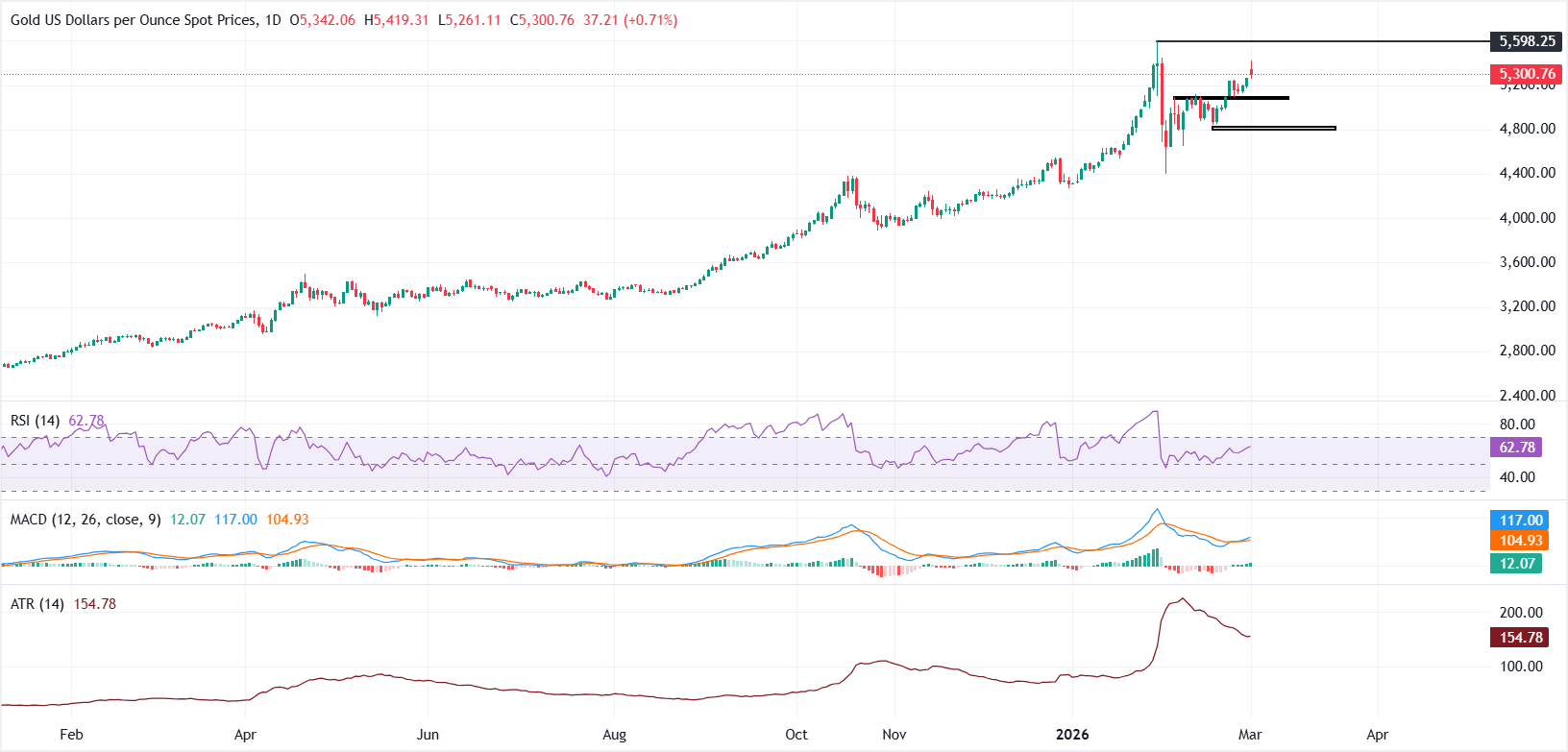
On the daily chart, XAU/USD maintains a bullish bias in the near-term, with the price holding above both the 21-day and 50-day Simple Moving Averages (SMAs), which continue to slope higher and reflect sustained buying interest.
The Relative Strength Index (RSI) at 65 signals firm positive momentum without entering extreme overbought territory, while the Moving Average Convergence Divergence (MACD) line turns higher in positive territory, suggesting strengthening upside pressure after a recent consolidation phase.
The Average Directional Index (ADX) has stabilized near 20, indicating a maturing but still trending environment rather than an aggressive breakout phase.
On the upside, initial resistance stands near the recent high zone around $5,400-$5,500. A sustained break above this area could open the door toward the $5,598 all-time high as the next bullish objective.
On the downside, immediate support emerges near the rising 21-day SMA around $5,040. A failure to hold above this level could signal fading momentum and expose the $4,900 support area, followed by the 50-day SMA near $4,815.
(The technical analysis of this story was written with the help of an AI tool.)














