“Epic” Japan Bond Selloff Sparks Market Panic as Gold Calmly Climbs Higher – Rethinking the Link Between JGB Yields and Gold
From 20–21 January 2026, Japan’s long-dated government bonds suffered a massive selloff. The 40-year JGB yield broke above 4%, marking its highest level since 2007. At the same time, the 10-year JGB yield briefly climbed to 2.330%, a peak not seen since February 1999, signalling that the Japanese government’s cost of financing its enormous debt pile is rising sharply.
The turbulence quickly spilled over into equities: the Nikkei 225 opened down 1.36%, while South Korea’s KOSPI index followed with a 1.52% drop.

What happened in the JGB market?
The immediate trigger for this bond market storm was Prime Minister Sanae Takaichi’s fiscal plan.
After announcing the dissolution of the lower house and calling a snap election, Takaichi and her political rivals rolled out competing tax-cut proposals to court voters, including a suspension of the consumption tax on food. The policy is expected to reduce government revenue by about 5 trillion yen (roughly USD 32 billion) per year.
For Japan, where public debt already exceeds 260% of GDP, this kind of election-driven fiscal loosening has been read by markets as a complete abandonment of fiscal discipline. Investors fear the government will be forced to issue even more bonds to plug the revenue gap, further worsening an already unsustainable debt trajectory.
At the same time, expectations of a shift in Bank of Japan monetary policy are pushing yields higher. BoJ Governor Kazuo Ueda has already hinted that if inflation remains elevated, further rate hikes in 2026 are possible. The collision of monetary policy normalisation with fiscal expansion has shaken the very foundations of the bond market.
The surge in bond yields is transmitting pressure to the Japanese economy and ordinary households through two main channels.
First, the yen is on the frontline.
Bond selling is often accompanied by capital outflows, intensifying depreciation pressure on the yen. For a country highly dependent on imported food and energy, a weaker currency translates directly into higher import prices and rising living costs.
Second, domestic credit conditions are tightening rapidly.
The 10-year JGB yield serves as a key benchmark for pricing long-term home loans in Japan, so its sharp rise means mortgage costs for millions of households will increase significantly. Higher financing costs for small and medium-sized enterprises may lead to layoffs or salary freezes. With living costs climbing and income growth under pressure, domestic demand risks being squeezed from both sides.
The relationship between gold and Japanese government bond yields
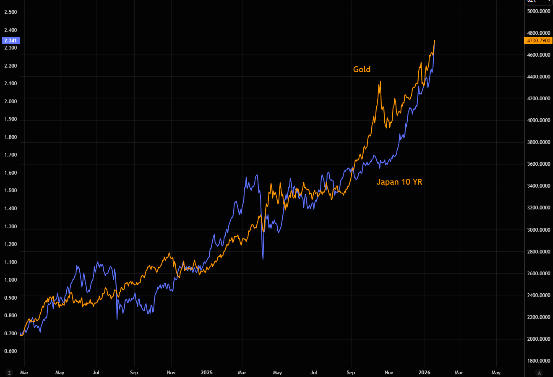
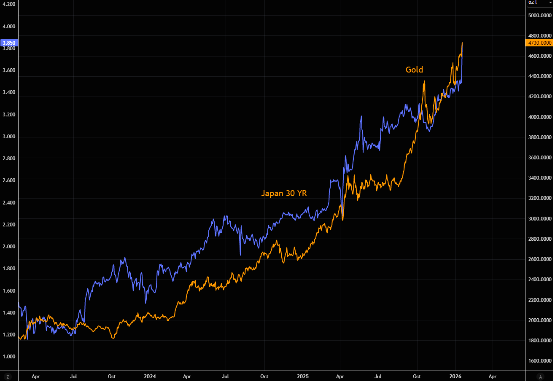
In traditional finance theory, rising government bond yields increase the opportunity cost of holding gold, thereby weighing on gold prices. But in this latest JGB crisis, gold has followed a completely different logic.
Market analysts point out that the current gold rally is not just a straightforward inflation hedge or rates trade, but rather a response to a broader loss of confidence in sovereign credit and the monetary system itself. When assets like Japanese government bonds—long treated as “risk-free”—start to be dumped because their fiscal sustainability is in doubt, the trust foundation underpinning them as a store of value begins to crack.
In this environment, gold is no longer simply competing with bonds. It does not rely on any government’s fiscal narrative or promises; its value is anchored in its physical properties and long-standing historical consensus. The turmoil in Japan’s bond market reflects growing market doubts about “sovereign credit,” the very bedrock of the modern financial system—and gold is the ultimate beneficiary of those doubts.
At the same time, as the chart below illustrates, periods of surging Japanese interest rates have often coincided with strength in gold.