

The Canadian Dollar ditches Crude Oil for Gold
- USD/CAD pushed to a fresh 14-month high this week, dragging the Loonie to its weakest against the Greenback since early 2025.
- The slide defies firm Crude Oil prices; the Loonie's traditional link to Crude Oil has broken down and even turned negative.
- The real drivers are a widening Canada-US rate gap and a six-week slide in Gold.
The textbook calls the Canadian Dollar a petro-currency, which means that with a Middle East war keeping Crude Oil bid, the Loonie should be holding its own. Instead it spent this week sliding to a fresh 14-month low against the Greenback, capping a run in which the US Dollar has closed higher in six of the last seven weeks. The textbook is wrong, at least for now: the Loonie has quietly stopped trading like a Crude Oil proxy, with its weakness driven by two forces that have nothing to do with the price of a barrel.

A petro-currency in name only
For years the Loonie moved with the price of a barrel; that relationship has quietly inverted. The rolling correlation between daily moves in the currency and Crude Oil has turned negative in recent months, a clean break from the historical norm. In its place, a less obvious driver has taken over: Gold. Canada is a major bullion producer; with Gold down for six straight weeks and well off its recent record, that slide has become a genuine weight on the currency. The market has swapped one commodity anchor for another; traders still watching only the barrel have missed it.
Two central banks moving apart
The second force is the one doing most of the damage: a widening gap between the Federal Reserve (Fed) and the Bank of Canada (BoC). The Fed held at 3.75% this month and revised its dot plot higher, with markets pricing a possible 2026 hike; the BoC, at 2.25%, is going nowhere. It held again this month, caught in a two-way bind between a soft domestic economy and fresh, energy-driven inflation, and has signalled no intention of moving. When one central bank is leaning toward hikes and the other is frozen, the rate spread does the talking; right now it points squarely against the Loonie. Speculative short positions on the currency have climbed to their highest in months as a result.
Outgunned, but not without a say
What makes the move striking is that this is not simply a story about Canada falling apart. The domestic picture is mixed rather than broken: a strong May jobs report sits alongside Friday's soft retail sales; the Loonie's slide owes more to relative positioning than to outright collapse. That also means the currency has a busier week ahead than the bears might like.
Canada's own May Consumer Price Index (CPI) lands Monday at 12:30 GMT. With inflation already running near 3% on elevated energy costs, a hot print would feed the BoC's inflation side and could lend the Loonie a rare bid; Governor Macklem then speaks Tuesday. The dominant event still sits south of the border: on Thursday at 12:30 GMT the US delivers its first-quarter Gross Domestic Product (GDP) third estimate alongside the May Personal Consumption Expenditures Price Index (PCE), with core PCE seen accelerating to 0.3% MoM. A hot US PCE widens the rate gap further and points USD/CAD higher still; only a genuinely hot Canadian CPI on Monday gives the Loonie much to fight back with.
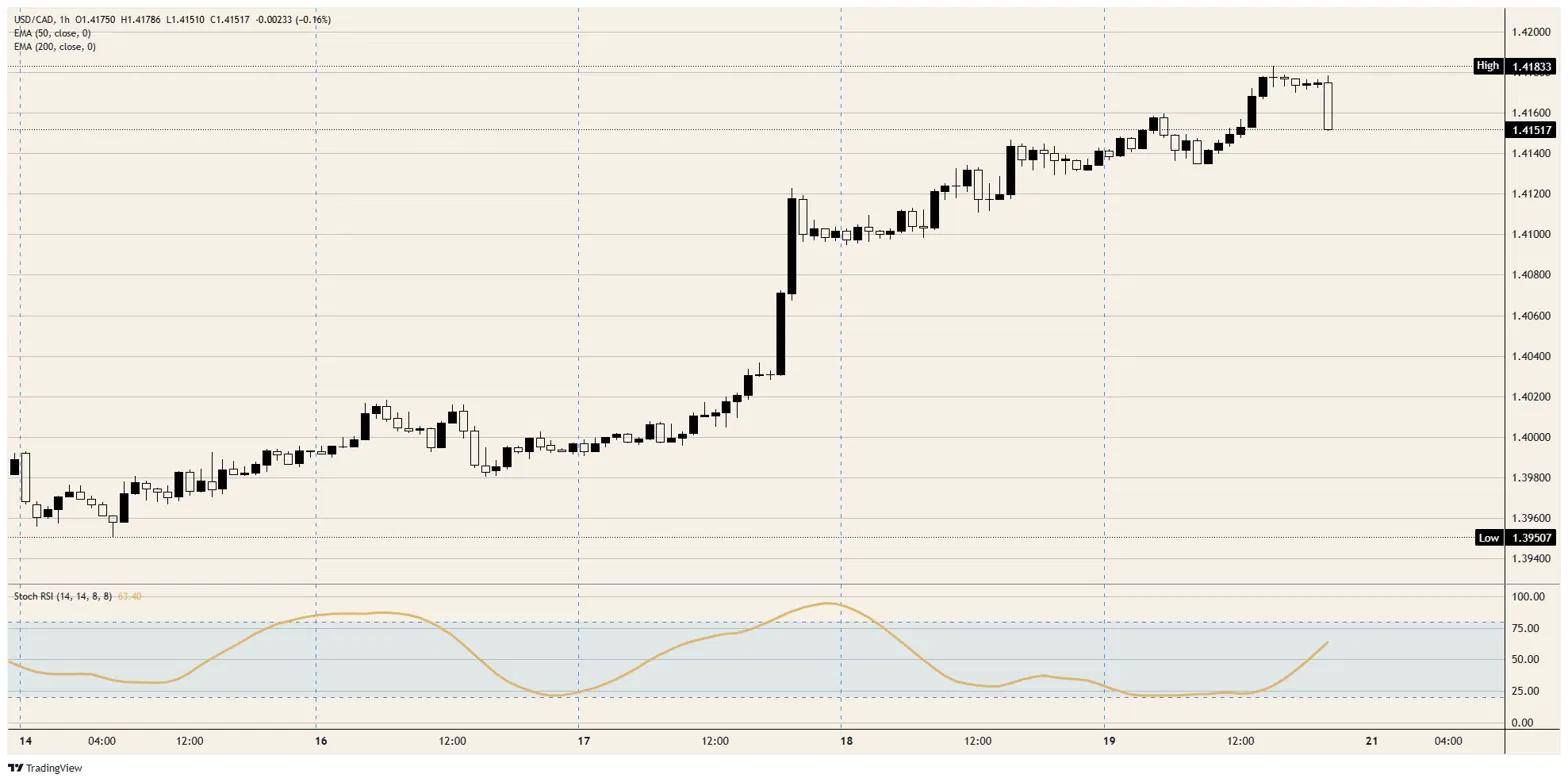
Resistance: USD/CAD is pressing the 1.4200 handle after this week's run; a clean break opens 1.4250 and then 1.4300, levels last seen well over a year ago.
Support: Initial support sits near 1.4100, then 1.4050; only a move back below 1.4000 would suggest the Loonie has found real footing.
Bias: Higher for USD/CAD while the Fed-BoC gap widens and Gold stays heavy, meaning further Loonie weakness is the base case. The one caution is positioning: the daily Stochastic Relative Strength Index (Stoch RSI) is deep in overbought after a near-vertical climb; a sharp but shallow pullback toward 1.4100 would not surprise. A hot US PCE next week is the catalyst most likely to push the pair on toward 1.4250.
USD/CAD hourly chart
Canadian Dollar FAQs
The key factors driving the Canadian Dollar (CAD) are the level of interest rates set by the Bank of Canada (BoC), the price of Oil, Canada’s largest export, the health of its economy, inflation and the Trade Balance, which is the difference between the value of Canada’s exports versus its imports. Other factors include market sentiment – whether investors are taking on more risky assets (risk-on) or seeking safe-havens (risk-off) – with risk-on being CAD-positive. As its largest trading partner, the health of the US economy is also a key factor influencing the Canadian Dollar.
The Bank of Canada (BoC) has a significant influence on the Canadian Dollar by setting the level of interest rates that banks can lend to one another. This influences the level of interest rates for everyone. The main goal of the BoC is to maintain inflation at 1-3% by adjusting interest rates up or down. Relatively higher interest rates tend to be positive for the CAD. The Bank of Canada can also use quantitative easing and tightening to influence credit conditions, with the former CAD-negative and the latter CAD-positive.
The price of Oil is a key factor impacting the value of the Canadian Dollar. Petroleum is Canada’s biggest export, so Oil price tends to have an immediate impact on the CAD value. Generally, if Oil price rises CAD also goes up, as aggregate demand for the currency increases. The opposite is the case if the price of Oil falls. Higher Oil prices also tend to result in a greater likelihood of a positive Trade Balance, which is also supportive of the CAD.
While inflation had always traditionally been thought of as a negative factor for a currency since it lowers the value of money, the opposite has actually been the case in modern times with the relaxation of cross-border capital controls. Higher inflation tends to lead central banks to put up interest rates which attracts more capital inflows from global investors seeking a lucrative place to keep their money. This increases demand for the local currency, which in Canada’s case is the Canadian Dollar.
Macroeconomic data releases gauge the health of the economy and can have an impact on the Canadian Dollar. Indicators such as GDP, Manufacturing and Services PMIs, employment, and consumer sentiment surveys can all influence the direction of the CAD. A strong economy is good for the Canadian Dollar. Not only does it attract more foreign investment but it may encourage the Bank of Canada to put up interest rates, leading to a stronger currency. If economic data is weak, however, the CAD is likely to fall.














