

USD/INR opens higher as oil prices recover on renewed Mideast conflicts
- The Indian Rupee declines at open against the US Dollar on renewed uncertainty over the US-Iran permanent ceasefire.
- A sharp recovery in the Oil price has dragged the Indian Rupee.
- Iran refuses to resume negotiations with the US due to its excessive demands.
The Indian Rupee (INR) opens lower against the US Dollar (USD) at the start of the week. The USD/INR jumps to near 92.80 as renewed tensions between the United States (US) and Iran have lifted the oil prices and offered support to the US Dollar (USD).

Oil prices recover strongly as Hormuz closed again
WTI Oil prices trade over 3.5% higher to near $88.00 in the Asian trade on Monday. The Oil prices strengthen as Iran closed the Strait of Hormuz, a vital passage to almost 20% of global energy supply, again, as retaliation for the continued US blockade of Iranian sea ports and Washington’s attack on one of Iran’s commercial ships.
On Friday, Iran announced a temporary reopening of the Hormuz after US President Donald Trump announced a ceasefire between Israel and Lebanon.
Currencies from economies, such as India, which rely heavily on oil imports to meet their energy needs, tend to underperform in a high oil price environment.
Meanwhile, US President Trump has reiterated threats to obliterate every power plant and bridge in Iran, through a post on Truth Social, if the nation doesn’t take a deal soon.
Renewed US-Iran tensions improve US Dollar’s safe-haven demand
Heightened uncertainty surrounding the occurrence of another round of talks between the US and Iran has improved the safe-haven demand of the US Dollar. As of writing, the US Dollar Index (DXY), which tracks the Greenback’s value against six major currencies, trades marginally higher to near 98.25.
Tehran has refused to return to the table to resume negotiations over the permanent ceasefire with the US due to its “excessive demands, unrealistic expectations, constant shifts in stance, repeated contradictions, and the ongoing naval blockade”, according to the Iranian Republic News Agency (IRNA).
FIIs continue raising stake in Indian stock market
Foreign Institutional Investors (FIIs) have remained net buyers in the last three trading days in the Indian stock market, and have raised their stake worth Rs. 1,731.71 crore. The sentiment of foreign investors toward the Indian equity market has improved since the announcement of the two-week ceasefire between the US and Iran, which will expire on April 22.
Overseas investors were not gung-ho on Indian equities since the announcement; however, the pace of selling reduced initially, and eventually they started turning out to be net buyers.
On the data front, investors will focus on the India-US private sector Purchasing Managers’ Index (PMI) data for April, which will be released on Thursday.
Technical Analysis: USD/INR remains below 20-day EMA
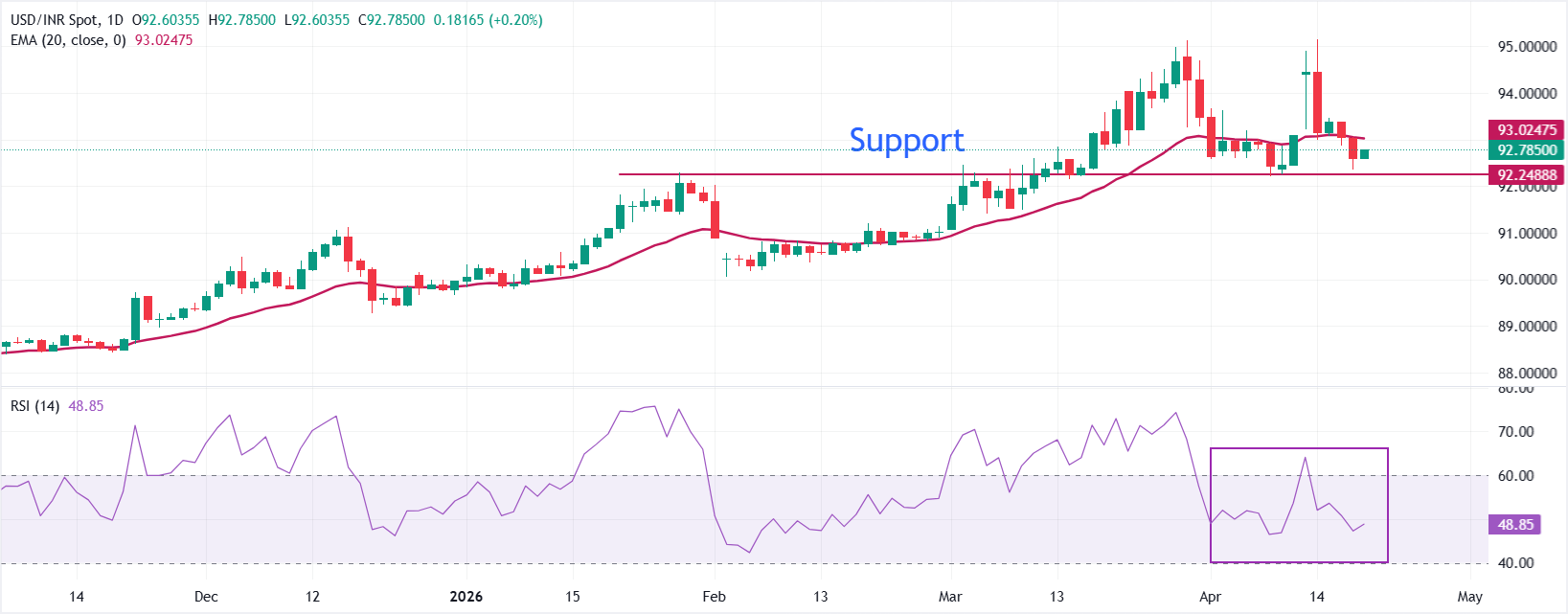
USD/INR rises to near 92.80 in the opening session on Monday. However, the near-term outlook for the pair remains bearish, as it stays below the 20-period exponential moving average (EMA) at 93.0247.
The Relative Strength Index (RSI) continues to oscillate in the 40.00-60.00 zone, hinting at waning upside momentum rather than outright oversold conditions.
On the upside, the 20-period EMA around 93.02 acts as immediate resistance, and a clear break above this level would open the scope of further recovery toward 94.00. Looking down, the January 28 high at around 92.28 is the key support level; a close below 92.28 would expose the spot to the March 5 low at 91.40.
(The technical analysis of this story was written with the help of an AI tool.)
Indian Rupee FAQs
The Indian Rupee (INR) is one of the most sensitive currencies to external factors. The price of Crude Oil (the country is highly dependent on imported Oil), the value of the US Dollar – most trade is conducted in USD – and the level of foreign investment, are all influential. Direct intervention by the Reserve Bank of India (RBI) in FX markets to keep the exchange rate stable, as well as the level of interest rates set by the RBI, are further major influencing factors on the Rupee.
The Reserve Bank of India (RBI) actively intervenes in forex markets to maintain a stable exchange rate, to help facilitate trade. In addition, the RBI tries to maintain the inflation rate at its 4% target by adjusting interest rates. Higher interest rates usually strengthen the Rupee. This is due to the role of the ‘carry trade’ in which investors borrow in countries with lower interest rates so as to place their money in countries’ offering relatively higher interest rates and profit from the difference.
Macroeconomic factors that influence the value of the Rupee include inflation, interest rates, the economic growth rate (GDP), the balance of trade, and inflows from foreign investment. A higher growth rate can lead to more overseas investment, pushing up demand for the Rupee. A less negative balance of trade will eventually lead to a stronger Rupee. Higher interest rates, especially real rates (interest rates less inflation) are also positive for the Rupee. A risk-on environment can lead to greater inflows of Foreign Direct and Indirect Investment (FDI and FII), which also benefit the Rupee.
Higher inflation, particularly, if it is comparatively higher than India’s peers, is generally negative for the currency as it reflects devaluation through oversupply. Inflation also increases the cost of exports, leading to more Rupees being sold to purchase foreign imports, which is Rupee-negative. At the same time, higher inflation usually leads to the Reserve Bank of India (RBI) raising interest rates and this can be positive for the Rupee, due to increased demand from international investors. The opposite effect is true of lower inflation.














