

USD/JPY snaps four-session winning streak, retreats to 159.00 region
- The Japanese Yen edged higher as broad US Dollar softness interrupted the pair's recent run to multi-week highs.
- The BoJ is expected to hold its policy rate at 0.75% at Thursday's meeting.
- Japan also has trade balance data due Thursday following a sharp rebound.
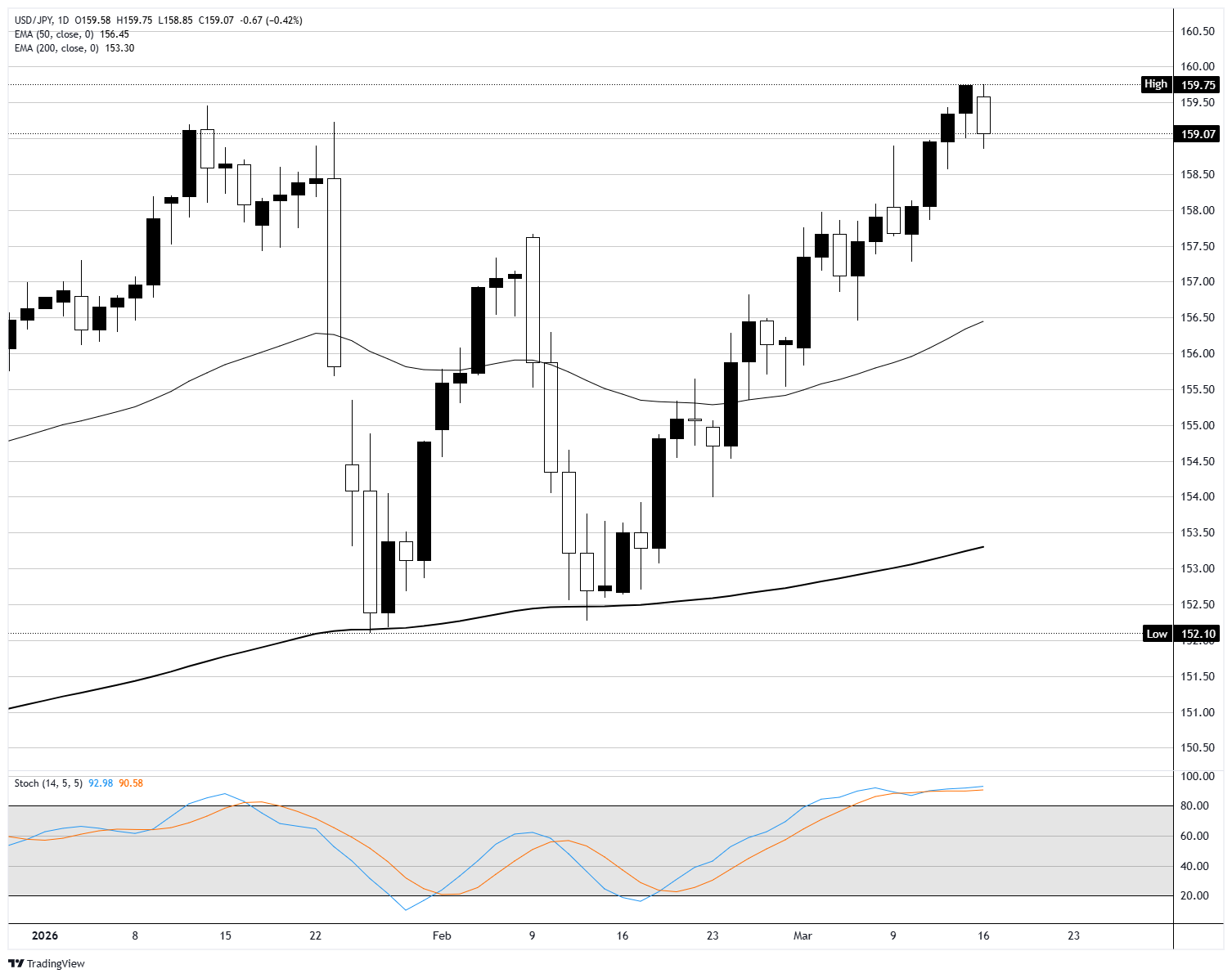
USD/JPY backslid around 0.4% on Monday, snapping a four-session winning streak and pulling back to the 159.00 region in otherwise unremarkable market action. The pair has surged from February's lows close to 152.10, but Monday's modest bearish candle near the top of the recent range suggests the intraday high at 159.75 failed to attract sustained follow-through buying. The broader pattern of higher lows since February is still valid, though the pair is visibly stretched relative to its key moving averages.

The Bank of Japan (BoJ) is widely expected to hold its policy rate at 0.75% at Thursday's meeting, keeping the policy gap with the US Federal Reserve (Fed) wide and structurally bullish for Yen shorts. Markets will closely watch BoJ Governor Ueda's press conference for any update on the tightening timeline, particularly given that underlying Japanese inflation continues to run above the 2% target. Thursday's February trade data will also be in focus after exports surged 16.8% year-on-year (YoY) in the prior reading.
On the USD side, easing Strait of Hormuz tensions softened safe-haven demand for the Dollar broadly on Monday. March NY Empire State Manufacturing came in at -0.2 against a 3.2 consensus, adding marginal downside pressure. The Fed's Wednesday decision, expected to hold at 3.75%, and the accompanying SEP update will be the week's central USD event, with the rate path outlook critical for the pair's near-term direction.
USD/JPY daily chart
Japanese Yen FAQs
The Japanese Yen (JPY) is one of the world’s most traded currencies. Its value is broadly determined by the performance of the Japanese economy, but more specifically by the Bank of Japan’s policy, the differential between Japanese and US bond yields, or risk sentiment among traders, among other factors.
One of the Bank of Japan’s mandates is currency control, so its moves are key for the Yen. The BoJ has directly intervened in currency markets sometimes, generally to lower the value of the Yen, although it refrains from doing it often due to political concerns of its main trading partners. The BoJ ultra-loose monetary policy between 2013 and 2024 caused the Yen to depreciate against its main currency peers due to an increasing policy divergence between the Bank of Japan and other main central banks. More recently, the gradually unwinding of this ultra-loose policy has given some support to the Yen.
Over the last decade, the BoJ’s stance of sticking to ultra-loose monetary policy has led to a widening policy divergence with other central banks, particularly with the US Federal Reserve. This supported a widening of the differential between the 10-year US and Japanese bonds, which favored the US Dollar against the Japanese Yen. The BoJ decision in 2024 to gradually abandon the ultra-loose policy, coupled with interest-rate cuts in other major central banks, is narrowing this differential.
The Japanese Yen is often seen as a safe-haven investment. This means that in times of market stress, investors are more likely to put their money in the Japanese currency due to its supposed reliability and stability. Turbulent times are likely to strengthen the Yen’s value against other currencies seen as more risky to invest in.














