





- The Australian Dollar extends losses despite growing odds of an RBA rate hike as early as February.
- Australia’s Consumer Inflation Expectations rose to 4.7% in December from November’s three-month low of 4.5%.
- The US Dollar gains amid fading likelihood of further Federal Reserve rate cuts.
The Australian Dollar (AUD) loses ground against the US Dollar (USD) on Thursday for the sixth successive day. The AUD/USD pair may gain ground as the Aussie Dollar could receive support from investors’ caution following the release of Australia’s Consumer Inflation Expectations, which rose to 4.7% in December from November’s three-month low of 4.5%, supporting the Reserve Bank of Australia’s (RBA) hawkish stance.
The AUD could find support as markets grow increasingly expectant of an RBA rate hike as early as February. Commonwealth Bank of Australia and National Australia Bank now expect the RBA to start tightening sooner than previously projected, pointing to stubborn inflation in a capacity-constrained economy. Their forecasts followed the central bank’s hawkish hold on rates at its final 2025 meeting last week. Swaps price in a 28% chance of a February hike, nearly 41% in March, with August almost fully priced.
US Dollar receives support from fading Fed rate cut bets
- The US Dollar Index (DXY), which measures the value of the US Dollar against six major currencies, is holding its ground and trading around 98.40 at the time of writing.
- The Greenback holds ground from market caution ahead of the release of the delayed US Consumer Price Index (CPI) report due later in the day, which is expected to provide further insight into how price pressures are evolving.
- Federal Reserve (Fed) Governor Christopher Waller, who is under consideration to become chair of the central bank, reiterated his dovish stance on interest rates during a CNBC forum. “Because inflation is still elevated, we can take our time - there’s no rush to get down. We can steadily bring the policy rate down toward neutral,” Waller said.
- The CME FedWatch tool suggests that Fed funds futures are pricing an implied 75.6% chance of a hold in rates at the US central bank's next meeting in January, up from nearly 74% a week ago.
- The US November jobs report showed payroll growth of 64K, slightly above forecasts, but October figures were revised sharply lower, and the unemployment rate rose to 4.6%, the highest since 2021, underscoring a gradually cooling labor market. Retail sales were flat on the month, reinforcing signs that consumer demand is losing momentum.
- Atlanta Fed President Raphael Bostic said in a blog post on Tuesday that the jobs report was a mixed picture and that it did not change the outlook, and that he would prefer to leave rates unchanged at the last Fed meeting.
- Fed officials are split over whether more easing of monetary policy is needed next year. The median Fed official penciled in just one reduction in 2026, but some policymakers see no further cuts. Meanwhile, traders anticipate two rate cuts next year.
- The National Bureau of Statistics (NBS) showed Monday that China’s Retail Sales rose 1.3% year-over-year (YoY) in November vs. 2.9% expected and 2.9% in October. Chinese Industrial Production increased 4.8% YoY in the same period, compared to the 5.0% forecast and 4.9% seen previously.
- China’s Fixed Asset Investment came in at -2.6% year-to-date (YTD) YoY in November, missing the expected -2.3% figure. The October reading was -1.7%.
- Australia’s preliminary S&P Global Manufacturing PMI edged up to 52.2 in December from 51.6 previously, according to data released by S&P Global on Tuesday. Meanwhile, the Services PMI slipped to 51.0 from 52.8, and the Composite PMI fell to 51.1 from 52.6.
- The Australian Bureau of Statistics (ABS) reported last week that the Unemployment Rate steadied at 4.3% in November. The figure came in below the market consensus of 4.4%. Furthermore, the Australian Employment Change arrived at -21.3K in November from 41.1K in October (revised from 42.2K), compared with the consensus forecast of 20K.
Australian Dollar moves below confluence support zone near 0.6600
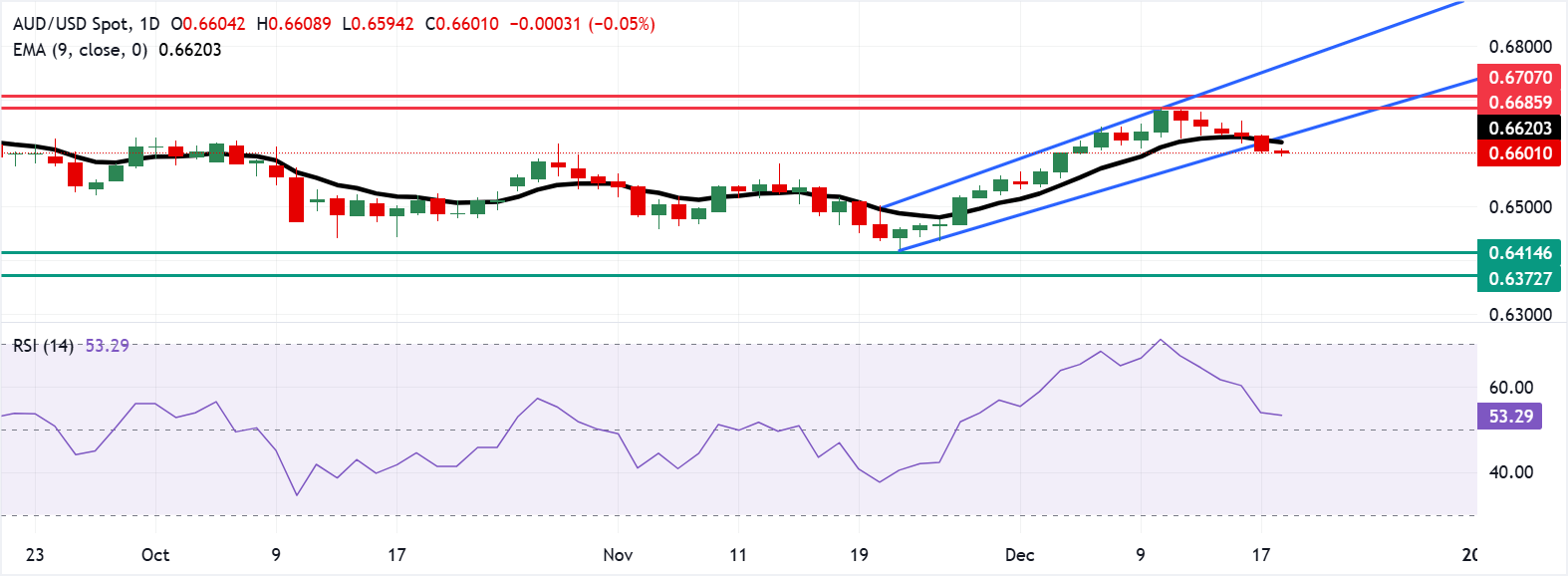
The AUD/USD pair is trading below 0.6600 on Thursday. The technical analysis of the daily chart shows the pair is positioned below the ascending channel trend, reflecting a weakening of a bullish bias. Additionally, the pair is trading below the nine-day Exponential Moving Average (EMA), indicating a weaker short-term price momentum.
The AUD/USD pair could fall toward the psychological level of 0.6500, followed by the six-month low of 0.6414, recorded on August 21.
On the upside, the AUD/USD pair may test the nine-day EMA at 0.6619. A rebound toward the ascending channel would revive the bullish bias and support the pair to test the three-month high of 0.6685, followed by 0.6707, the highest since October 2024. Further advances would support the pair to test the upper ascending channel boundary around 0.6760.
Australian Dollar Price Today
The table below shows the percentage change of Australian Dollar (AUD) against listed major currencies today. Australian Dollar was the weakest against the Swiss Franc.
| USD | EUR | GBP | JPY | CAD | AUD | NZD | CHF | |
|---|---|---|---|---|---|---|---|---|
| USD | -0.04% | 0.06% | 0.03% | -0.03% | -0.00% | 0.21% | -0.06% | |
| EUR | 0.04% | 0.08% | 0.05% | 0.00% | 0.03% | 0.25% | -0.02% | |
| GBP | -0.06% | -0.08% | -0.02% | -0.09% | -0.06% | 0.16% | -0.12% | |
| JPY | -0.03% | -0.05% | 0.02% | -0.05% | -0.03% | 0.16% | -0.09% | |
| CAD | 0.03% | -0.00% | 0.09% | 0.05% | 0.04% | 0.23% | -0.03% | |
| AUD | 0.00% | -0.03% | 0.06% | 0.03% | -0.04% | 0.22% | -0.06% | |
| NZD | -0.21% | -0.25% | -0.16% | -0.16% | -0.23% | -0.22% | -0.28% | |
| CHF | 0.06% | 0.02% | 0.12% | 0.09% | 0.03% | 0.06% | 0.28% |
The heat map shows percentage changes of major currencies against each other. The base currency is picked from the left column, while the quote currency is picked from the top row. For example, if you pick the Australian Dollar from the left column and move along the horizontal line to the US Dollar, the percentage change displayed in the box will represent AUD (base)/USD (quote).
Australian Dollar FAQs
One of the most significant factors for the Australian Dollar (AUD) is the level of interest rates set by the Reserve Bank of Australia (RBA). Because Australia is a resource-rich country another key driver is the price of its biggest export, Iron Ore. The health of the Chinese economy, its largest trading partner, is a factor, as well as inflation in Australia, its growth rate and Trade Balance. Market sentiment – whether investors are taking on more risky assets (risk-on) or seeking safe-havens (risk-off) – is also a factor, with risk-on positive for AUD.
The Reserve Bank of Australia (RBA) influences the Australian Dollar (AUD) by setting the level of interest rates that Australian banks can lend to each other. This influences the level of interest rates in the economy as a whole. The main goal of the RBA is to maintain a stable inflation rate of 2-3% by adjusting interest rates up or down. Relatively high interest rates compared to other major central banks support the AUD, and the opposite for relatively low. The RBA can also use quantitative easing and tightening to influence credit conditions, with the former AUD-negative and the latter AUD-positive.
China is Australia’s largest trading partner so the health of the Chinese economy is a major influence on the value of the Australian Dollar (AUD). When the Chinese economy is doing well it purchases more raw materials, goods and services from Australia, lifting demand for the AUD, and pushing up its value. The opposite is the case when the Chinese economy is not growing as fast as expected. Positive or negative surprises in Chinese growth data, therefore, often have a direct impact on the Australian Dollar and its pairs.
Iron Ore is Australia’s largest export, accounting for $118 billion a year according to data from 2021, with China as its primary destination. The price of Iron Ore, therefore, can be a driver of the Australian Dollar. Generally, if the price of Iron Ore rises, AUD also goes up, as aggregate demand for the currency increases. The opposite is the case if the price of Iron Ore falls. Higher Iron Ore prices also tend to result in a greater likelihood of a positive Trade Balance for Australia, which is also positive of the AUD.
The Trade Balance, which is the difference between what a country earns from its exports versus what it pays for its imports, is another factor that can influence the value of the Australian Dollar. If Australia produces highly sought after exports, then its currency will gain in value purely from the surplus demand created from foreign buyers seeking to purchase its exports versus what it spends to purchase imports. Therefore, a positive net Trade Balance strengthens the AUD, with the opposite effect if the Trade Balance is negative.







