




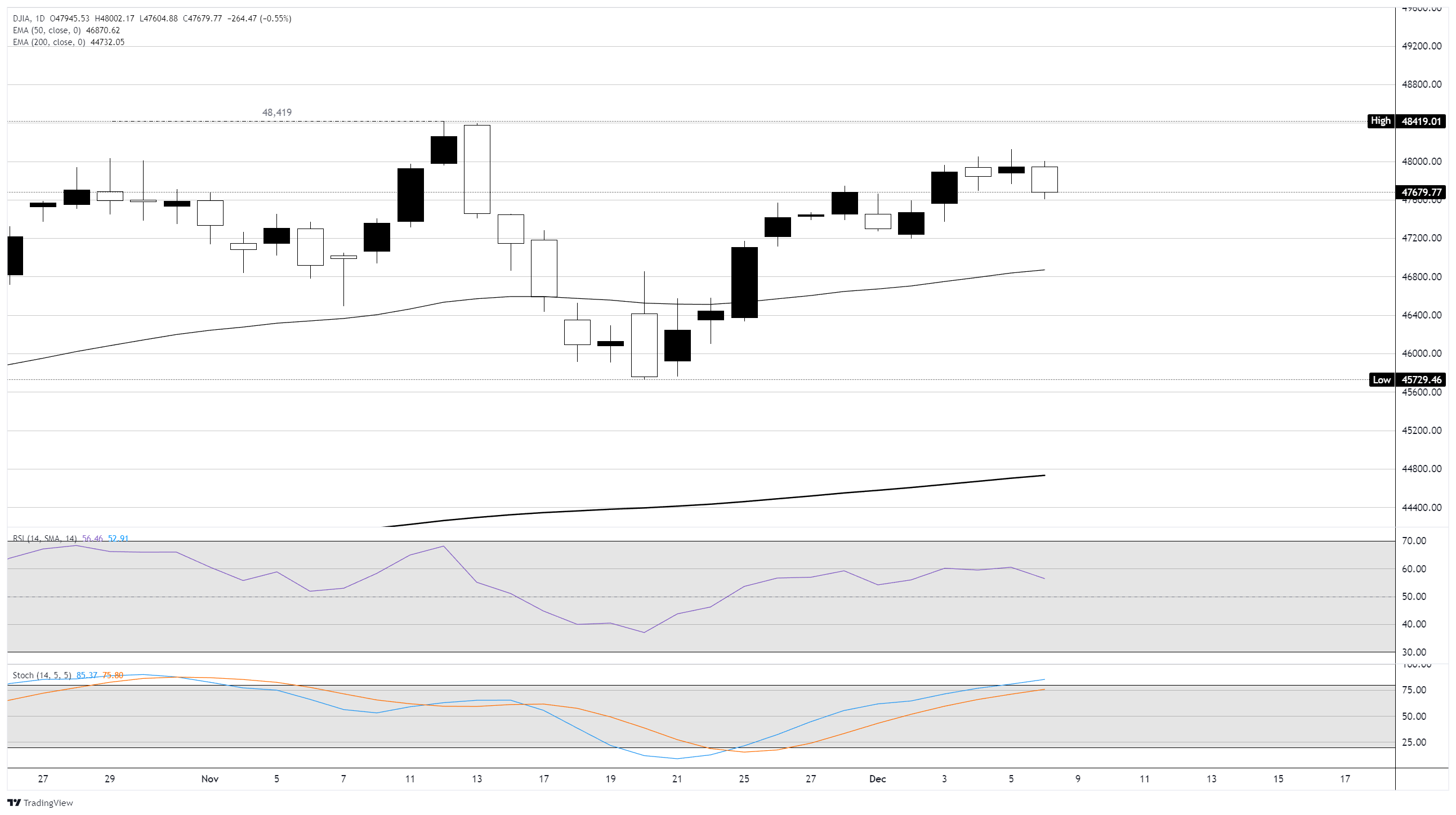
- The Dow Jones shed around 200 points on Monday, falling away from 48,000.
- Equities started the new trading week on an AI-driven high note before backsliding.
- Investors are widely expecting another Fed interest rate cut, but rising Treasuries are pressing down on sentiment.
The Dow Jones Industrial Average fell back from the 48,000 handle on Monday as investor expectations for an upcoming interest rate cut from the Federal Reserve (Fed) were overridden by a fresh upswing in 10-year Treasury yields.
Rising Treasury yields batter investor sentiment
Stocks slipped on Monday as investors shifted their focus to the Federal Reserve’s December 10 meeting, where the central bank is widely expected to deliver a third straight interest rate cut. The S&P 500 (SP500) fell 0.5%, the Nasdaq dipped 0.4%, and the Dow lost 0.6%. Even with the strong expectations for another 25-basis-point cut, rising 10-year Treasury yields kept pressure on markets, reflecting investor uncertainty about inflation trends going into 2025. Futures markets now price in roughly a 90% chance of a rate cut, up sharply from a month ago.
Recent market gains, with multiple winning streaks across major indexes, suggest that investors have already “baked in” the likelihood of this cut. Analysts warn that if the Fed unexpectedly holds rates steady, stocks could fall quickly. Beyond the decision itself, attention is turning to what Fed Chair Jerome Powell will signal about the path ahead. With cooling labor data and Powell’s term running to 2026, analysts expect him to emphasize a cautious, data-dependent approach rather than offering clear clues about the pace of cuts next year.
AI tech rally continues to sputter along
Tech stocks were a bright spot in an otherwise muted session. Broadcom (AVGO) hit a record high on chip-development news with Microsoft (MSFT), while Confluent (CFLT) surged after IBM announced an $11 billion acquisition plan. Big movers elsewhere included Wave Life Sciences (WVE) and Structure Therapeutics (GPCR), both soaring on promising obesity-drug data, and Paramount Skydance (PSKY), which jumped amid a hostile bid for Warner Bros. Discovery (WBD). Berkshire Hathaway (BRK) also made headlines with a major leadership reshuffle as the company prepares for eventual post-Buffett transitions.
Dow Jones daily chart
AI stocks FAQs
First and foremost, artificial intelligence is an academic discipline that seeks to recreate the cognitive functions, logical understanding, perceptions and pattern recognition of humans in machines. Often abbreviated as AI, artificial intelligence has a number of sub-fields including artificial neural networks, machine learning or predictive analytics, symbolic reasoning, deep learning, natural language processing, speech recognition, image recognition and expert systems. The end goal of the entire field is the creation of artificial general intelligence or AGI. This means producing a machine that can solve arbitrary problems that it has not been trained to solve.
There are a number of different use cases for artificial intelligence. The most well-known of them are generative AI platforms that use training on large language models (LLMs) to answer text-based queries. These include ChatGPT and Google’s Bard platform. Midjourney is a program that generates original images based on user-created text. Other forms of AI utilize probabilistic techniques to determine a quality or perception of an entity, like Upstart’s lending platform, which uses an AI-enhanced credit rating system to determine credit worthiness of applicants by scouring the internet for data related to their career, wealth profile and relationships. Other types of AI use large databases from scientific studies to generate new ideas for possible pharmaceuticals to be tested in laboratories. YouTube, Spotify, Facebook and other content aggregators use AI applications to suggest personalized content to users by collecting and organizing data on their viewing habits.
Nvidia (NVDA) is a semiconductor company that builds both the AI-focused computer chips and some of the platforms that AI engineers use to build their applications. Many proponents view Nvidia as the pick-and-shovel play for the AI revolution since it builds the tools needed to carry out further applications of artificial intelligence. Palantir Technologies (PLTR) is a “big data” analytics company. It has large contracts with the US intelligence community, which uses its Gotham platform to sift through data and determine intelligence leads and inform on pattern recognition. Its Foundry product is used by major corporations to track employee and customer data for use in predictive analytics and discovering anomalies. Microsoft (MSFT) has a large stake in ChatGPT creator OpenAI, the latter of which has not gone public. Microsoft has integrated OpenAI’s technology with its Bing search engine.
Following the introduction of ChatGPT to the general public in late 2022, many stocks associated with AI began to rally. Nvidia for instance advanced well over 200% in the six months following the release. Immediately, pundits on Wall Street began to wonder whether the market was being consumed by another tech bubble. Famous investor Stanley Druckenmiller, who has held major investments in both Palantir and Nvidia, said that bubbles never last just six months. He said that if the excitement over AI did become a bubble, then the extreme valuations would last at least two and a half years or long like the DotCom bubble in the late 1990s. At the midpoint of 2023, the best guess is that the market is not in a bubble, at least for now. Yes, Nvidia traded at 27 times forward sales at that time, but analysts were predicting extremely high revenue growth for years to come. At the height of the DotCom bubble, the NASDAQ 100 traded for 60 times earnings, but in mid-2023 the index traded at 25 times earnings.







