

Trade The World
Gold edges higher after mixed US labour data
By Vishal Chaturvedi
Date Published: 9 Jan 2026 | Date Modified: 9 Jan 2026


POPULAR ARTICLES

Gold (XAU/USD) trades with a mild positive bias on Friday as investors assess mixed US labour data. At the time of writing, XAU/USD trades around $4,490, after bouncing from the $4,400 region on Thursday.
- Gold firms as markets digest mixed US labour data.
- Fed easing bets and lingering geopolitical risks keep demand underpinned.
- Technically, prices hold above the rising 21-day SMA, keeping the near-term bias bullish.
Gold (XAU/USD) trades with a mild positive bias on Friday as investors assess mixed US labour data. At the time of writing, XAU/USD trades around $4,490, after bouncing from the $4,400 region on Thursday.
Data from the US Bureau of Labor Statistics (BLS) showed that job growth slowed in December. The US economy added 50,000 jobs, falling short of market expectations for a 60,000 increase and easing from November’s revised 56,000 gain. Meanwhile, the Unemployment Rate ticked lower to 4.4% from 4.6%, coming in below forecasts of 4.5%.
On the monetary policy front, a weaker-than-expected NFP reading was offset by a lower Unemployment Rate, which has strengthened market conviction that the Federal Reserve (Fed) will leave interest rates unchanged at its January 27-28 meeting. However, markets are still pricing in around two rate cuts later in the year. Gold typically benefits from a lower-interest-rate environment, as falling yields reduce the opportunity cost of holding the non-yielding metal.
Looking ahead, focus shifts to the University of Michigan’s preliminary January Consumer Sentiment survey, including readings on consumer expectations and short- and long-term inflation expectations.
Markets will also monitor remarks from Richmond Fed President Thomas Barkin and Minneapolis Fed President Neel Kashkari for fresh clues on the monetary policy outlook.
Market movers: Markets eye geopolitical risks, tariff ruling and Fed leadership headlines
- Markets remain focused on rising geopolitical risks after the United States expanded its oversight of Venezuelan Oil exports, following military actions in Caracas. Sentiment has also been unsettled by fresh controversial remarks from US President Donald Trump about annexing Greenland. Elsewhere, growing unrest in Iran and renewed frictions involving Japan and China are adding to a cautious mood, keeping risk appetite fragile and underpinning demand for Gold.
- US President Donald Trump posted on Truth Social on Friday that Venezuela is releasing political prisoners and that the US is working with Caracas to rebuild its oil and gas sector. He added that a planned second wave of attacks has been cancelled, though US ships will remain in place “for safety and security.” Trump also said he will meet major oil executives at the White House today and that around $100 billion could be invested.
- Attention is also on a US Supreme Court hearing later on Friday over the legality of President Trump’s tariffs imposed under the International Emergency Economic Powers Act (IEEPA). Lower courts have previously ruled that the administration exceeded its authority in imposing sweeping tariffs.
- Markets are also watching headlines around the next Federal Reserve Chair. The New York Times reported that President Trump said he has “a decision in mind” but has not discussed it yet. Treasury Secretary Scott Bessent later said Trump has not interviewed one of the four final candidates and that the announcement could come around his Davos trip in two weeks.
- On the data front, releases on Thursday showed that Initial Jobless Claims rose modestly to 208,000 in the week ended January 3, slightly below market expectations of 210,000, while Challenger job cuts fell to 35,553 in December, the lowest level since July 2024. Elsewhere, the US trade deficit narrowed sharply to $29.4 billion in October, the smallest since June 2009 and well below the $58.1 billion forecast.
Technical analysis: XAU/USD eyes $4,500
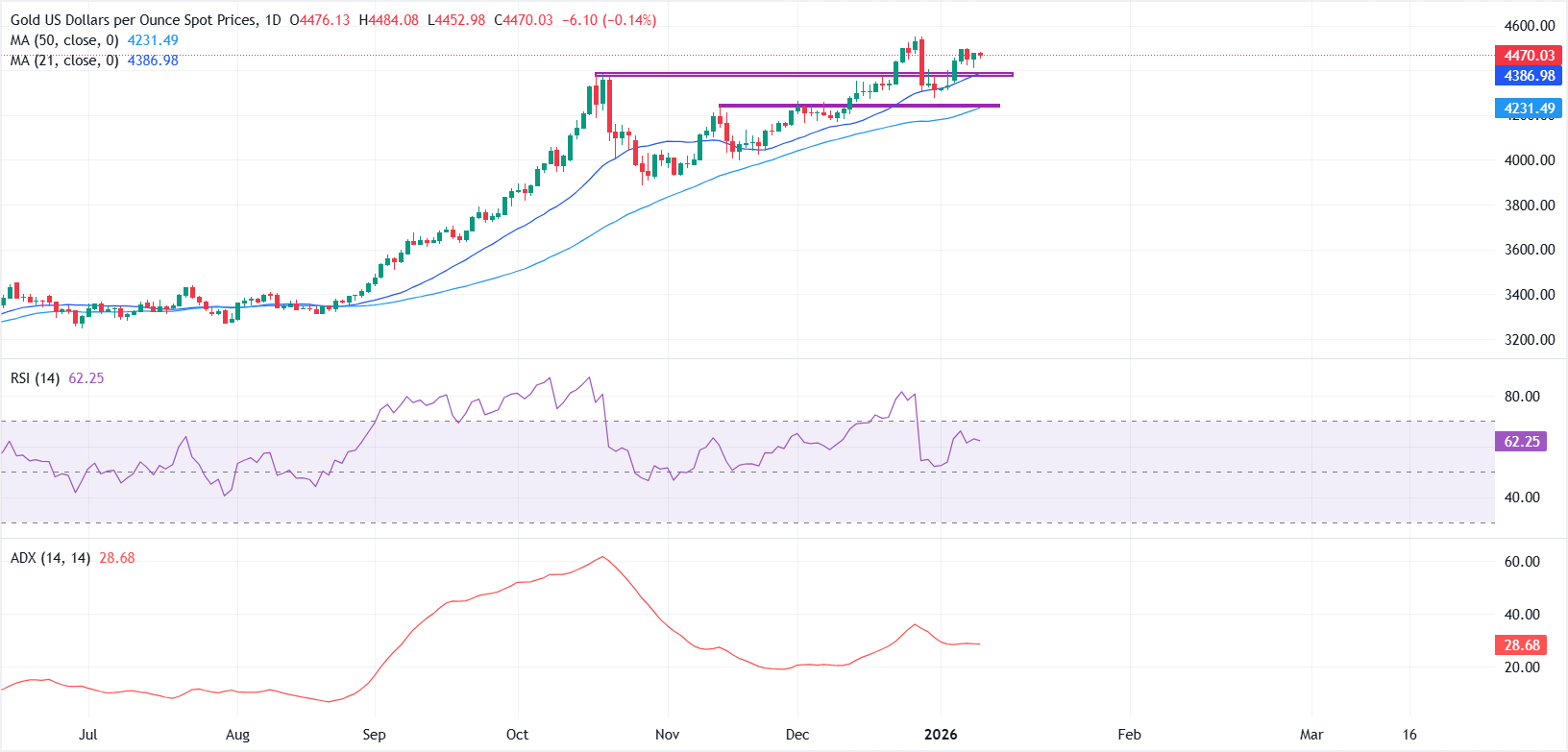
From a technical perspective, XAU/USD is in a holding pattern with price action consolidating after the recent rally. The broader bias remains bullish as prices hold above the rising 21-day Simple Moving Average (SMA) near 4,387.
On the downside, 4,400-4,380 marks the first key support zone. A break below this area would expose the 50-day SMA near 4,231, opening the door for a deeper pullback.
On the upside, 4,500 stands as immediate resistance. A sustained break above this level would shift focus back to the record high near 4,549, and potentially beyond.
The Relative Strength Index (RSI) sits around 62, holding above the mid-line and suggesting bullish momentum is intact. The Average Directional Index (ADX) at 28.68 indicates a moderate trend that has softened from earlier peaks, suggesting slower follow-through.
Nonfarm Payrolls FAQs
Nonfarm Payrolls (NFP) are part of the US Bureau of Labor Statistics monthly jobs report. The Nonfarm Payrolls component specifically measures the change in the number of people employed in the US during the previous month, excluding the farming industry.
The Nonfarm Payrolls figure can influence the decisions of the Federal Reserve by providing a measure of how successfully the Fed is meeting its mandate of fostering full employment and 2% inflation. A relatively high NFP figure means more people are in employment, earning more money and therefore probably spending more. A relatively low Nonfarm Payrolls’ result, on the either hand, could mean people are struggling to find work. The Fed will typically raise interest rates to combat high inflation triggered by low unemployment, and lower them to stimulate a stagnant labor market.
Nonfarm Payrolls generally have a positive correlation with the US Dollar. This means when payrolls’ figures come out higher-than-expected the USD tends to rally and vice versa when they are lower. NFPs influence the US Dollar by virtue of their impact on inflation, monetary policy expectations and interest rates. A higher NFP usually means the Federal Reserve will be more tight in its monetary policy, supporting the USD.
Nonfarm Payrolls are generally negatively-correlated with the price of Gold. This means a higher-than-expected payrolls’ figure will have a depressing effect on the Gold price and vice versa. Higher NFP generally has a positive effect on the value of the USD, and like most major commodities Gold is priced in US Dollars. If the USD gains in value, therefore, it requires less Dollars to buy an ounce of Gold. Also, higher interest rates (typically helped higher NFPs) also lessen the attractiveness of Gold as an investment compared to staying in cash, where the money will at least earn interest.
Nonfarm Payrolls is only one component within a bigger jobs report and it can be overshadowed by the other components. At times, when NFP come out higher-than-forecast, but the Average Weekly Earnings is lower than expected, the market has ignored the potentially inflationary effect of the headline result and interpreted the fall in earnings as deflationary. The Participation Rate and the Average Weekly Hours components can also influence the market reaction, but only in seldom events like the “Great Resignation” or the Global Financial Crisis.

FXStreet
More than a million users rely on FXStreet for real-time market data, charting tools, expert insights, and forex news. Its comprehensive economic calendar and educational webinars help traders stay informed and make calculated decisions. FXStreet is supported by a team of about 60 professionals, split between the Barcelona headquarters and various global regions.
Read More








