

Trade The World
Gold extends rally beyond $4,300, fresh high since October 21 amid dovish Fed bets
By Haresh Menghani
Date Published: 12 Dec 2025 | Date Modified: 12 Dec 2025


POPULAR ARTICLES
Gold (XAU/USD) prolongs its uptrend for the fourth straight day and climbs beyond the $4,300 mark, hitting a fresh high since October 21 during the first half of the European session on Friday.
- Gold scales higher for the fourth straight day and remains supported by a combination of factors.
- The Fed’s dovish outlook weighs on the USD and continues to act as a tailwind for the commodity.
- Geopolitical risks further benefit the safe-haven XAU/USD, offsetting the prevalent risk-on mood.
Gold (XAU/USD) prolongs its uptrend for the fourth straight day and climbs beyond the $4,300 mark, hitting a fresh high since October 21 during the first half of the European session on Friday. The US Dollar (USD) struggles to attract any meaningful buyers and remains close to a two-month low, touched on Thursday, amid the Federal Reserve's (Fed) dovish outlook. This, in turn, is seen as a key factor that continues to drive flows towards the non-yielding yellow metal.
Apart from this, stalled talks on the Russia-Ukraine peace deal keep geopolitical risks in play and turn out to be another factor that benefits the safe-haven Gold. The supporting factors, to a larger extent, offsets the risk-on mood and does little to hinder the safe-haven commodity's move higher. This, in turn, suggests that the path of least resistance for the bullion remains to the upside. Traders now look to speeches from influential FOMC members for short-term impetus heading into the weekend.
Daily Digest Market Movers: Gold bulls retain control as Fed rate cut bets keep USD on the defensive
- The US Federal Reserve's dovish outlook dragged the US Dollar to an over two-month low and lifted the non-yielding Gold to its highest level since October 21 on Thursday. In a widely expected move, the US central bank lowered borrowing costs by 25 basis points on Wednesday and projected just one more rate cut in 2026.
- Fed Chair Jerome Powell said during the post-meeting press conference that the US labor market has significant downside risks and that the central bank does not want its policy to push down on job creation. This fueled speculations about two more rate cuts by the Fed next year and, in turn, favors the XAU/USD bulls.
- Meanwhile, Asian stocks tracked the overnight strength on Wall Street and advanced in early trade on Friday, which is seen undermining demand for the traditional safe-haven bullion. However, prospects for lower interest rates in the US, along with persistent geopolitical uncertainties, could lend support to the commodity.
- Meanwhile, US President Donald Trump is extremely frustrated with Russia and Ukraine, and he doesn't want any more talk, his spokeswoman said on Thursday. Earlier, Ukrainian President Volodymyr Zelensky said that the US was pushing it to cede land to Russia as part of an agreement to end a nearly four-year war.
- There isn't any relevant market-moving economic data due for release from the US on Friday, leaving the USD at the mercy of speeches from influential FOMC members. Apart from this, the broader risk sentiment could provide some impetus to the yellow metal, which remains on track to register strong weekly gains.
Gold builds on strength beyond $4,300 following a trading range breakout on Thursday
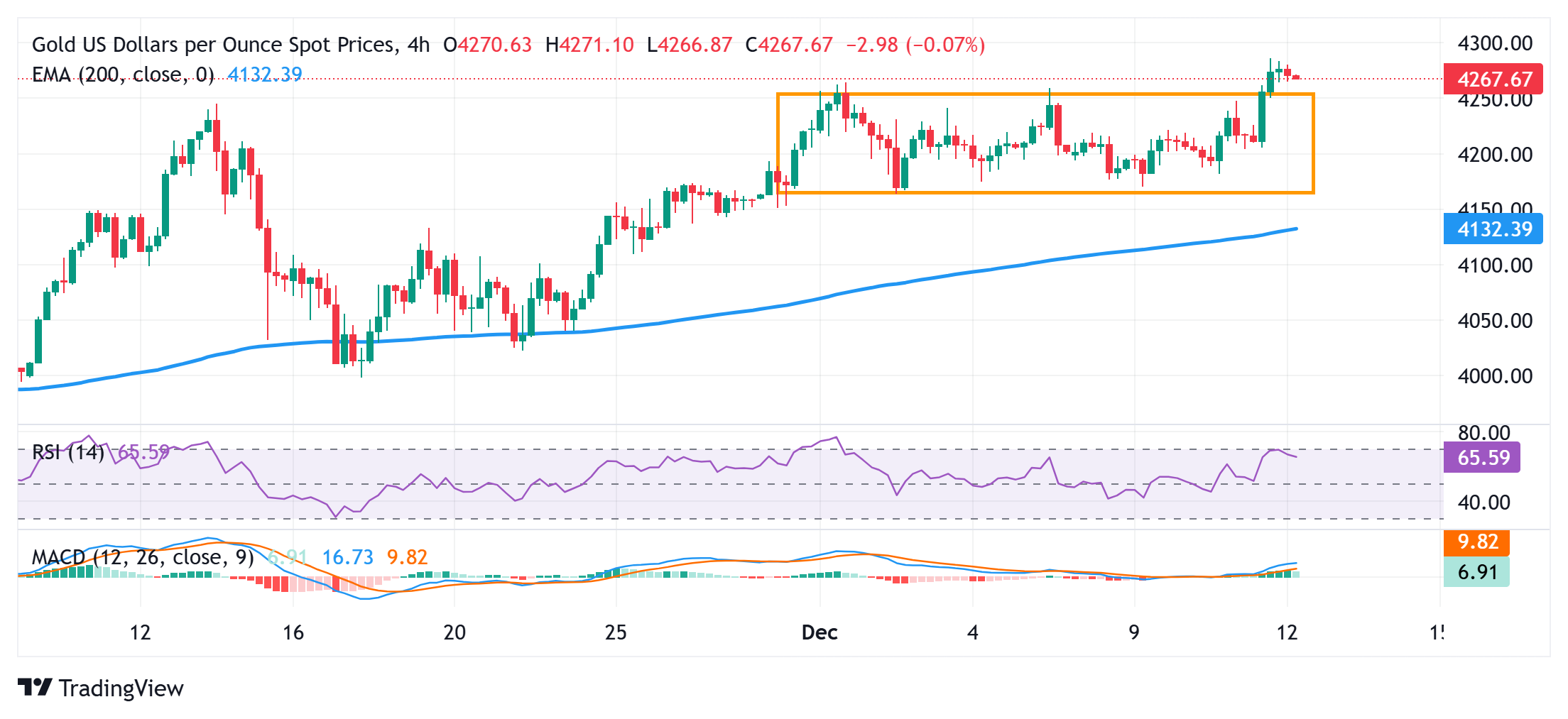
The overnight strong move up confirmed a fresh bullish breakout through a nearly two-week-old trading range hurdle, around the $4,245-4,250 region. Moreover, oscillators on the daily chart are holding in positive territory and are still away from being in the overbought zone, suggesting that the path of least resistance for the Gold price remains to the upside. Hence, any further pullback towards the aforementioned resistance breakpoint could be seen as a buying opportunity. This should limit losses for the XAU/USD pair near the $4,220-4,218 region, which is followed by the $4,200 mark and the $4,170-4,165 support area. A convincing break below the latter might shift the bias in favor of bearish traders and pave the way for deeper losses.
On the flip side, the $4,300 mark now seems to act as an immediate hurdle, above which the XAU/USD pair could climb to the next relevant hurdle near the $4,328-4,330 region. The momentum could extend further and allow the Gold to aim towards challenging the all-time peak, around the $4,380 zone, touched in October. Some follow-through buying beyond the $4,400 round figure will be seen as a fresh trigger for bullish traders and set the stage for an extension of the commodity's recent well-established uptrend from the October monthly swing low.
US Dollar FAQs
The US Dollar (USD) is the official currency of the United States of America, and the ‘de facto’ currency of a significant number of other countries where it is found in circulation alongside local notes. It is the most heavily traded currency in the world, accounting for over 88% of all global foreign exchange turnover, or an average of $6.6 trillion in transactions per day, according to data from 2022. Following the second world war, the USD took over from the British Pound as the world’s reserve currency. For most of its history, the US Dollar was backed by Gold, until the Bretton Woods Agreement in 1971 when the Gold Standard went away.
The most important single factor impacting on the value of the US Dollar is monetary policy, which is shaped by the Federal Reserve (Fed). The Fed has two mandates: to achieve price stability (control inflation) and foster full employment. Its primary tool to achieve these two goals is by adjusting interest rates. When prices are rising too quickly and inflation is above the Fed’s 2% target, the Fed will raise rates, which helps the USD value. When inflation falls below 2% or the Unemployment Rate is too high, the Fed may lower interest rates, which weighs on the Greenback.
In extreme situations, the Federal Reserve can also print more Dollars and enact quantitative easing (QE). QE is the process by which the Fed substantially increases the flow of credit in a stuck financial system. It is a non-standard policy measure used when credit has dried up because banks will not lend to each other (out of the fear of counterparty default). It is a last resort when simply lowering interest rates is unlikely to achieve the necessary result. It was the Fed’s weapon of choice to combat the credit crunch that occurred during the Great Financial Crisis in 2008. It involves the Fed printing more Dollars and using them to buy US government bonds predominantly from financial institutions. QE usually leads to a weaker US Dollar.
Quantitative tightening (QT) is the reverse process whereby the Federal Reserve stops buying bonds from financial institutions and does not reinvest the principal from the bonds it holds maturing in new purchases. It is usually positive for the US Dollar.

FXStreet
More than a million users rely on FXStreet for real-time market data, charting tools, expert insights, and forex news. Its comprehensive economic calendar and educational webinars help traders stay informed and make calculated decisions. FXStreet is supported by a team of about 60 professionals, split between the Barcelona headquarters and various global regions.
Read More








