

Gold retreats to near $4,600 as Fed rate pause expectations grow
By Akhtar Faruqui
Date Published: 15 Jan 2026 | Date Modified: 15 Jan 2026


POPULAR ARTICLES
Gold (XAU/USD) loses ground after hitting a fresh record high of $4,643 in the previous session, trading around $4,600 per troy ounce on Thursday.
- Gold retreats after reaching a fresh record high of $4,643 in the previous session.
- The non-interest-bearing Gold slips as strong US data bolster expectations that the Fed will keep rates on hold.
- Safe-haven Gold weakens as easing geopolitical tensions emerge after Trump said Iran’s crackdown-related killings are subsiding.
Gold (XAU/USD) loses ground after hitting a fresh record high of $4,643 in the previous session, trading around $4,600 per troy ounce on Thursday. The non-interest-bearing Gold lost ground as a stronger-than-expected United States (US) Producer Price Index (PPI) and Retail Sales, along with last week’s easing Unemployment Rate, reinforced the case for the US Federal Reserve (Fed) to keep interest rates on hold for the coming months.
Safe-haven Gold prices also weaken, partly reflecting easing geopolitical concerns. US President Donald Trump said reports indicated Iran’s crackdown-related killings were subsiding and that no large-scale executions were planned, though he did not rule out potential US military action, noting Washington would continue to monitor developments, according to Reuters.
The safe-haven demand for precious metals, including Gold, may further gain amid renewed concerns over the Fed’s independence. The Federal Reserve Chair Jerome Powell called out the Trump administration's decision to subpoena him, saying it amounted to intimidating the Fed into delivering easier monetary policy. Trump said on Wednesday he has no plans to fire Powell despite the Justice Department's criminal investigation into the Fed chair, but it was "too early" to say what he would ultimately do.
Daily Digest Market Movers: Gold declines as US Dollar strengthens
- The US Dollar Index (DXY), which measures the value of the US Dollar against six major currencies, is gaining ground after registering modest losses in the previous session. The DXY is trading around 99.10 at the time of writing, dampening foreign-currency demand for dollar-denominated Gold.
- The US Census Bureau reported on Wednesday that Retail Sales rose more than expected to $735.9 billion in November, up 0.6%, following a 0.1% contraction in October and beating market expectations of a 0.4% increase. Meanwhile, the Producer Price Index (PPI) came in hot in November, with both headline and core measures reaching 3% year-over-year (YoY).
- Morgan Stanley analysts delayed their expectations for rate cuts to June and September from January and April following Friday’s jobs report.
- Minneapolis Fed President Neel Kashkari said at the Midwest Economic Forecast Forum hosted online by the Wisconsin Bankers Association on Wednesday that the overall economy seems quite resilient and that he has seen less tariff pass-through than expected. Kashkari added that inflation is still too high but is moving the right way.
- Fed Beige Book noted that US economic activity picked up at a "slight to modest pace" in most parts of the country since mid-November. "This marks an improvement over the last three report cycles, where a majority of Fed districts reported little change."
- US Core Consumer Price Index (CPI), excluding food and energy, rose 0.2% in December, below market expectations, while annual core inflation held at 2.6%, matching a four-year low. The data provided a clearer sign of easing inflation after earlier releases were skewed by shutdown effects. Meanwhile, CPI increased by 0.3% month-over-month in December 2025, matching market expectations and repeating the rise seen in September. The annual inflation remains at 2.7% increase as expected.
- The US-based HRANA rights group reported on Wednesday that the death toll from Iran’s protests has reached 2,571. US President Donald Trump has urged Iranians to continue protesting, pledging that help is on the way, per Reuters.
- President Trump said on Monday that he would impose 25% tariffs on goods from any country doing business with Iran, stepping up pressure on Tehran amid widespread domestic protests. He added that the measure would take effect immediately, without providing further details. Trump warned on Sunday that action may be required before any meeting, even as he said Iran’s leadership had reached out seeking “to negotiate” after his military threats.
- US Nonfarm Payrolls (NFP) rose by 50,000 in December, falling short of November's 56,000 (revised from 64,000) and came in weaker than the market expectation of 60,000. However, the Unemployment Rate ticked lower to 4.4% in December from 4.6% in November, while the Average Hourly Earnings climbed to 3.8% YoY in December from 3.6% in the previous reading.
Gold bulls remain intact as holds above the rising nine-day EMA
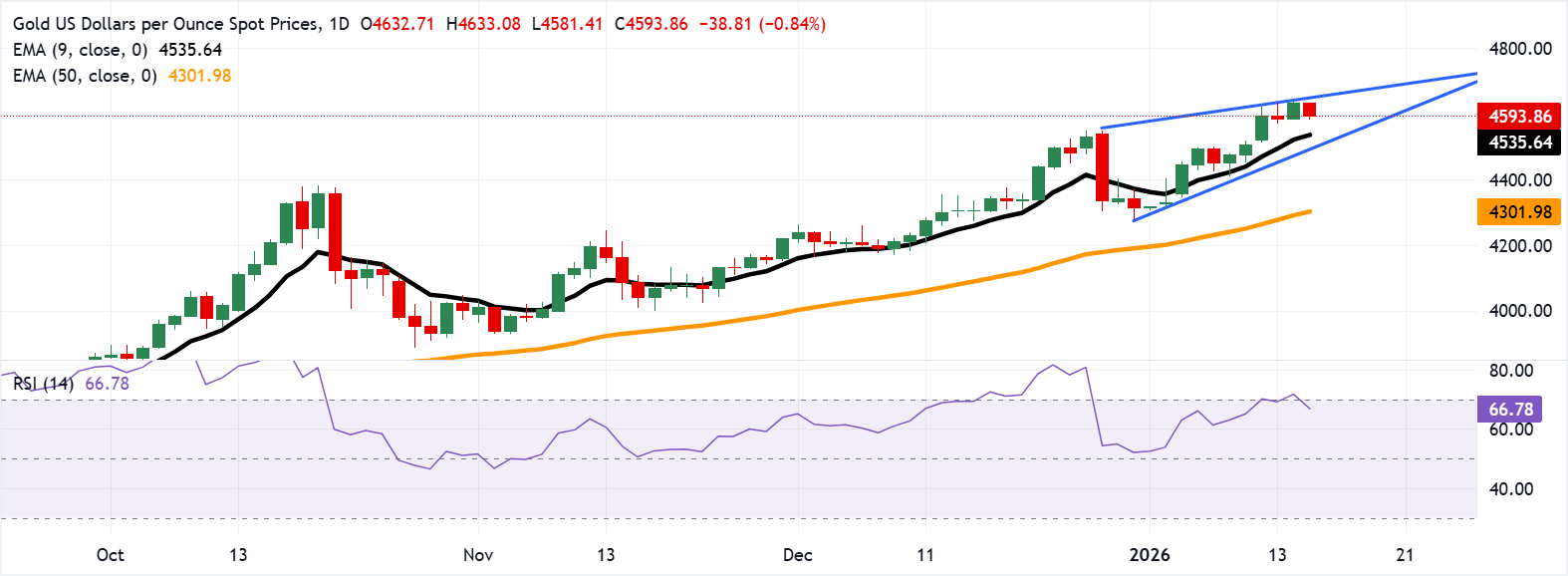
Gold (XAU/USD) is trading around $4,600 on Thursday. The daily chart technical analysis shows the XAU/USD pair remains within an emerging ascending wedge pattern. This formation signals weakening upside momentum and warns of a potential bearish reversal if the price breaks below the lower trendline on strong volume.
Gold price holds above the rising nine-day Exponential Moving Average (EMA), keeping the near-term uptrend intact. The 50-day EMA turns higher and underpins the broader bullish bias. The 14-day Relative Strength Index (RSI) at 66.05 is positive without overbought extremes. RSI could ease toward the midline if momentum cools, but staying elevated would preserve upside pressure.
The immediate resistance appears at the record high of $4,643, followed by the upper boundary of the ascending wedge around $4,660. A break above this confluence resistance zone would lead the XAU/USD pair to the $4,700 level. On the downside, the initial support lies at the nine-day EMA of $4,535.64, followed by the lower ascending wedge boundary around $4,490.00.
(The technical analysis of this story was written with the help of an AI tool.)
Central banks FAQs
Central Banks have a key mandate which is making sure that there is price stability in a country or region. Economies are constantly facing inflation or deflation when prices for certain goods and services are fluctuating. Constant rising prices for the same goods means inflation, constant lowered prices for the same goods means deflation. It is the task of the central bank to keep the demand in line by tweaking its policy rate. For the biggest central banks like the US Federal Reserve (Fed), the European Central Bank (ECB) or the Bank of England (BoE), the mandate is to keep inflation close to 2%.
A central bank has one important tool at its disposal to get inflation higher or lower, and that is by tweaking its benchmark policy rate, commonly known as interest rate. On pre-communicated moments, the central bank will issue a statement with its policy rate and provide additional reasoning on why it is either remaining or changing (cutting or hiking) it. Local banks will adjust their savings and lending rates accordingly, which in turn will make it either harder or easier for people to earn on their savings or for companies to take out loans and make investments in their businesses. When the central bank hikes interest rates substantially, this is called monetary tightening. When it is cutting its benchmark rate, it is called monetary easing.
A central bank is often politically independent. Members of the central bank policy board are passing through a series of panels and hearings before being appointed to a policy board seat. Each member in that board often has a certain conviction on how the central bank should control inflation and the subsequent monetary policy. Members that want a very loose monetary policy, with low rates and cheap lending, to boost the economy substantially while being content to see inflation slightly above 2%, are called ‘doves’. Members that rather want to see higher rates to reward savings and want to keep a lit on inflation at all time are called ‘hawks’ and will not rest until inflation is at or just below 2%.
Normally, there is a chairman or president who leads each meeting, needs to create a consensus between the hawks or doves and has his or her final say when it would come down to a vote split to avoid a 50-50 tie on whether the current policy should be adjusted. The chairman will deliver speeches which often can be followed live, where the current monetary stance and outlook is being communicated. A central bank will try to push forward its monetary policy without triggering violent swings in rates, equities, or its currency. All members of the central bank will channel their stance toward the markets in advance of a policy meeting event. A few days before a policy meeting takes place until the new policy has been communicated, members are forbidden to talk publicly. This is called the blackout period.

More than a million users rely on FXStreet for real-time market data, charting tools, expert insights, and forex news. Its comprehensive economic calendar and educational webinars help traders stay informed and make calculated decisions. FXStreet is supported by a team of about 60 professionals, split between the Barcelona headquarters and various global regions.
Read More








