





- XRP rebounds as bulls target a short-term breakout above $2.00 on Friday.
- XRP ETFs record the highest inflow since December 8, signaling growing institutional appetite.
- Low retail demand, as reflected by futures Open Interest falling to $3.21 billion, could cap XRP price recovery.
Ripple (XRP) is up more than 3%, trading at $1.87 at the time of writing on Friday. XRP regains momentum, following whipsaw price action to an intraday low of $1.77, building on softer United States (US) Consumer Price Index (CPI) inflation, which increased by 2.7% annually in November, slower than analysts’ estimates of 3.1%.
A close above $2.00 will likely reinforce a short-term bullish outlook. However, key technical indicators still lean bearishly, which could cap rebounds.
XRP ETFs extend inflow streak
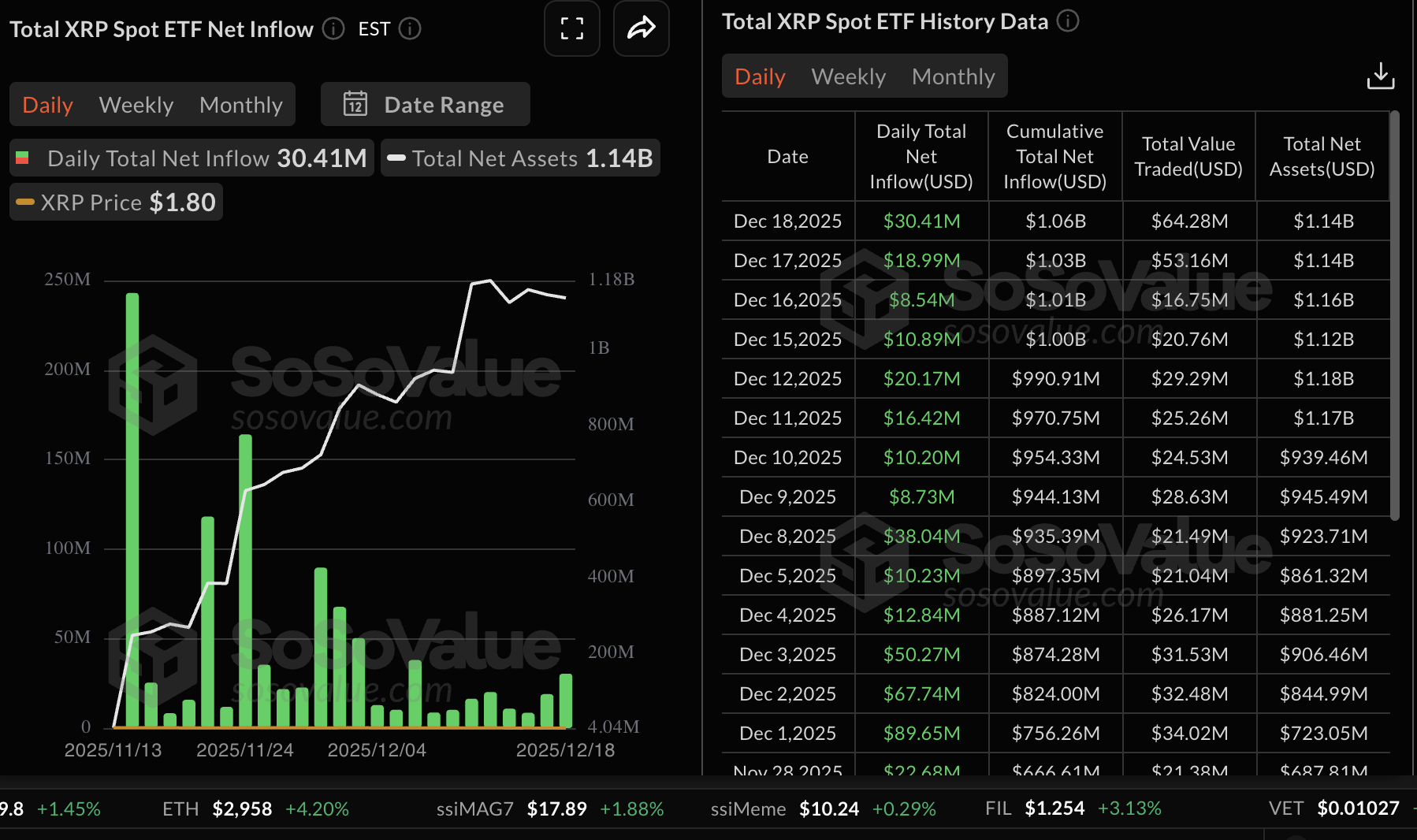
XRP spot Exchange Traded Funds (ETFs) listed in the United States (US) recorded inflows of approximately $30 million on Thursday. Grayscale’s GXRP ETF led with inflows of $10 million, followed by 21Shares’ TOXR ETF with almost $10 million and Franklin Templeton’s ZXRP ETF with nearly $7 million.
The cumulative inflow stands at $1.06 billion while net assets average $1.14 billion, according to SoSoValue data. Since their November debut, XRP ETFs have not experienced outflows, suggesting that institutional risk appetite is growing.
Steady ETF inflows are likely to support positive market sentiment, increasing the odds that XRP will sustain an uptrend.
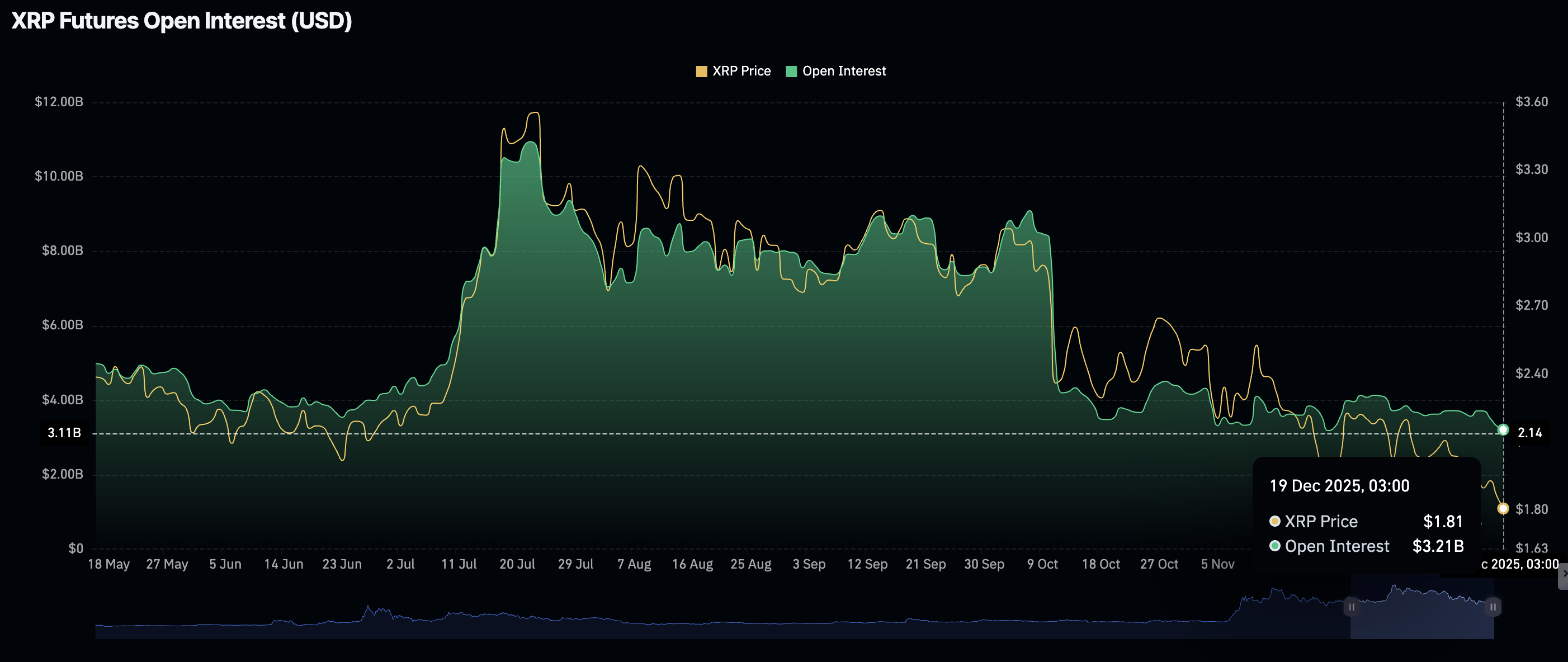
On the other side, XRP is facing a significant drop in retail interest, which is negatively affecting the derivatives market and, on a larger scale, triggering frequent sell-offs. CoinGlass data shows futures Open Interest (OI) at $3.21 billion on Friday, down from $3.31 billion the previous day and $3.52 billion on Wednesday.
Since the October 10 flash crash, the XRP derivatives market has remained significantly suppressed, with OI fluctuating between $3 billion and $4 billion. Before the deleveraging event, OI stood at $8.36 billion on October 10 and $10.94 billion on July 22, which emphasizes the prevailing low retail interest and demand.
A sustained uptick in the OI is required to support steady price increases. Otherwise, recovery could remain a pipe dream, as investors reduce their exposure or stay on the sidelines.
Technical outlook: XRP edges higher, but downside risks remain
XRP is trading at $1.87 at the time of writing on Friday, supported by an uptrending Relative Strength Index (RSI) at 37 on the daily chart. A steady increase toward the 50 midline would affirm a short-term bullish outlook and increase the odds of XRP breaking above the pivotal $2.00 resistance.
On the contrary, the Moving Average Convergence Divergence (MACD) indicator sits in the negative region on the same chart and has maintained a sell signal since Monday. Investors will likely reduce exposure if the blue MACD line remains below the red signal line.
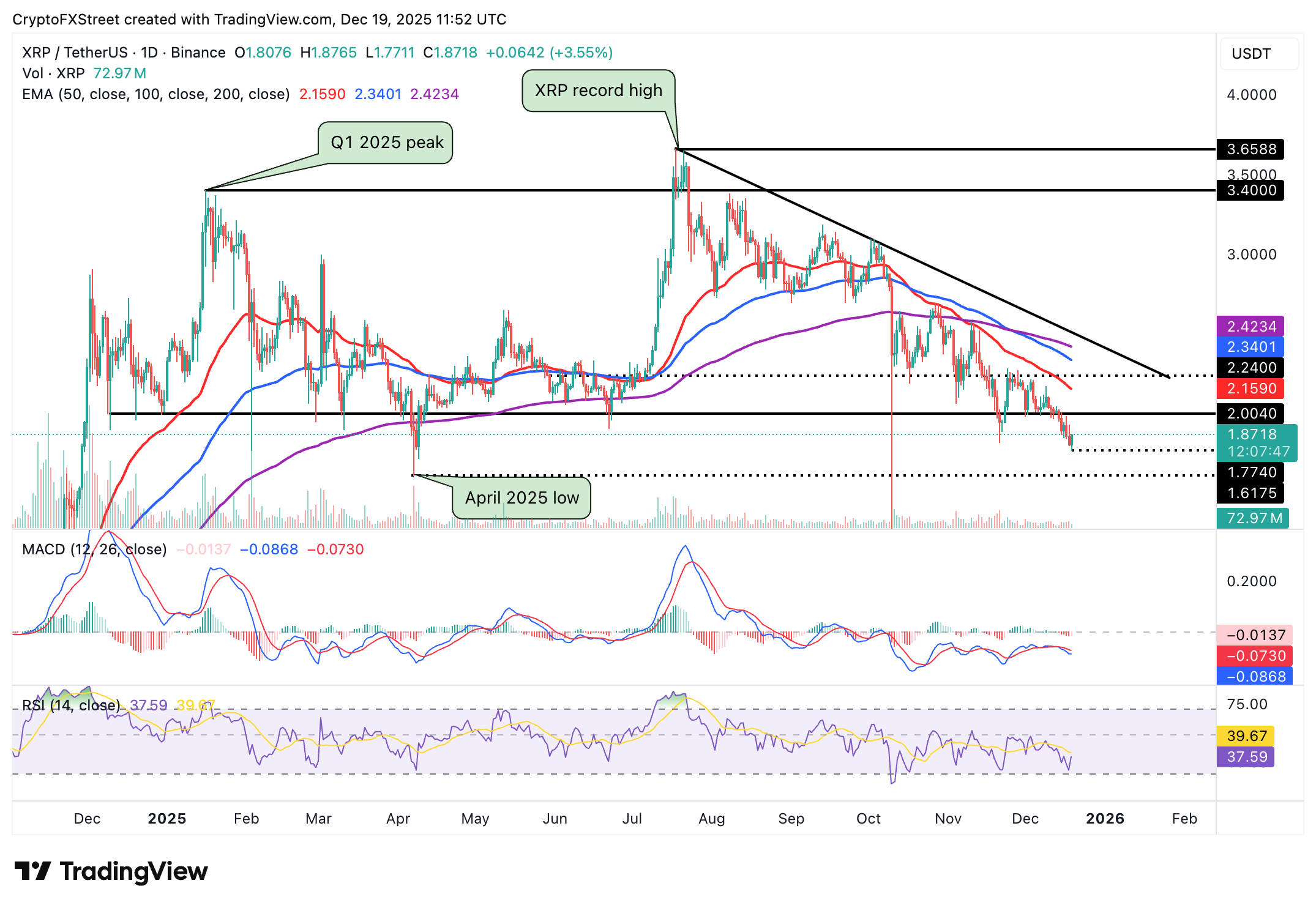
Meanwhile, the overall trend remains bearish, as evidenced by the 50-day Exponential Moving Average (EMA) at $2.15, the 100-day EMA at $2.34, and the 200-day EMA at $2.42, all sloping downward.
A close above the intraday low at $1.77 may steady the recovery toward $2.00.
Bulls must, however, flip the 50-day EMA at $2.15 to pave the way for gains above the 200-day EMA at $2.42. A further breakout above the descending trendline will likely mark a significant step toward XRP’s bullish outlook and a sustained uptrend, targeting $3.00.
Cryptocurrency metrics FAQs
The developer or creator of each cryptocurrency decides on the total number of tokens that can be minted or issued. Only a certain number of these assets can be minted by mining, staking or other mechanisms. This is defined by the algorithm of the underlying blockchain technology. On the other hand, circulating supply can also be decreased via actions such as burning tokens, or mistakenly sending assets to addresses of other incompatible blockchains.
Market capitalization is the result of multiplying the circulating supply of a certain asset by the asset’s current market value.
Trading volume refers to the total number of tokens for a specific asset that has been transacted or exchanged between buyers and sellers within set trading hours, for example, 24 hours. It is used to gauge market sentiment, this metric combines all volumes on centralized exchanges and decentralized exchanges. Increasing trading volume often denotes the demand for a certain asset as more people are buying and selling the cryptocurrency.
Funding rates are a concept designed to encourage traders to take positions and ensure perpetual contract prices match spot markets. It defines a mechanism by exchanges to ensure that future prices and index prices periodic payments regularly converge. When the funding rate is positive, the price of the perpetual contract is higher than the mark price. This means traders who are bullish and have opened long positions pay traders who are in short positions. On the other hand, a negative funding rate means perpetual prices are below the mark price, and hence traders with short positions pay traders who have opened long positions.







