




- The Indian Rupee surrenders early gains against the US Dollar despite the US CPI growing moderately in November.
- FIIs turned out to be net buyers on Wednesday and Thursday.
- US President Trump called Fed’s Waller “great” after interviewing him for the next chairman.
The Indian Rupee (INR) gives back early gains against the US Dollar (USD) during India's afternoon trading hours on Friday. The USD/INR pair bounces back to near 90.65 after correcting in the last two days, as the US Dollar refreshes its weekly high despite an unexpected slowdown in the United States (US) inflation data for November.
The pair retraced this week from its record highs of 91.55 due to the Reserve Bank of India's (RBI) intervention in spot and non-deliverable forward (NDF) markets to support one-way depreciation of the Indian Rupee.
At the time of writing, the US Dollar Index (DXY), which tracks the Greenback's value against six major currencies, trades 0.25% higher to near 98.65.
On Thursday, the US Consumer Price Index (CPI) data showed that the headline inflation cooled down to 2.7% year-on-year (YoY) from 3% in October. Economists expected the inflation data to come in higher at 3.1%. The so-called core reading, which strips out volatile food and energy items, dropped to 2.6% from estimates and the prior reading of 3%.
Initially, the US Dollar reacted negatively to soft inflation data, but has since recovered losses as the data has not materially affected dovish expectations for the Federal Reserve’s (Fed) January policy meeting. According to the CME FedWatch tool, the probability of the Fed reducing interest rates by 25 basis points (bps) to 3.25%-3.50% in the January meeting is 25.5%, marginally higher from 24.4% recorded on Wednesday.
Chicago President Austan Goolsbee welcomed soft inflation prints in his interview with Fox Business on Thursday, stating that “there’s a lot to like” in the data. Goolsbee signaled that there could be additional interest rate cuts next year if inflation remains on track toward the 2% target.
Daily digest market movers: Indian Rupee lacks supportive fundamentals
- It was expected that the Indian Rupee's latest recovery would not last long due to an absence of supportive fundamentals.
- So far this year, the Indian Rupee has depreciated more than 6% against the US Dollar due to strong demand for Greenback by Indian importers and the persistent outflow of foreign funds from the Indian stock market amid the absence of a US-India trade deal announcement.
- Currently, Washington is charging 50% tariffs on imports from New Delhi, which includes a 25% punitive import duty for buying Oil from Russia. This is one of the highest tariffs charged by Washington among its trading partners.
- This month, Foreign Institutional Investors (FIIs) have offloaded a stake worth Rs. 21,688.26 crore in the Indian equity market. However, some sort of buying has been observed in the past two trading days. FIIs have turned out to be net buyers of Rs. 1,767.49 crore worth of shares collectively on Wednesday and Thursday. Nominal buying interest in FIIs' activity is unlikely to provide a sustainable boost to risk sentiment, as the overall mood is still cautious amid the US-India trade stalemate.
- Going forward, the next major trigger for the USD/INR pair will be the announcement of Fed Chair Jerome Powell’s successor by the White House. On Thursday, US President Donald Trump interviewed Fed Governor Christopher Waller for the Chairman post, and praised him as “great”, while responding to reporters. Trump also called Governor Michelle Bowman, "fantastic", when asked about his views on her as Powell’s successor.
- Last week, US President Trump stated he has downsized his choices for Fed’s chairman to both Kevins, which are White House Economic Adviser Kevin Hassett and former Fed Chairman Kevin Warsh.
Technical Analysis: USD/INR sees more downside below 90.00
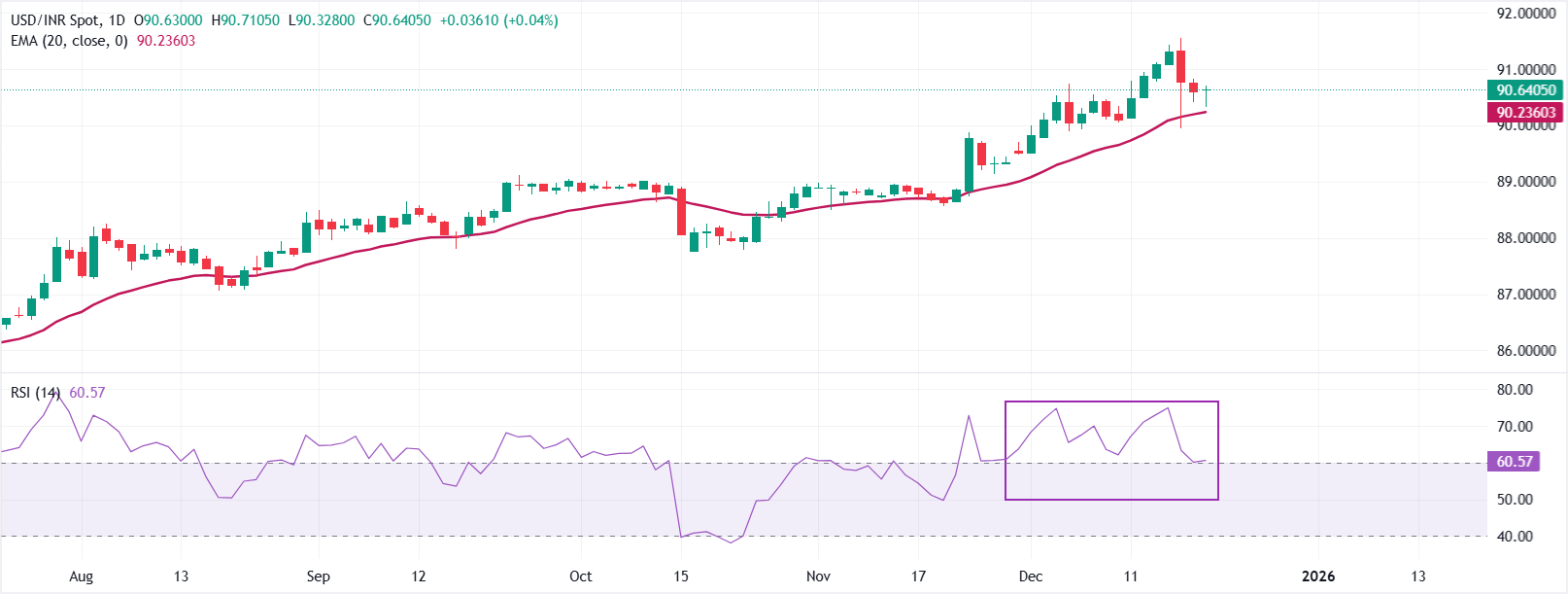
USD/INR recovers early losses and flattens around 90.6405 on Friday. The price holds above the ascending 20-day Exponential Moving Average (EMA) at 90.2360, which preserves the upside bias and indicates shallow pullbacks.
The 14-day Relative Strength Index (RSI) strives to gain ground near 60, sustaining hopes of a fresh upside move.
A close north of the EMA would keep the path open for revisiting the all-time high of 91.50. The price would enter uncharted territory if it breaks above that level. On the contrary, a breach below the 20-day EMA could trigger a broader pullback towards the December low of 89.52.
(The technical analysis of this story was written with the help of an AI tool.)
Inflation FAQs
Inflation measures the rise in the price of a representative basket of goods and services. Headline inflation is usually expressed as a percentage change on a month-on-month (MoM) and year-on-year (YoY) basis. Core inflation excludes more volatile elements such as food and fuel which can fluctuate because of geopolitical and seasonal factors. Core inflation is the figure economists focus on and is the level targeted by central banks, which are mandated to keep inflation at a manageable level, usually around 2%.
The Consumer Price Index (CPI) measures the change in prices of a basket of goods and services over a period of time. It is usually expressed as a percentage change on a month-on-month (MoM) and year-on-year (YoY) basis. Core CPI is the figure targeted by central banks as it excludes volatile food and fuel inputs. When Core CPI rises above 2% it usually results in higher interest rates and vice versa when it falls below 2%. Since higher interest rates are positive for a currency, higher inflation usually results in a stronger currency. The opposite is true when inflation falls.
Although it may seem counter-intuitive, high inflation in a country pushes up the value of its currency and vice versa for lower inflation. This is because the central bank will normally raise interest rates to combat the higher inflation, which attract more global capital inflows from investors looking for a lucrative place to park their money.
Formerly, Gold was the asset investors turned to in times of high inflation because it preserved its value, and whilst investors will often still buy Gold for its safe-haven properties in times of extreme market turmoil, this is not the case most of the time. This is because when inflation is high, central banks will put up interest rates to combat it. Higher interest rates are negative for Gold because they increase the opportunity-cost of holding Gold vis-a-vis an interest-bearing asset or placing the money in a cash deposit account. On the flipside, lower inflation tends to be positive for Gold as it brings interest rates down, making the bright metal a more viable investment alternative.







