

Trade The World
USD/INR bounces back as RBI cuts Repo Rate, announces liquidity stimulus
By Sagar Dua
Date Published: 5 Dec 2025 | Date Modified: 5 Dec 2025


POPULAR ARTICLES

The Indian Rupee (INR) falls back against the US Dollar (USD) on Friday, with the USD/INR pair recovering to near 90.25, following the Reserve Bank of India's (RBI) dovish monetary policy announcement.
- The Indian Rupee falls against the US Dollar after the RBI’s dovish monetary policy announcement.
- The RBI cuts Repo Rate by 25 bps to 5.25%, and announces an OMO worth Rs. 1 lakh crore.
- Investors expect the Fed to cut interest rates by 25 bps to 3.50%-3.75% next week.
The Indian Rupee (INR) falls back against the US Dollar (USD) on Friday, with the USD/INR pair recovering to near 90.25, following the Reserve Bank of India's (RBI) dovish monetary policy announcement. The RBI cuts its Repo Rate by 25 basis points (bps) to 5.25%, and announces to inject Rs. 1 lakh crore into the economy through Open Market Operations (OMO), a tool through which the Indian central bank purchases government securities and a three-year USD/INR swap of $5 billion in December.
The RBI has explained that members decided unanimously to lower borrowing rates amid cooling inflationary pressures. RBI Governor Sanjay Malhotra stated that the headline inflation has eased significantly and is likely to remain below projections.
The central bank has projected that both headline and core inflation will remain below 4% during the first half of 2026. For the current financial year, the RBI has revised inflation projections to 2.0% from 2.6% anticipated earlier. Taking strong cues from the Q3 Gross Domestic Product (GDP) data, the RBI has raised growth projections for the current fiscal year to 7.3% from 6.8%.
On the forex reserves front, the RBI stated that it holds a healthy USD 686 billion buffer that could provide import cover for more than 11 months . Governor Malhotra has also expressed confidence that the external sector remains "resilient", and the central bank is "confident of meeting its external financing requirements comfortably”.
A dovish monetary policy announcement by the RBI is expected to exert pressure on the Indian Rupee going forward, which is already facing the burden of continuous outflow of overseas funds from the Indian stock market amid tariff issues with the United States (US).
Foreign Institutional Investors (FIIs) have turned out to be net sellers in all four trading days of December, and have offloaded shares worth Rs. 9,964.72 crores in this period. Overseas investors have also remained net sellers in all months since July.
The table below shows the percentage change of Indian Rupee (INR) against listed major currencies today. Indian Rupee was the weakest against the Japanese Yen.
| USD | EUR | GBP | JPY | CAD | AUD | INR | CHF | |
|---|---|---|---|---|---|---|---|---|
| USD | -0.11% | -0.14% | -0.32% | -0.07% | -0.19% | 0.14% | -0.12% | |
| EUR | 0.11% | -0.03% | -0.23% | 0.05% | -0.06% | 0.24% | -0.00% | |
| GBP | 0.14% | 0.03% | -0.21% | 0.08% | -0.05% | 0.29% | 0.03% | |
| JPY | 0.32% | 0.23% | 0.21% | 0.29% | 0.15% | 0.47% | 0.22% | |
| CAD | 0.07% | -0.05% | -0.08% | -0.29% | -0.13% | 0.19% | -0.05% | |
| AUD | 0.19% | 0.06% | 0.05% | -0.15% | 0.13% | 0.33% | 0.06% | |
| INR | -0.14% | -0.24% | -0.29% | -0.47% | -0.19% | -0.33% | -0.25% | |
| CHF | 0.12% | 0.00% | -0.03% | -0.22% | 0.05% | -0.06% | 0.25% |
The heat map shows percentage changes of major currencies against each other. The base currency is picked from the left column, while the quote currency is picked from the top row. For example, if you pick the Indian Rupee from the left column and move along the horizontal line to the US Dollar, the percentage change displayed in the box will represent INR (base)/USD (quote).
Daily digest market movers: US Dollar falls back to five-week low amid dovish Fed bets
- The Indian Rupee falls against the US Dollar, even as the US Dollar struggles to hold its immediate lows. At the press time, the US Dollar Index (DXY), which tracks the Greenback’s value against six major currencies, retreats to near its five-week low around 98.75.
- The outlook of the US Dollar remains weak as the Federal Reserve (Fed) is widely anticipated to cut interest rates in its monetary policy meeting next week. According to the November 28-December 4 Reuters poll, 82% of economists surveyed predicted that the Fed would reduce its key borrowing rates by 25 basis points (bps) to 3.50%-3.75% to support deteriorating job market conditions.
- Upbeat Fed dovish expectations are contrary to October’s Federal Open Market Committee (FOMC) minutes, which showed that several members did not necessarily view a reduction in December as appropriate, while remaining confident that more rate cuts would be needed in the distant future.
- In the monetary policy meeting next week, investors would like to know how much the Fed will cut interest rates further if it decides to reduce the Federal Funds Rate by 25 bps. In addition, investors would also pay close attention to the Fed’s guidance on the labor market outlook.
- Meanwhile, labor demand has weakened significantly, partly driven by growing acceptance of Artificial Intelligence (AI) by firms. The US ADP reported on Thursday that the private sector shed 32K jobs in November, while it was expected to add 5K fresh workers.
- In Friday’s session, investors will focus on the US Personal Consumption Expenditure Price Index (PCE) data for September, which will be released on Friday.
Technical Analysis: USD/INR holds key 20-day EMA
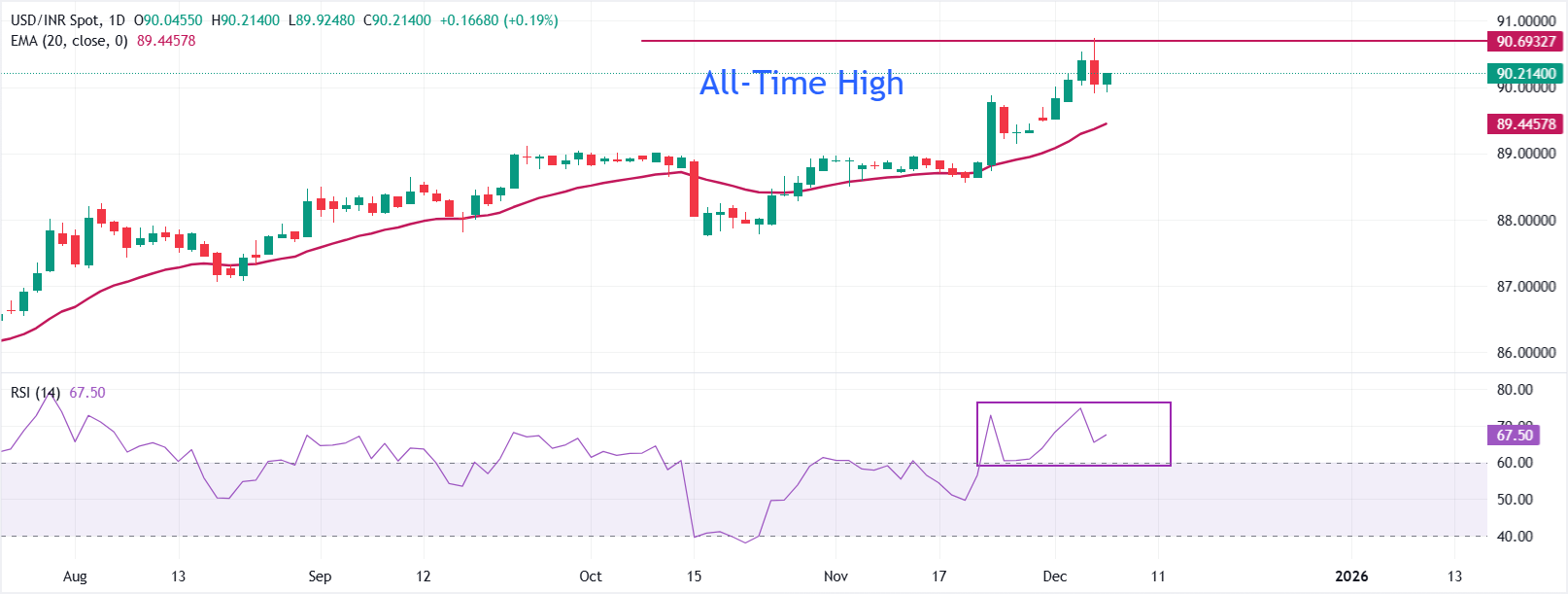
USD/INR rises to near 90.25 on Friday. The pair corrected on Thursday after posting a fresh all-time high around 90.70.
The 14-day Relative Strength Index (RSI) retraces to near 67.50 after turning overbought around 76.14, flagging a cool down in stretched momentum.
Initial support is the 20-day Exponential Moving Average (EMA) near 89.44; above this gauge, the uptrend would stay in place. On the upside, the pair could extend its rally towards 91.00.
Indian economy FAQs
The Indian economy has averaged a growth rate of 6.13% between 2006 and 2023, which makes it one of the fastest growing in the world. India’s high growth has attracted a lot of foreign investment. This includes Foreign Direct Investment (FDI) into physical projects and Foreign Indirect Investment (FII) by foreign funds into Indian financial markets. The greater the level of investment, the higher the demand for the Rupee (INR). Fluctuations in Dollar-demand from Indian importers also impact INR.
India has to import a great deal of its Oil and gasoline so the price of Oil can have a direct impact on the Rupee. Oil is mostly traded in US Dollars (USD) on international markets so if the price of Oil rises, aggregate demand for USD increases and Indian importers have to sell more Rupees to meet that demand, which is depreciative for the Rupee.
Inflation has a complex effect on the Rupee. Ultimately it indicates an increase in money supply which reduces the Rupee’s overall value. Yet if it rises above the Reserve Bank of India’s (RBI) 4% target, the RBI will raise interest rates to bring it down by reducing credit. Higher interest rates, especially real rates (the difference between interest rates and inflation) strengthen the Rupee. They make India a more profitable place for international investors to park their money. A fall in inflation can be supportive of the Rupee. At the same time lower interest rates can have a depreciatory effect on the Rupee.
India has run a trade deficit for most of its recent history, indicating its imports outweigh its exports. Since the majority of international trade takes place in US Dollars, there are times – due to seasonal demand or order glut – where the high volume of imports leads to significant US Dollar- demand. During these periods the Rupee can weaken as it is heavily sold to meet the demand for Dollars. When markets experience increased volatility, the demand for US Dollars can also shoot up with a similarly negative effect on the Rupee.

FXStreet
More than a million users rely on FXStreet for real-time market data, charting tools, expert insights, and forex news. Its comprehensive economic calendar and educational webinars help traders stay informed and make calculated decisions. FXStreet is supported by a team of about 60 professionals, split between the Barcelona headquarters and various global regions.
Read More








