Key Takeaways
Triple Top = Bearish Reversal: Three equal peaks at resistance after an uptrend. Confirmed on a neckline break below support.
Triple Bottom = Bullish Reversal: Three equal troughs at support after a downtrend. Confirmed on a neckline break above resistance.
Neckline Break is a strong Confirmation: Best approach is to not trade peaks or troughs. Wait for a full daily or weekly candle close beyond the neckline.
Volume Confirms Intent: Volume declines across the three tests. A volume surge on the breakout confirms the reversal.
Minimum 2:1 Reward-to-Risk Required: Stop above the third peak (Triple Top) or below the third trough (Triple Bottom). Skip any setup that cannot achieve 2:1.
What Are Triple Top and Triple Bottom Patterns?
The triple top pattern and triple bottom pattern are classical reversal formations in technical analysis. The price action mechanism behind it signal that a dominant trend is losing strength after three failed attempts to break a key price level, shifting control from buyers to sellers in a triple top, or from sellers to buyers in a triple bottom.
Each pattern consists of three peaks or three troughs at approximately the same level. Between these tests, price pulls back or rallies to form the neckline. The pattern is structurally incomplete until price closes beyond the neckline, which acts as the trade trigger. Both patterns usually develop through the same sequence: first test, pullback or rally, second test, third failed test, then neckline confirmation.
The triple top chart pattern and triple bottom chart pattern appear across Forex, Gold, crypto, and other markets. They are generally more reliable on the Daily and Weekly timeframes, where each test reflects more meaningful participation at the key level.
Triple Top Pattern
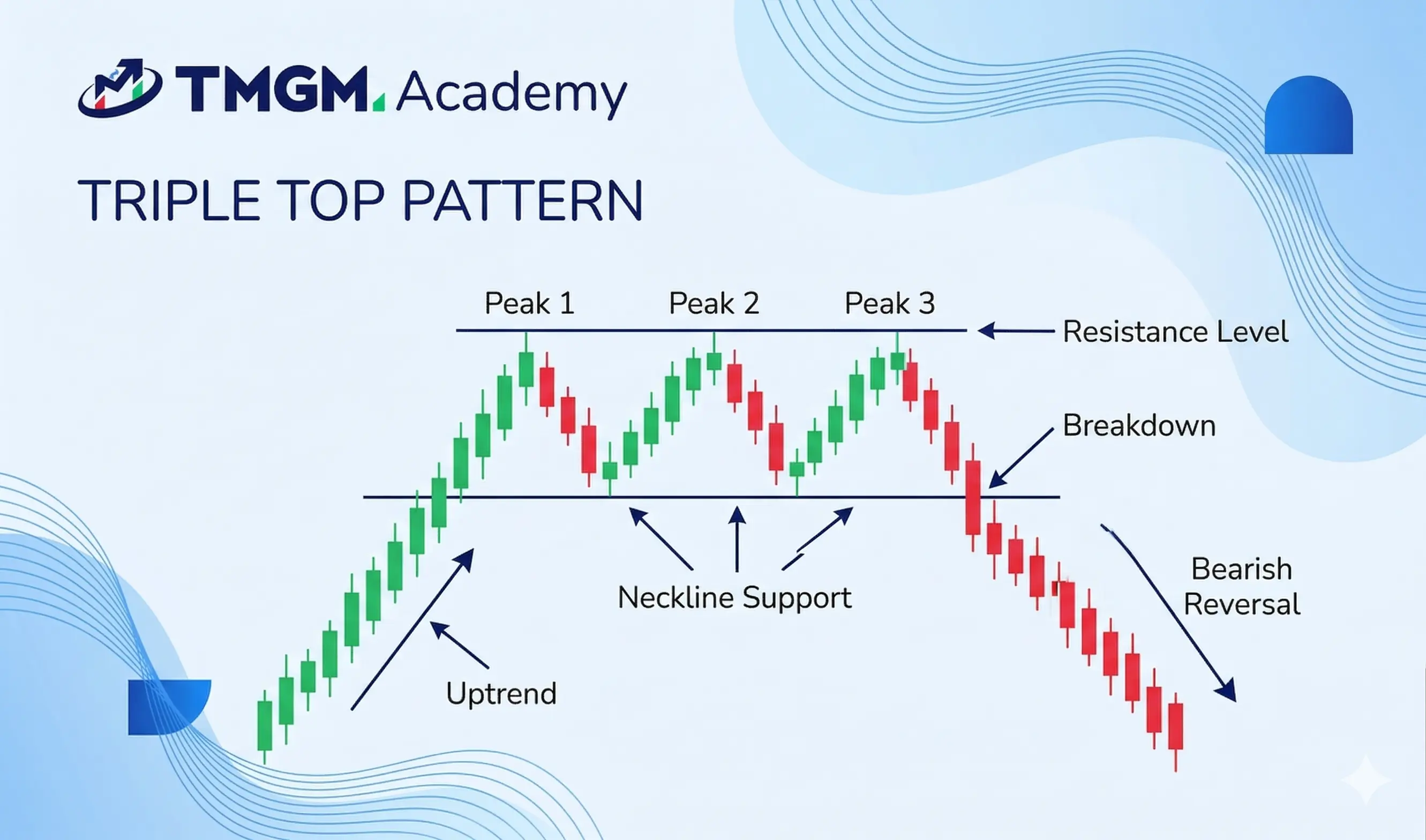
The triple top pattern is a bearish reversal chart pattern. Price rallies to a resistance level three times, fails to break above it on each attempt, then closes below neckline support, signalling a shift in control from bulls to bears.
The three peaks form at approximately the same price. Volume typically declines across the repeated tests, reflecting weakening buying pressure, then expands on the breakdown. The neckline connects the two swing lows between the peaks and serves as the confirmation level.
Triple Bottom Pattern
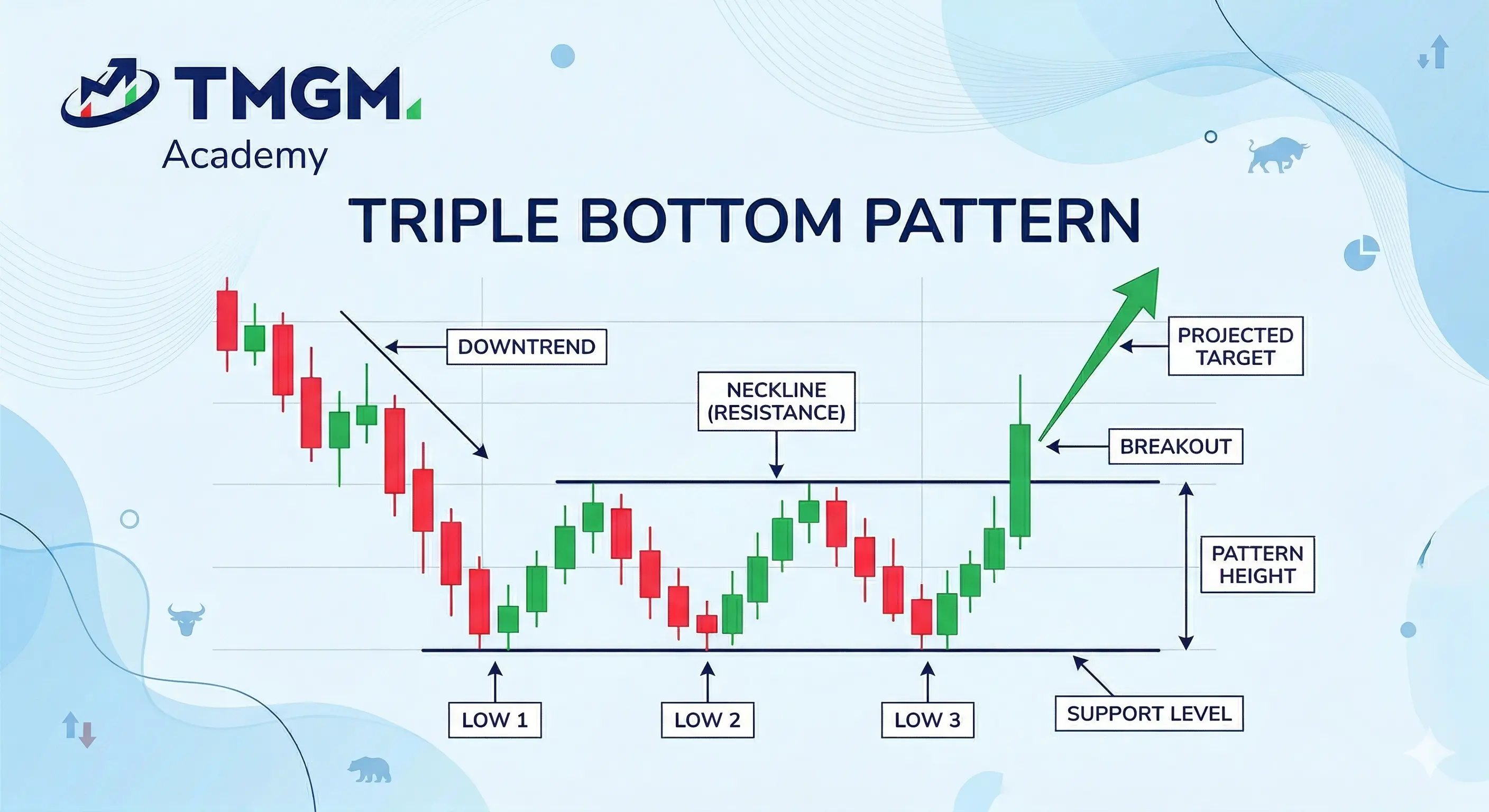
The triple bottom pattern is a bullish reversal chart pattern. Price falls to a support level three times, fails to break below it on each test, then closes above neckline resistance, signalling a shift in control from bears to bulls.
The three troughs form at approximately the same price. Volume typically fades during the repeated tests, then increases on the breakout, showing that selling pressure is weakening and buyers are taking control. The neckline connects the two swing highs between the troughs and acts as the confirmation level.
Triple Top Pattern vs. Triple Bottom Pattern: Key Differences
The triple top chart pattern and triple bottom chart pattern share the same three-test structure but differ in directional bias, entry logic, and market context. Applying the wrong execution rules to either pattern is one of the most common structural errors in triple bottom trading.
Both patterns share structural traits:
Three clear tests of a horizontal level
A defined neckline (support or resistance)
Decreasing momentum before breakout
Volatility contraction before expansion
Strong breakout candle for confirmation
Pro Tip: Without a decisive confirmation break, the structure is consolidation — not a reversal.
Pro Tip
Try not to enter the triple top pattern or triple bottom pattern at the third peak or trough. Anticipating the third failure without neckline confirmation is the most common — and often costliest — risk.
Triple Top and Triple Bottom Pattern Validation Checklist
Use this checklist to decide whether a triple top or triple bottom is structurally valid and ready for confirmation. The goal is not just to spot three equal highs or lows, but to confirm that the pattern has formed in the right context and triggered with the right signals.
1. Pre Breakout Validation
Prior trend:
A triple top should form after a clear uptrend, while a triple bottom should form after a clear downtrend. Without a meaningful trend before the pattern, the setup carries less reversal value.Three level tests:
The three peaks in a triple top, or the three troughs in a triple bottom, should form at approximately the same price level. Large variation between the three tests weakens the pattern.Neckline clarity:
The neckline should connect two clear swing lows in a triple top or two clear swing highs in a triple bottom. If the neckline is difficult to define, the structure is weak.Volume behaviour during formation:
Volume should generally fade across the three tests. In a triple top, this suggests buying pressure is weakening. In a triple bottom, it suggests selling pressure is fading.Higher timeframe context:
Patterns are stronger when they align with the broader market structure on the Daily or Weekly chart. Lower timeframe setups that fight the higher timeframe trend tend to be less reliable.
2. Breakout Confirmation
Neckline break:
The pattern is only confirmed when price closes beyond the neckline. For a triple top, price must close below support. For a triple bottom, price must close above resistance. An intraday wick is not enough.Breakout volume:
Volume should expand on the breakout candle. This shows that the reversal is gaining participation and is less likely to fail immediately.Momentum confirmation:
RSI divergence can strengthen the setup. In a triple top, price may print similar highs while RSI makes lower highs. In a triple bottom, price may print similar lows while RSI makes higher lows. MACD can also support confirmation if the crossover happens on or after the neckline break.Retest quality:
A retest of the neckline after the breakout often provides the cleaner entry. In a triple top, former support should act as resistance. In a triple bottom, former resistance should act as support.
Bulkowski's data shows a 65% throwback rate on triple bottom patterns — giving traders a second, tighter entry. Triple Top: look for rejection at the neckline with RSI failing to reclaim 50. Triple Bottom: look for a bounce at the neckline with RSI holding above 50. – [Bulkowski TN. Triple Bottoms — Statistical Performance Data. ThePatternSite.com]
How to Trade the Triple Top Pattern and Triple Bottom Pattern
Triple bottom trading and triple top trading both follow a four-point execution framework: Entry, Stop, Target, and Retest. Every element must be defined before entering the trade. Never adjust your stop after entry to accommodate a losing position.
Triple Top Pattern: Execution
Entry: Sell on a confirmed daily close below the neckline. A more conservative entry is to wait for a retest of the neckline from below and sell the rejection.
Stop-Loss: Place the stop above the highest of the three peaks, with a 0.5 to 1 ATR buffer where needed.
Target (Measured Move): Use the measured move. Measure the vertical distance from the highest peak to the neckline, then project that distance downward from the breakout level. A minimum 2:1 reward to risk ratio is preferred where possible. Partial profits can be taken at 1R, with the remainder trailed toward the full target.
Retest Entry: Former neckline support becomes resistance. A failed retest often provides a tighter stop and better reward to risk than the initial breakdown.
Triple Bottom Pattern: Execution (Triple Bottom Trading)
Entry: Buy on a confirmed daily close above the neckline. A more conservative entry is to wait for a retest of the neckline from above and buy the bounce.
Stop-Loss: Place the stop below the lowest of the three troughs, with a 0.5 to 1 ATR buffer where needed.
Target (Measured Move): Use the measured move. Measure the vertical distance from the lowest trough to the neckline, then project that distance upward from the breakout level. The target should justify the stop distance, with at least a 2:1 reward to risk ratio where possible. Partial profits can be taken at 1R, with the remainder trailed toward the full target.
Retest Entry: Former neckline resistance becomes support. A successful retest often provides a tighter stop and better reward to risk than chasing the breakout.
Measured Move Example: If a triple top forms with peaks at 1.3000 and a neckline at 1.2700, the pattern height is 300 pips. Projecting that distance below the neckline gives a target of 1.2400.
Important: The neckline retest is often the cleaner entry because it confirms that the broken level has flipped its role. This usually gives a tighter stop and a better reward to risk profile than entering the initial breakout.
Risk-Reward Planning
Compare the projected target to your stop distance. A minimum 2:1 reward-to-risk ratio is generally preferred to justify the setup.
Partial Exits
Consider scaling out at 1R and holding the remainder toward the full measured move. This balances profit protection with trend participation.
Should You Trade the Triple Top Pattern or Triple Bottom Pattern? Decision Framework
A textbook-perfect triple top pattern or triple bottom chart pattern does not guarantee a trade. Every setup must pass this six-filter decision matrix. Failing more than two filters is a signal to skip the setup.
How to Learn Triple Top and Triple Bottom Chart Patterns
Study Historical Charts: Use TradingView to manually scan completed Triple Top and Triple Bottom formations. Focus on volume profile, neckline structure, and whether the measured move target was achieved.
Paper Trade First: Execute 20–30 simulated trades on live market data before risking real capital. Track win rate, average reward-to-risk, and measured move accuracy.
Start on Higher Timeframes: Learn to identify the pattern on Daily and Weekly charts first. A Triple Bottom on a Weekly chart carries significantly more weight than the same pattern on a 15-minute chart.
Study the Source Material: Thomas Bulkowski's Encyclopedia of Chart Patterns (John Wiley & Sons) is the most data-backed reference available. His free website ThePatternSite.com provides pattern statistics, real chart examples, and trading lessons.
Advantages and Limitations of Triple Top and Triple Bottom Patterns
FAQ (People Also Ask)
What is the pattern of triple tops and triple bottoms?
Triple Tops and Triple Bottoms are reversal chart patterns where price tests a key level three times before a breakout confirms a trend change. Triple Tops signal bearish reversals, while Triple Bottoms signal bullish reversals after extended trends.
What is the 3 5 7 rule in trading?
The 3-5-7 rule refers to a trade management guideline: risk no more than 3% per trade, target 5% monthly growth, and allow no more than 7 consecutive losses before reevaluating strategy. It promotes disciplined capital preservation.
Is a triple top bullish?
A triple top is not bullish. A Triple Top is a bearish reversal formation that occurs after an uptrend and signals potential downside once price breaks below the neckline support level.