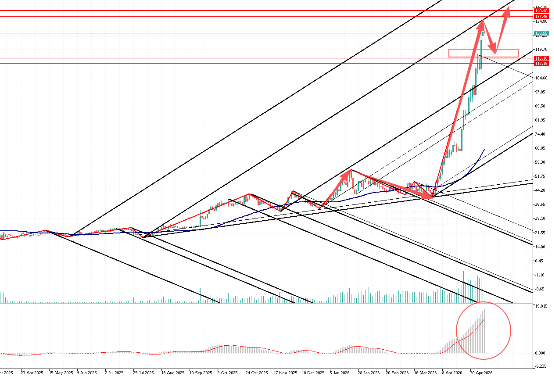
Why Has Intel’s Share Price Continued to Surge Recently?
After more than a year of negotiations, Intel and Apple have finally reached an initial agreement under which Intel will manufacture processors for Apple products. This development marks a significant milestone for Intel’s struggling foundry business, which has faced ongoing losses and heavy skepticism from industry analysts.
The US government reportedly played a key role in facilitating the deal, having previously converted US$9 billion in subsidies into Intel equity, giving it an ownership stake of approximately 10%.
Overall, the Apple foundry agreement is viewed as the most decisive recent catalyst for Intel, transforming the narrative around its foundry business from a loss-making internal operation into a credible external revenue source.

The cooperation agreement with Apple is also supported by solid fundamentals. Intel’s first-quarter earnings significantly exceeded Wall Street expectations, with adjusted earnings per share reaching US$0.29, far above the market forecast of US$0.01. Revenue came in at US$13.58 billion, surpassing the consensus estimate of US$12.42 billion.
Intel’s data center business delivered the strongest performance, with revenue rising 22% year-on-year to US$5.1 billion, driven by robust demand for CPUs supporting artificial intelligence workloads.
During the earnings call, Intel’s CEO shared his perspective on the company’s transformation, stating that CPUs are re-establishing themselves as an indispensable foundation in the AI era. He emphasized that this is not merely wishful thinking, but reflects direct feedback from customers.
From a sector-wide perspective, the global semiconductor industry has added approximately US$3.8 trillion in market capitalization over the past six weeks, with momentum expanding beyond AI processors into traditional CPUs and memory chips.
For Intel, success in this partnership will depend on proving that its manufacturing capabilities can meet Apple’s highly demanding supplier standards. The timing of the announcement and the market’s strong reaction clearly reflect investors’ growing optimism toward Intel’s foundry prospects.
Bank of America recently raised its target price for Intel, mainly based on a new sum-of-the-parts valuation framework and a more optimistic outlook for the server CPU market. The bank now forecasts the server CPU market could reach US$120 billion by 2030, significantly higher than its previous estimate of US$80 billion.
In the near term, Apple’s M-series chips used in MacBooks and iPads are viewed as the most likely entry point for Intel, with the potential to later expand into Apple’s A-series processors used in iPhones.
Market Analysis
However, before the cooperation terms become fully finalized, Intel has not yet incorporated the Apple partnership into its official financial projections.
Even if the partnership is formally announced, the company will still face a two-to-three-year cycle involving capital expenditure, qualification certification, and production ramp-up.
Due to factors such as depreciation pressure, lower initial yields, and startup costs, profit margins could remain under pressure during the early stages.
Intel’s original goal of achieving operational break-even for its foundry business by 2027 may therefore be delayed by another one to two years.