

Trading
Explorez une large gamme de marchés avec des prix compétitifs, une liquidité profonde et des outils de trading avancés.
En savoir plus 
Plateforme
Tradez en toute fluidité avec la plateforme puissante de TMGM, conçue pour la vitesse, la précision et une expérience de trading supérieure.
En savoir plus Plateforme de trading
Outils de trading
Académie
Apprenez les fondamentaux du trading avec des ressources adaptées aux débutants, incluant des guides, des webinaires et des analyses de marché.
En savoir plus Actualités et analyses
Obtenez des mises à jour de marché en temps réel et des analyses d'experts pour anticiper les opportunités de trading
En savoir plus Actualités et analyses
À propos
Découvrez ce qui distingue TMGM — notre présence mondiale, notre solidité réglementaire et notre engagement envers l'innovation dans le trading.
En savoir plus Pourquoi choisir TMGM
[TMGM Financial Breakfast] War Escalates! Trump’s 48-Hour Ultimatum Sparks Market Panic, Gold Prices Continue to Slide
The conflict has entered its fourth week. Since the joint U.S.-Israel strikes on Iran on February 28, thousands have been killed across the Middle East, and the fighting has spread throughout the region. The latest flashpoint came from U.S. President Donald Trump, who issued a dramatic ultimatum on social media last Saturday: if Iran does not fully and unconditionally reopen the Strait of Hormuz within 48 hours, the United States will completely destroy Iran’s largest power plant. This marks a 180-degree reversal from his previous day’s comments suggesting de-escalation.

Iran responded just as forcefully. The Islamic Revolutionary Guard Corps stated that if the U.S. strikes Iran’s power facilities, the Strait would be completely closed until reconstruction is complete. Iran’s parliamentary speaker warned that if its infrastructure is attacked, all energy and oil facilities across the Middle East would become legitimate targets, potentially driving oil prices sharply higher for an extended period.
The Middle East crisis has directly pushed energy prices to their highest levels since July 2022, with gains nearing 50% this month. Iran’s attacks on a Kuwaiti refinery and the closure of the Strait of Hormuz have caused European natural gas prices to surge 35% in just one week. The U.S. is also deploying thousands of additional Marines and naval personnel, further intensifying concerns over oil supply disruptions.
Rising energy prices are now feeding through global supply chains. Europe, which relies more heavily on imported energy, faces particularly severe inflationary pressure. Although gold is traditionally seen as a hedge against inflation, expectations of higher interest rates driven by soaring oil prices have become the biggest bearish factor for gold.
Before the conflict, markets expected the Federal Reserve to cut rates twice in 2026. Now, many believe even one rate cut is unlikely, with the possibility of rate hikes instead. A stronger U.S. dollar reduces gold’s appeal to non-dollar holders, while higher interest rates increase the opportunity cost of holding non-yielding assets like gold. Precious metals are therefore under pressure, and after this week’s sharp correction driven by rate-hike fears, price movements are likely to remain volatile.
Despite the current bearish pressure, if the Middle East conflict continues to escalate—especially if the Strait of Hormuz remains closed or key infrastructure is attacked—oil prices could hit new highs. Inflation may spiral out of control, and gold’s safe-haven appeal could ultimately outweigh interest rate pressures, pushing it back into a strong upward trend.
Market Analysis:
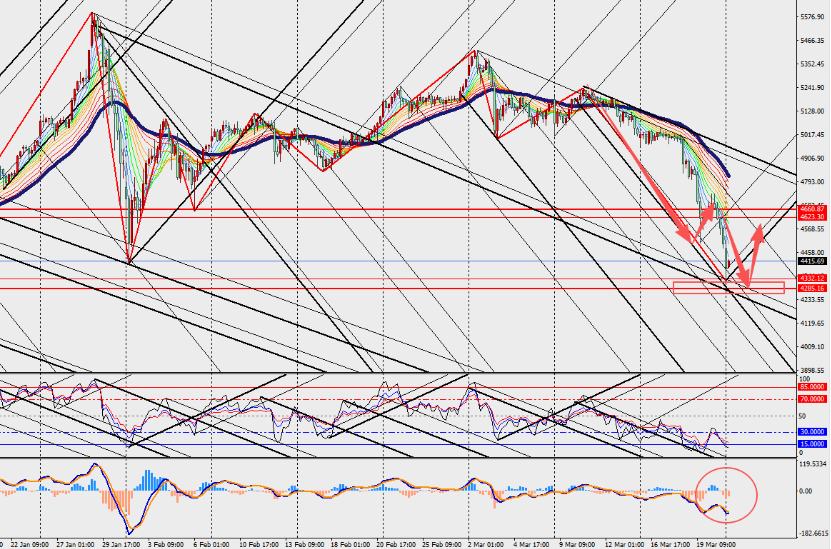
On the 4-hour chart, gold has fallen sharply. The MACD lines and histogram are showing a converging bullish divergence below the zero axis. This gold movement, triggered by the Middle East conflict, is far from ordinary volatility—it reflects a convergence of three major forces: global inflation, interest rates, and geopolitical risk. The battle around the $4,300 level has just begun. Investors should closely monitor three key signals: the Strait of Hormuz, Trump’s statements, and oil price fluctuations.
ARTICLES POPULAIRES
1Copper: Chinese tightness supports prices despite weak positioning – ING2Silver Price Forecast: Daily range holds, but 4-hour chart turns bearish3US Dollar: Growth edge narrative supports gains – BBH4NEAR partners with Ondo to bring tokenized US stocks, ETFs with confidential execution5Swiss Franc: Range-bound trading outlook against US Dollar – UOB6US Dollar Index: Rally extend to near 101.00 as hawkish Fed narrative takes hold7Euro rallies against a weak British Pound as UK business activity disappoints8Swedish Krona: Growth and future rate outlook favour SEK – Societe Generale9Crypto Today: Bitcoin and Ethereum consolidate gains as XRP extends breakout
COTATIONS EN DIRECT


TOUT SUR FOREX
Commencez !
Inscrivez-vous et accédez aux Marchés Mondiaux en moins de 3 minutes

Connectez-vous avec Nous









Contacts
Téléphone: +61 2 8036 8388
Fax: +61 2 8036 8388
Email: support@tmgm.com
Web: https://www.tmgm.com



Les informations fournies sur ce site web sont de nature générale uniquement et ne constituent pas un conseil financier personnalisé. Avant d’agir sur la base de toute information figurant sur ce site web, vous devez évaluer la pertinence de ces informations au regard de vos objectifs, de votre situation financière et de vos besoins. Investir dans les CFD et les contrats de marge sur le Forex comporte des risques importants et ne convient pas à tous les investisseurs. Vous pouvez perdre plus que votre dépôt initial. Vous ne détenez pas, et n’avez, aucun droit de propriété ou intérêt sur l’actif sous-jacent. Nous vous recommandons de solliciter un avis indépendant et de vous assurer que vous comprenez pleinement les risques encourus avant de trader. Il est important que vous lisiez et preniez en considération le document d’information avant d’acquérir tout produit présenté sur le site web. Les informations et publicités proposées sur ce site web ne sont pas destinées à être utilisées par toute personne dans tout pays ou toute juridiction où une telle utilisation serait contraire aux lois et réglementations locales. Les Produits et Services proposés sur ce site web ne sont pas destinés aux résidents des États-Unis, de la Malaisie et de la Thaïlande.
TMGM est autorisé et réglementé dans diverses juridictions.
Trademax Australia Limited, opérant sous le nom de TMGM, est réglementé par l'Australian Securities and Investments Commission (ASIC), AFSL no. 436416 et est situé au Level 28, One International Tower, 100 Barangaroo Avenue, 2000 Sydney, NSW Australie.
Email: support@tmgm.com.au
Trademax Global Limited, opérant sous le nom de TMGM, est autorisé et réglementé par la Vanuatu Financial Services Commission (VFSC), numéro d'enregistrement 40356 et enregistré au 1276, Kumul Highway, Port Vila, Vanuatu, République de Vanuatu.
Email: support@tmgm.com
Trademax Global Markets (SE) Limited, exerçant sous le nom TMGM, est autorisée et régulée par la Financial Services Authority (FSA) des Seychelles, sous le numéro de licence SD224. La société est enregistrée au bureau n° 13, Providence Estate ABIS Centre, Mahé, Seychelles.
Email: support@tmgm.com
Trademax Global Markets (International) Pty Ltd, opérant sous le nom de TMGM, est autorisé et réglementé par la Financial Services Commission, Maurice (FSC) avec la licence no. GB22201012, et enregistré au 33, Edith Cavell Street C/o IQ EQ Fund Services (Mauritius) Ltd Port Louis, 11324 Maurice.
Email: support@tmgm.com
Copyright © TMGM. Tous droits réservés