

Dow Jones Industrial Average surges as a possible US-Iran deal lands within hours
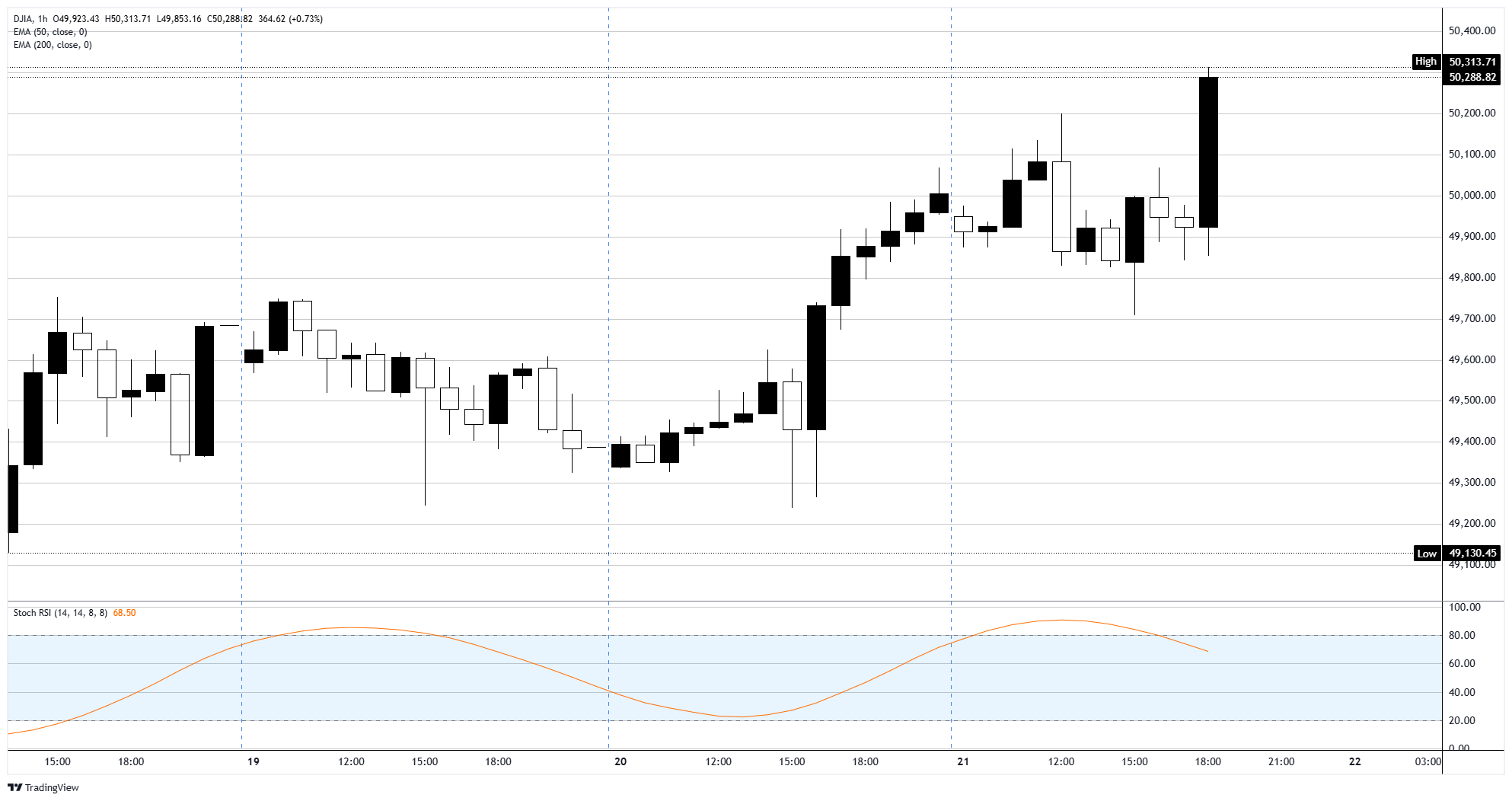
- The Dow reversed a midday slump to rip to fresh session highs, pushing toward 50,350 late in the day after reports that a final US-Iran agreement could be announced within hours.
- Peace is the risk-on trade. A deal that cools Oil takes the edge off the inflation scare that has kept the Fed boxed in and yields elevated.
- The timing is almost too neat, with rate-cut champion Kevin Warsh sworn in as Fed chair on Friday just as a de-escalation reopens the door to the easing he wants.

For most of Thursday the Dow Jones Industrial Average looked heavy, sliding to a session low near 49,700 as firmer Oil and a stubborn rise in yields did the work a static Federal Reserve (Fed) would not. Then the headline hit. Iranian state media, citing Al Arabiya, reported that a final draft of a US-Iran agreement had been reached through Pakistani mediation and could be announced within hours. The index ripped, erasing the slump and powering back above 50,000 to print fresh session highs toward 50,350 at the time of writing. The mechanism is straightforward. The single biggest weight on this market has been a war that kept Oil bid and inflation sticky, and a deal threatens to lift it.
Why a peace deal is a rate story
The reason equities care so much about a far-off chokepoint is that it runs straight through the inflation pipeline. Crude pushing toward triple digits has been one of the main reasons the most recent inflation reading sits near 4% YoY, well above the 2% target, and one of the main reasons Fed funds futures have priced the central bank on hold through the rest of 2026 with a rising tail risk of a hike. Take Oil out of the equation and that arithmetic softens fast. A deal that cools energy prices is a deal that hands the Fed room it does not currently have. The Dow, packed with rate-sensitive industrials and financials, is the index that benefits most directly, which is why it led the afternoon charge.
Yields and mortgages were the bear case, and the deal undercuts them
Before the headline, the bond market had been tightening on its own. The 10-year Treasury yield pushed back toward the mid-4% area as firmer Oil revived inflation fears, and the 30-year mortgage rate climbed to around its highest since last summer, closing in on the 7% mark. That was the squeeze pressuring the rate-sensitive corners of the tape. A credible de-escalation pulls the rug from under that trade. Lower Oil means lower breakevens, lower breakevens mean lower yields, and lower yields mean relief for everything from homebuilders to financials. Thursday's data did little to settle the direction on its own, with firm housing starts and Initial Jobless Claims near 209K running into a Philadelphia Fed manufacturing survey that collapsed into negative territory. The deal headline simply overwhelmed all of it.
The catch the rally is ignoring
Here is the discomfort. The market has bought the peace trade before and been burned. Deadlines slipped through March and April, ceasefires were declared and then broken, and the mediators briefing reporters are still describing an agenda for talks rather than a signed agreement. Tehran and Washington remain apart on the length of any nuclear freeze, and Pakistan's army chief is reportedly heading to Tehran because the gap is not closed. So Thursday's surge is the market front-running an announcement, not banking a result. If the deal slips again, the Oil premium and the yield squeeze come straight back, and the Dow gives this move back as quickly as it took it.
What Friday brings
The new era starts in earnest tomorrow. Kevin Warsh, the rate-cut champion President Trump installed after the closest Fed chair confirmation vote in modern history, is sworn in as chair, with outgoing chair Jerome Powell keeping his board seat and his vote. The swearing-in is ceremonial, but any early read on tone will be parsed hard, especially if a deal has reshaped the inflation outlook overnight. More tradeable is the University of Michigan (UoM) sentiment release, where consensus sees 1-year inflation expectations near 4.5% and the 5-year measure around 3.4%. A cooler print, helped along by falling Oil, would hand the new chair the cover he needs. A speech from Fed governor Christopher Waller offers another chance for the rate path to wobble. The irony writes itself: Warsh spent months arguing there was room to cut, and a peace deal he had nothing to do with may be the thing that finally proves him right.
Dow Jones 60-minute chart
Dow Jones FAQs
The Dow Jones Industrial Average, one of the oldest stock market indices in the world, is compiled of the 30 most traded stocks in the US. The index is price-weighted rather than weighted by capitalization. It is calculated by summing the prices of the constituent stocks and dividing them by a factor, currently 0.152. The index was founded by Charles Dow, who also founded the Wall Street Journal. In later years it has been criticized for not being broadly representative enough because it only tracks 30 conglomerates, unlike broader indices such as the S&P 500.
Many different factors drive the Dow Jones Industrial Average (DJIA). The aggregate performance of the component companies revealed in quarterly company earnings reports is the main one. US and global macroeconomic data also contributes as it impacts on investor sentiment. The level of interest rates, set by the Federal Reserve (Fed), also influences the DJIA as it affects the cost of credit, on which many corporations are heavily reliant. Therefore, inflation can be a major driver as well as other metrics which impact the Fed decisions.
Dow Theory is a method for identifying the primary trend of the stock market developed by Charles Dow. A key step is to compare the direction of the Dow Jones Industrial Average (DJIA) and the Dow Jones Transportation Average (DJTA) and only follow trends where both are moving in the same direction. Volume is a confirmatory criteria. The theory uses elements of peak and trough analysis. Dow’s theory posits three trend phases: accumulation, when smart money starts buying or selling; public participation, when the wider public joins in; and distribution, when the smart money exits.
There are a number of ways to trade the DJIA. One is to use ETFs which allow investors to trade the DJIA as a single security, rather than having to buy shares in all 30 constituent companies. A leading example is the SPDR Dow Jones Industrial Average ETF (DIA). DJIA futures contracts enable traders to speculate on the future value of the index and Options provide the right, but not the obligation, to buy or sell the index at a predetermined price in the future. Mutual funds enable investors to buy a share of a diversified portfolio of DJIA stocks thus providing exposure to the overall index.














