

Gold climbs before Warsh’s Fed debut as hawkish tilt looms
- US Retail Sales strength challenges claims that policy is restrictive.
- Fed dot plot could revive year-end hike speculation.
- Trump’s Iran warning keeps geopolitical risks in focus.
Gold (XAU/USD) price rises 0.77% on Wednesday as traders await the Federal Reserve’s (Fed) monetary policy decision, the first one led by Kevin Warsh, in which the central bank is expected to keep rates steady amid the jump in inflation sparked by the Iran war. At the time of writing, the XAU/USD pair trades at $4,358 after bouncing off daily lows of $4,317.

XAU/USD rises as traders brace for Fed projections
The yellow metal advances amid growing speculation that the Fed could turn slightly hawkish in Warsh’s first meeting at the central bank. Last week, the US CPI and PPI prints were higher than expected, and a strong May Retail Sales report suggests that policy is not as tight as some Fed officials have expressed.
In addition to the Fed’s decision, officials will update their economic projections regarding GDP, inflation and the path of interest rates towards the end of 2026.
US Retail Sales for May rose 0.9% MoM, beating the 0.5% forecast, as per the US Census Bureau. Gas station sales were up 3.4% due to higher gasoline prices amid Iran tensions. The data shows consumer resilience, with 11 of 13 categories growing.
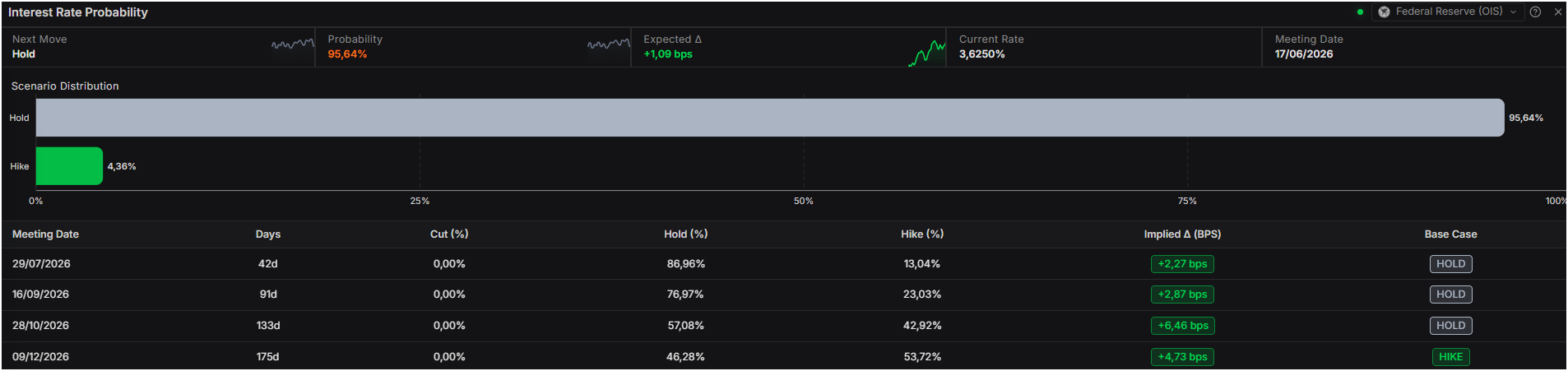
So far, Prime Terminal data shows that traders estimate a 20% probability that the Federal Reserve might increase interest rates by the end of 2026.
US Treasury yields remained steady ahead of the Fed’s decision. The US 10-year Treasury note yield is flat at 4.432%. The Greenback is posting modest gains of 0.01% according to the US Dollar Index (DXY). The DXY, which measures the buck’s value against a basket of six peers, is at 99.69.
Geopolitical noise has tempered since the US and Iran agreed on a Memorandum of Understanding (MOU) setting the stage for a 60-day truce, aimed at talking about Tehran’s nuclear program and that they are not allowed to acquire nuclear weapons. Earlier, US President Donald Trump said that the agreement is not final and that he could resume bombing if Iran does not behave.
XAU/USD technical outlook: Gold advances, but stalls near $4,400
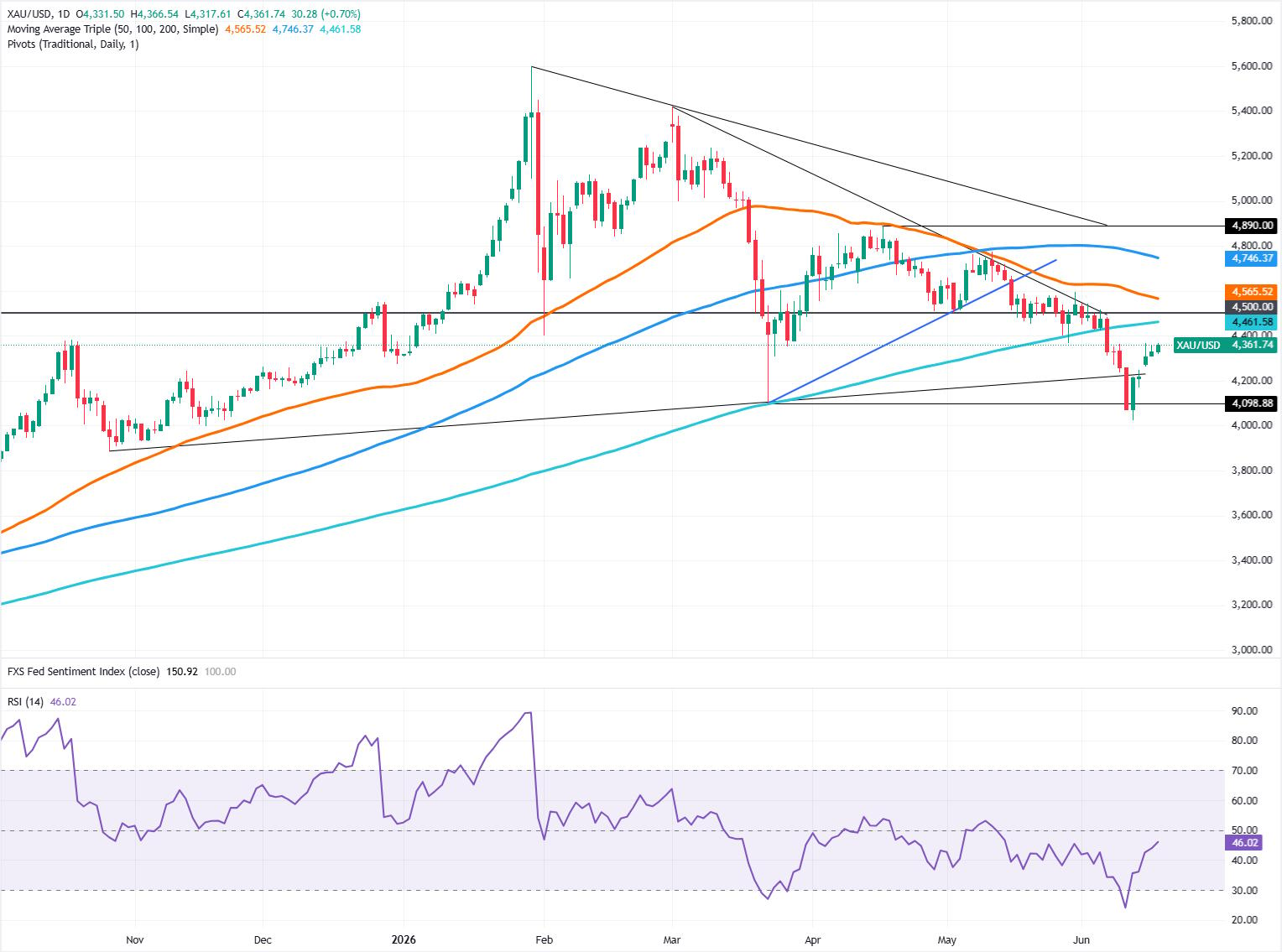
Gold price remains in a sideways rotation, with investors waiting for Warsh’s first policy decision. Momentum remains mixed, as depicted by the Relative Strength Index (RSI). The RSI is aiming upwards, though in bearish territory, a reading that hints caution.
If XAU/USD clears the 200-day Simple Moving Average (SMA) decisively at $4,458, the next resistance would be the $4,500 milestone. Above this area sits the 50-day SMA at $4,571.
Downwards, Gold’s first support is the June 15 swing low of $4,262, ahead of the $4,200 psychological level. Below this area, the next area of interest would be the June 11 swing low of $4,023, ahead of the $4,000 mark.
Gold FAQs
Gold has played a key role in human’s history as it has been widely used as a store of value and medium of exchange. Currently, apart from its shine and usage for jewelry, the precious metal is widely seen as a safe-haven asset, meaning that it is considered a good investment during turbulent times. Gold is also widely seen as a hedge against inflation and against depreciating currencies as it doesn’t rely on any specific issuer or government.
Central banks are the biggest Gold holders. In their aim to support their currencies in turbulent times, central banks tend to diversify their reserves and buy Gold to improve the perceived strength of the economy and the currency. High Gold reserves can be a source of trust for a country’s solvency. Central banks added 1,136 tonnes of Gold worth around $70 billion to their reserves in 2022, according to data from the World Gold Council. This is the highest yearly purchase since records began. Central banks from emerging economies such as China, India and Turkey are quickly increasing their Gold reserves.
Gold has an inverse correlation with the US Dollar and US Treasuries, which are both major reserve and safe-haven assets. When the Dollar depreciates, Gold tends to rise, enabling investors and central banks to diversify their assets in turbulent times. Gold is also inversely correlated with risk assets. A rally in the stock market tends to weaken Gold price, while sell-offs in riskier markets tend to favor the precious metal.
The price can move due to a wide range of factors. Geopolitical instability or fears of a deep recession can quickly make Gold price escalate due to its safe-haven status. As a yield-less asset, Gold tends to rise with lower interest rates, while higher cost of money usually weighs down on the yellow metal. Still, most moves depend on how the US Dollar (USD) behaves as the asset is priced in dollars (XAU/USD). A strong Dollar tends to keep the price of Gold controlled, whereas a weaker Dollar is likely to push Gold prices up.













