

Gold rebounds from one-month lows as ceasefire lifts buying interest
- Gold recoveres as the fragile US-Iran ceasefire improves overall risk sentiment.
- Lower Treasury yields and a softer US Dollar help bullion regain traction.
- Traders now await Fed speeches and Friday’s Nonfarm Payrolls report.
Gold (XAU/USD) advances nearly 1% on Tuesday as a fragile ceasefire between the US and Iran improves risk appetite, with Wall Street trading higher. At the time of writing, XAU/USD trades at $4,560 after bouncing off one-month lows of $4,500.
Bullion rises as lower yields offset sticky inflation worries now
Geopolitical headlines are dominating financial markets. On Monday, the US and Iran engaged in combat as the US Navy escorted commercial vessels through the Strait of Hormuz as Washington implements "Operation Freedom." Consequently, Iran fired back as the US blockade of Iranian ports squeezes them.
The US military destroyed six Iranian boats, while Tehran launched attacks on United Arab Emirates (UAE) Oil facilities, triggering a jump in Oil prices. In tandem, the Greenback appreciated, but on Tuesday it remains steady, as depicted by the US Dollar Index (DXY).
The DXY, which measures the buck’s value versus six currencies, is modestly down 0.04% at 98.45. US Treasury yields, namely the 10-year T-note, drop 1.5 basis points to 4.416%, a tailwind for bullion, which usually benefits amid lower interest-rate environments.
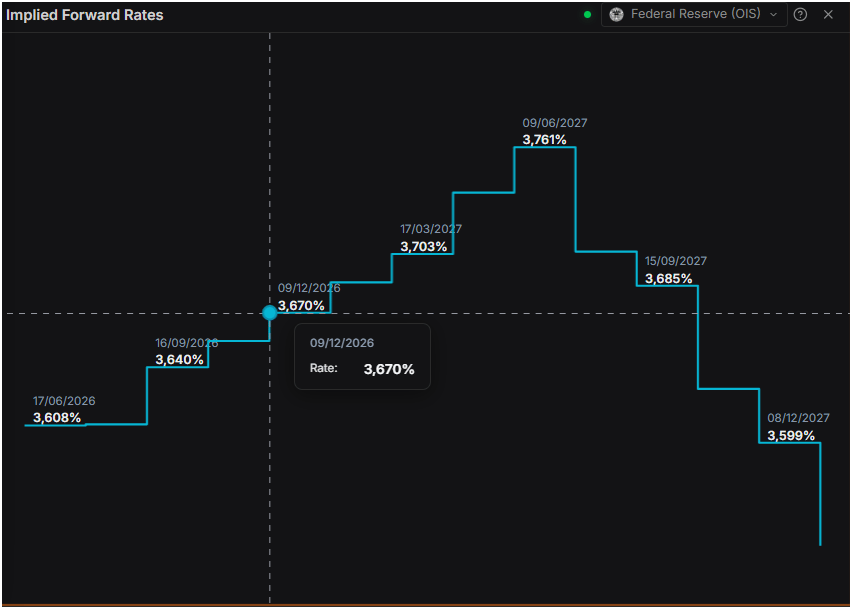
As of writing, money markets expect the Fed to hold rates unchanged throughout 2026, according to Prime Terminal data.
Aside from geopolitics, recent US data indicate a deceleration in economic activity for April. The ISM Services PMI declined to 53.6 from March’s reading of 54. The employment sub-components showed improvement, rising from 45.2 to 48, while the prices paid index remained steady at 70.7, near four-year highs last seen in April 2022.
Meanwhile, March’s trade deficit expanded, driven by increased AI investments, as imports grew 3.6% and exports rose 3.1%. Meanwhile, March’s JOLTS job openings dropped from 6.922 million to 6.866 million, falling short of the 6.83 million forecast.
On Monday, New York Fed President John Williams commented that policy is “well-positioned” amid the uncertainty caused by the Middle East conflict. He said that a quick resolution to the conflict would clarify the future, adding that “I don’t feel, with all the uncertainty today, that we are in a position to provide strong guidance about where interest rates are likely to be in the next meetings.”
Despite advocating keeping rates unchanged, Williams added that the Fed “will need to cut rates at some point in the future,” as price pressures move toward the central bank’s 2% goal.
Ahead, the US economic docket will feature speeches by Federal Reserve officials, as traders brace for Friday’s Nonfarm Payrolls report.
Technical outlook: Gold is sideways trading, ahead of NFP data
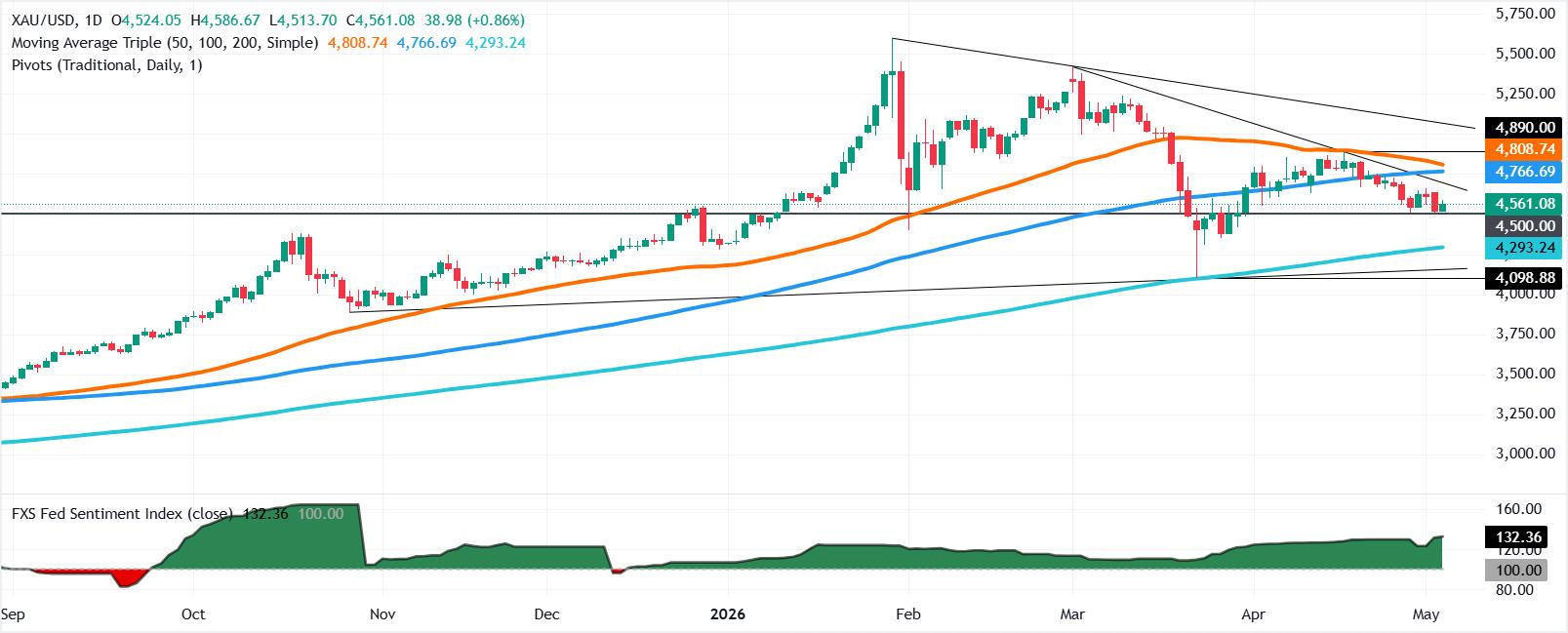
Gold price continues to trade sideways, unable to breach the top of the range, seen at around the psychological $4,700 mark on the upside, and the $4,500 figure on the downside. Momentum is bearish as seen in the Relative Strength Index (RSI), but the RSI is pointing upwards, not far from clearing the latest higher high, ahead of turning bullish.
For a bullish continuation, XAU/USD must surpass the $4,600 milestone. A breach of the latter will expose the May 1 high at $4,660. Once cleared, the next stop would be the 20-day Simple Moving Average (SMA) at $4,703, followed by the confluence of a downtrend resistance trendline and the 100-day SMA at around $4,750-$4,755.
On the flip side, the first support for XAU/USD is $4,500. Once hurdled, the next area of interest would be the March 26 daily low of $4,351, before testing the 200-day SMA at $4,269.
Gold FAQs
Gold has played a key role in human’s history as it has been widely used as a store of value and medium of exchange. Currently, apart from its shine and usage for jewelry, the precious metal is widely seen as a safe-haven asset, meaning that it is considered a good investment during turbulent times. Gold is also widely seen as a hedge against inflation and against depreciating currencies as it doesn’t rely on any specific issuer or government.
Central banks are the biggest Gold holders. In their aim to support their currencies in turbulent times, central banks tend to diversify their reserves and buy Gold to improve the perceived strength of the economy and the currency. High Gold reserves can be a source of trust for a country’s solvency. Central banks added 1,136 tonnes of Gold worth around $70 billion to their reserves in 2022, according to data from the World Gold Council. This is the highest yearly purchase since records began. Central banks from emerging economies such as China, India and Turkey are quickly increasing their Gold reserves.
Gold has an inverse correlation with the US Dollar and US Treasuries, which are both major reserve and safe-haven assets. When the Dollar depreciates, Gold tends to rise, enabling investors and central banks to diversify their assets in turbulent times. Gold is also inversely correlated with risk assets. A rally in the stock market tends to weaken Gold price, while sell-offs in riskier markets tend to favor the precious metal.
The price can move due to a wide range of factors. Geopolitical instability or fears of a deep recession can quickly make Gold price escalate due to its safe-haven status. As a yield-less asset, Gold tends to rise with lower interest rates, while higher cost of money usually weighs down on the yellow metal. Still, most moves depend on how the US Dollar (USD) behaves as the asset is priced in dollars (XAU/USD). A strong Dollar tends to keep the price of Gold controlled, whereas a weaker Dollar is likely to push Gold prices up.














