

Gold trades flat as central bank decisions and global inflation risks weigh
- Gold remains subdued ahead of major central bank decisions this week.
- Markets focus on forward guidance as Oil-driven global inflation risks complicate the outlook.
- On the 4-hour chart, XAU/USD maintains a bearish near-term bias as price trades below key SMAs.
Gold (XAU/USD) trades in a tight range on Tuesday as traders remain cautious and avoid large directional bets ahead of a heavy week of monetary policy announcements from major central banks. At the time of writing, XAU/USD trades virtually unchanged around $5,008, hovering near one-month lows.

Focus on central banks as inflation risks resurface
The upcoming policy decisions from major central banks, including the Federal Reserve (Fed), European Central Bank (ECB), Bank of England (BoE), Bank of Japan (BoJ), Bank of Canada (BoC), and the Swiss National Bank (SNB), come at a particularly sensitive time for global markets.
While all are widely expected to keep interest rates unchanged, the focus will be firmly on forward guidance and how policymakers assess the future policy path, as elevated Oil prices driven by the ongoing US-Iran war raise concerns about renewed inflationary pressure.
This backdrop has strengthened expectations that central banks may delay cuts on borrowing costs to keep them higher for longer. Higher interest rates increase the opportunity cost of holding non-yielding assets such as Gold, which is reflected in the metal’s steady downside pressure since the Middle East war began as markets started to reprice the global interest-rate outlook in a more hawkish direction.
Traders now anticipate only around 25 basis points (bps) of Fed rate cuts by year-end, down from earlier expectations of more than 50 bps. According to the CME FedWatch Tool, the Fed is expected to remain on hold through April, June and July. September is currently seen as the most likely timing for a rate cut, with a probability of around 50.8%.
Strait of Hormuz tensions keep markets on edge
Meanwhile, escalating geopolitical tensions continue to support Gold prices, helping to limit deeper losses. The ongoing conflict between the US-Irael and Iran shows no clear signs of de-escalation, while disruptions in the Strait of Hormuz persist, keeping energy markets on edge.
US President Donald Trump has called on other countries to help secure the Strait, urging nations that rely on the route to support his country's efforts. However, international backing remains limited.
Japan's defense minister said it has no plans to send ships, UK Prime Minister Keir Starmer noted Britain would “not be drawn into the wider war,” while Spain’s Foreign Minister Jose Manuel Albares remarked, “We must not do anything that adds even more tension or escalation.”
Arsenio Dominguez, Secretary-General of the International Maritime Organization (IMO), said naval escorts through the Strait of Hormuz would not “100 per cent guarantee” the safety of ships transiting the critical waterway. He added that military assistance is “not a long-term or sustainable solution,” according to the Financial Times.
Technical analysis: Downside bias holds below key SMAs
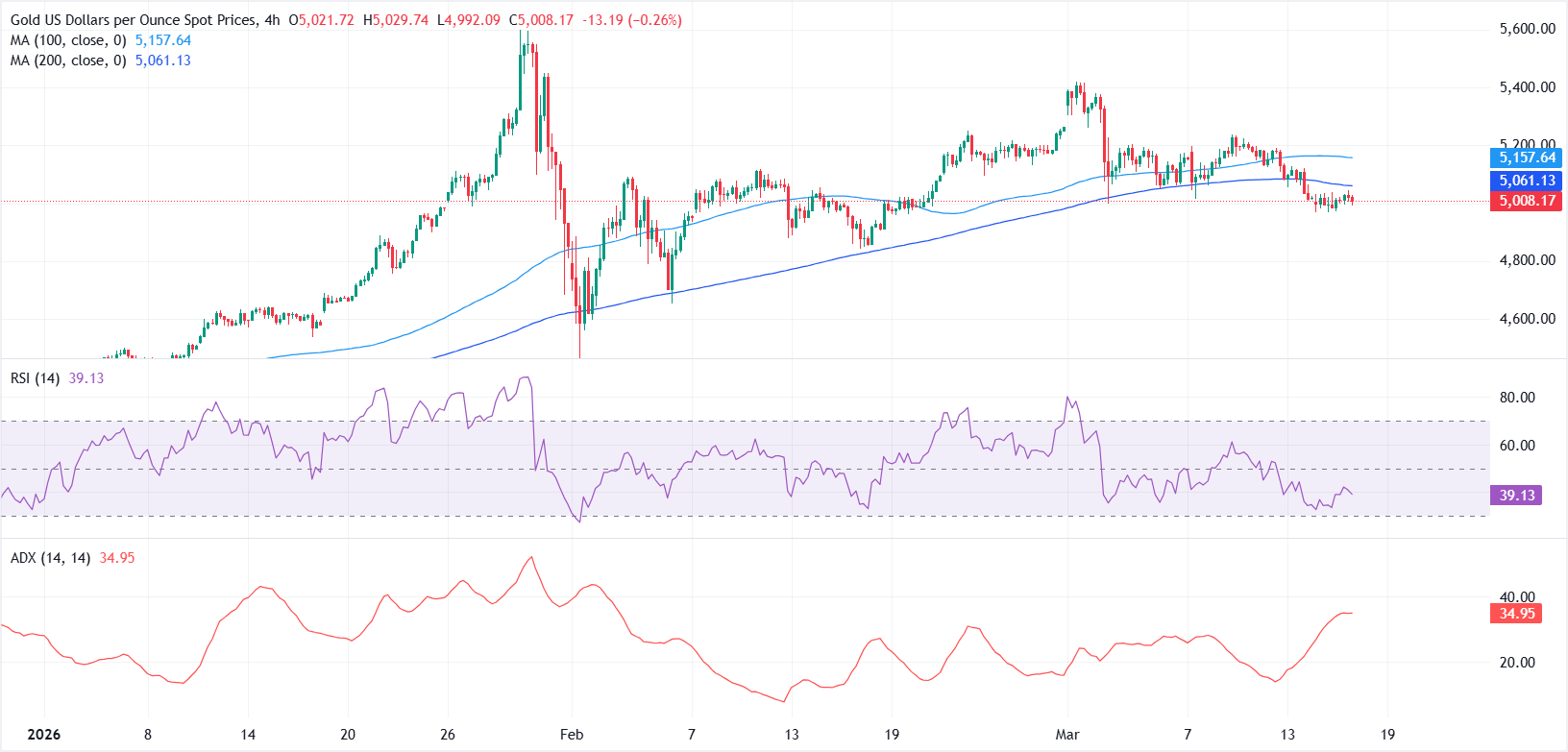
On the 4-hour chart, XAU/USD remains under pressure below the 100-period Simple Moving Average (SMA) near $5,158, with the 200-period SMA at $5,061 acting as immediate resistance.
The Relative Strength Index (RSI) has slipped to around 39, suggesting bearish momentum without entering oversold territory, while the Average Directional Index (ADX) near 35 signals a strengthening trend that currently favors the downside.
On the upside, a decisive break above the 200-period SMA near $5,061 could pave the way toward the 100-period SMA around $5,158. A sustained move above these levels could extend gains toward the $5,200 region.
On the downside, initial support stands at Monday’s low at $4,967, with a break below exposing the $4,850 and $4,650 levels as the next downside targets.
Gold FAQs
Gold has played a key role in human’s history as it has been widely used as a store of value and medium of exchange. Currently, apart from its shine and usage for jewelry, the precious metal is widely seen as a safe-haven asset, meaning that it is considered a good investment during turbulent times. Gold is also widely seen as a hedge against inflation and against depreciating currencies as it doesn’t rely on any specific issuer or government.
Central banks are the biggest Gold holders. In their aim to support their currencies in turbulent times, central banks tend to diversify their reserves and buy Gold to improve the perceived strength of the economy and the currency. High Gold reserves can be a source of trust for a country’s solvency. Central banks added 1,136 tonnes of Gold worth around $70 billion to their reserves in 2022, according to data from the World Gold Council. This is the highest yearly purchase since records began. Central banks from emerging economies such as China, India and Turkey are quickly increasing their Gold reserves.
Gold has an inverse correlation with the US Dollar and US Treasuries, which are both major reserve and safe-haven assets. When the Dollar depreciates, Gold tends to rise, enabling investors and central banks to diversify their assets in turbulent times. Gold is also inversely correlated with risk assets. A rally in the stock market tends to weaken Gold price, while sell-offs in riskier markets tend to favor the precious metal.
The price can move due to a wide range of factors. Geopolitical instability or fears of a deep recession can quickly make Gold price escalate due to its safe-haven status. As a yield-less asset, Gold tends to rise with lower interest rates, while higher cost of money usually weighs down on the yellow metal. Still, most moves depend on how the US Dollar (USD) behaves as the asset is priced in dollars (XAU/USD). A strong Dollar tends to keep the price of Gold controlled, whereas a weaker Dollar is likely to push Gold prices up.














