

Indian Rupee drifts sharply lower as US claims right of Hormuz toll fee
- The Indian Rupee trades sharply lower against the US Dollar, with USD/INR rising to near 96.13.
- Oil prices and US Treasury yields surge as the US claims toll rights on ships passing the Strait of Hormuz.
- Investors await US CPI data and Fed Chair Warsh’s testimony.
The Indian Rupee opens significantly lower against the US Dollar (USD) on Tuesday. The USD/INR pair posts a fresh seven-week high near 96.13 as surging oil prices and United States (US) Treasury Yields due to threats of levy from Washington have weakened the appeal of the Indian currency.
In the opening session, the MCX Crude Oil contract expiring on July 20 opens 4.24% higher to near Rs. 7,673, the highest level seen in almost a month. Currencies from economies, such as India, which rely heavily on oil imports to meet their energy needs, tend to underperform in a high oil price environment.
As of writing, 10-year US Treasury Yields are up 0.3% to near 4.62%, approaching their 18-month high of 4.66%. The scenario of higher US bond yields bodes poorly for risky assets.
Trump’s levy threat sends oil prices and bond yields higher
On Monday, US President Donald Trump announced, through a post on Truth Social, that Washington is reinstating the US blockade on Iranian sea ports, aiming to stop Iranian ships and customers from leaving or entering. The US lifted its Iranian blockade after signing a memorandum of understanding (MoU), which had collapsed due to the exchange of attacks between them.
US President Trump also said in a media post that Washington will charge a 20% fee on all cargo ships traversing the Strait of Hormuz, a critical chokepoint for almost one-fifth of global energy supply, calling it a reimbursement for providing safety and security near the waterway. Trump also declared the US “The Guardian of the Hormuz Strait”.
FIIs turned out net sellers on Monday
Foreign Institutional Investors (FIIs) remained net sellers on Monday, offloading their stake worth Rs. 3,062.27 crore. Rising oil prices due to Middle East aggression appear to have dented the sentiment of overseas investors toward the Indian stock market again. However, they are still net buyers so far this month and have invested Rs. 1,510.62 crore.
US CPI data awaited
Later in the day, investors will pay close attention to the US Consumer Price Index (CPI) data for June and Federal Reserve (Fed) Chairman Kevin Warsh’s two-day testimony. Investors will pay close attention to both events to get fresh cues regarding the US interest rate outlook.
On Monday, Fed Governor Christopher Waller said that another hot inflation figure would be treated as “signal, not noise" on the need to tighten monetary conditions further.
According to estimates, the US headline CPI growth cooled down to 3.8% Year-on-Year (YoY) in June from 4.2% in May, with core figures rising steadily by 2.9%.
Technical Analysis: USD/INR approaches all-time high near 97.10
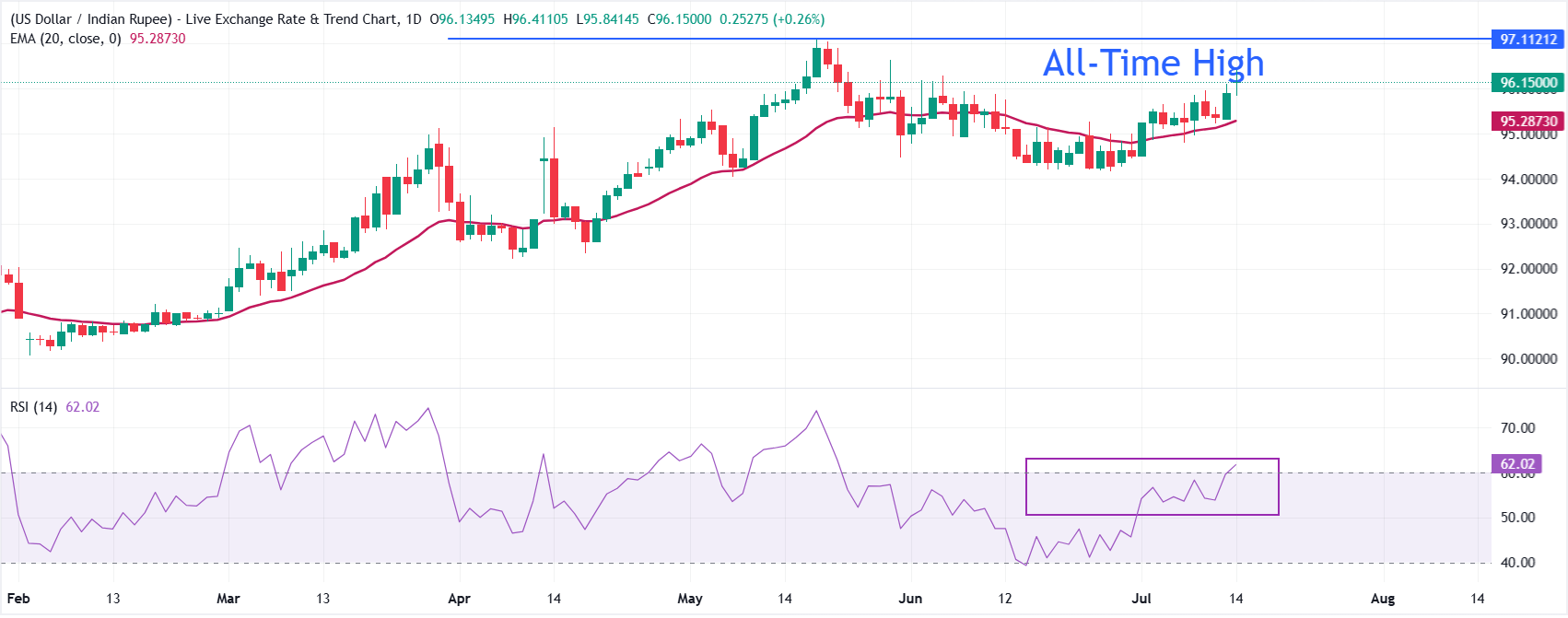
USD/INR trades higher at around 96.12 at press time. The pair holds above the 20-period exponential moving average (EMA) at 95.2840, keeping a constructive bullish bias as price extends away from dynamic trend support.
The Relative Strength Index (RSI) at 61.69 leans into positive territory, suggesting firm upward momentum rather than overbought excess.
On the downside, immediate support is seen at the 20-period EMA near 95.28, followed by 95.00. Looking up, the pair aims to revisit the all-time high at 97.10.
(The technical analysis of this story was written with the help of an AI tool. Know more.)
Indian Rupee FAQs
The Indian Rupee (INR) is one of the most sensitive currencies to external factors. The price of Crude Oil (the country is highly dependent on imported Oil), the value of the US Dollar – most trade is conducted in USD – and the level of foreign investment, are all influential. Direct intervention by the Reserve Bank of India (RBI) in FX markets to keep the exchange rate stable, as well as the level of interest rates set by the RBI, are further major influencing factors on the Rupee.
The Reserve Bank of India (RBI) actively intervenes in forex markets to maintain a stable exchange rate, to help facilitate trade. In addition, the RBI tries to maintain the inflation rate at its 4% target by adjusting interest rates. Higher interest rates usually strengthen the Rupee. This is due to the role of the ‘carry trade’ in which investors borrow in countries with lower interest rates so as to place their money in countries’ offering relatively higher interest rates and profit from the difference.
Macroeconomic factors that influence the value of the Rupee include inflation, interest rates, the economic growth rate (GDP), the balance of trade, and inflows from foreign investment. A higher growth rate can lead to more overseas investment, pushing up demand for the Rupee. A less negative balance of trade will eventually lead to a stronger Rupee. Higher interest rates, especially real rates (interest rates less inflation) are also positive for the Rupee. A risk-on environment can lead to greater inflows of Foreign Direct and Indirect Investment (FDI and FII), which also benefit the Rupee.
Higher inflation, particularly, if it is comparatively higher than India’s peers, is generally negative for the currency as it reflects devaluation through oversupply. Inflation also increases the cost of exports, leading to more Rupees being sold to purchase foreign imports, which is Rupee-negative. At the same time, higher inflation usually leads to the Reserve Bank of India (RBI) raising interest rates and this can be positive for the Rupee, due to increased demand from international investors. The opposite effect is true of lower inflation.













