




Nonfarm Payrolls set to show broadly stable US job market as Fed rate hike odds mount
- Nonfarm Payrolls are expected to rise by 85K in May, slowing from the 115K gain seen in April.
- The Unemployment Rate is forecast to hold steady at 4.3%.
- US employment data could influence the Fed policy outlook and ramp up the US Dollar’s volatility.
The United States (US) Bureau of Labor Statistics (BLS) will release the Nonfarm Payrolls (NFP) data for May on Friday at 12:30 GMT.
With Fed policymakers becoming more hawkish as the new Chairman Kevin Warsh takes the helm, investors will scrutinize the underlying details of the employment report to assess whether the Federal Reserve (Fed) will lean toward a tighter policy later in the year.

US payrolls are among the most market-moving indicators. Still, this time, with all eyes on the inflation front, only a dismal print will be able to significantly hit the US Dollar.
What to expect from the Nonfarm Payrolls report?
Investors expect NFP to rise by 85K following the surprisingly strong 185K and 115K increases recorded in March and April, respectively. The Unemployment Rate is seen holding steady at 4.3%, while the annual wage inflation, as measured by the change in the Average Hourly Earnings, is projected to soften to 3.4% from 3.6% in April.
Previewing the employment report, TD Securities analysts note that they expect NFP to register its lowest gain in three months at 60K in May.
“Gains will stem from the private sector, as we expect government jobs to be flat. We also anticipate the Unemployment Rate rate will edge higher for a second consecutive month to 4.4% [above the broader consensus of a stable 4.3%], assuming the participation rate stays largely unchanged. Average Hourly Earnings likely picked up 0.3% m/m (3.5% y/y),” they add.
Automatic Data Processing (ADP) reported earlier in the week that employment in the private sector rose by 122K in May. This print followed the 105K (revised from 109K) increase reported in April.
"Hiring was more broad-based in May than we've seen in the last few years. The labor market continues to show sustained momentum going into the summer hiring season," said Nela Richardson, Chief Economist at ADP.
Meanwhile, the Employment Index of the Institute for Supply Management’s (ISM) Manufacturing Purchasing Managers’ Index (PMI) improved to 48.6 from 46.4 in April, while the Employment Index of the ISM Services PMI was virtually unchanged at 47.9. Still, with both readings remained in the contraction territory, contradicting the ADP’s findings.
Economic Indicator
Nonfarm Payrolls
The Nonfarm Payrolls release presents the number of new jobs created in the US during the previous month in all non-agricultural businesses; it is released by the US Bureau of Labor Statistics (BLS). The monthly changes in payrolls can be extremely volatile. The number is also subject to strong reviews, which can also trigger volatility in the Forex board. Generally speaking, a high reading is seen as bullish for the US Dollar (USD), while a low reading is seen as bearish, although previous months' reviews and the Unemployment Rate are as relevant as the headline figure. The market's reaction, therefore, depends on how the market assesses all the data contained in the BLS report as a whole.
Read more.Next release: Fri Jun 05, 2026 12:30
Frequency: Monthly
Consensus: 85K
Previous: 115K
Source: US Bureau of Labor Statistics
America’s monthly jobs report is considered the most important economic indicator for forex traders. Released on the first Friday following the reported month, the change in the number of positions is closely correlated with the overall performance of the economy and is monitored by policymakers. Full employment is one of the Federal Reserve’s mandates and it considers developments in the labor market when setting its policies, thus impacting currencies. Despite several leading indicators shaping estimates, Nonfarm Payrolls tend to surprise markets and trigger substantial volatility. Actual figures beating the consensus tend to be USD bullish.
How will the US May Nonfarm Payrolls affect EUR/USD?
The US Dollar (USD) has been benefiting from the risk-averse market environment due to a prolonged crisis in the Middle East. Additionally, growing fears over high energy costs leading to persistently strong inflation have been paving the way for a hawkish Federal Reserve (Fed) policy pricing, further supporting the currency.
After rising about 0.9% in May, the USD Index is up 0.5% so far in June, while markets see a nearly 60% probability of the US central bank raising the policy rate by 25 basis points (bps) at least once by the end of 2026, as per CME FedWatch Tool.
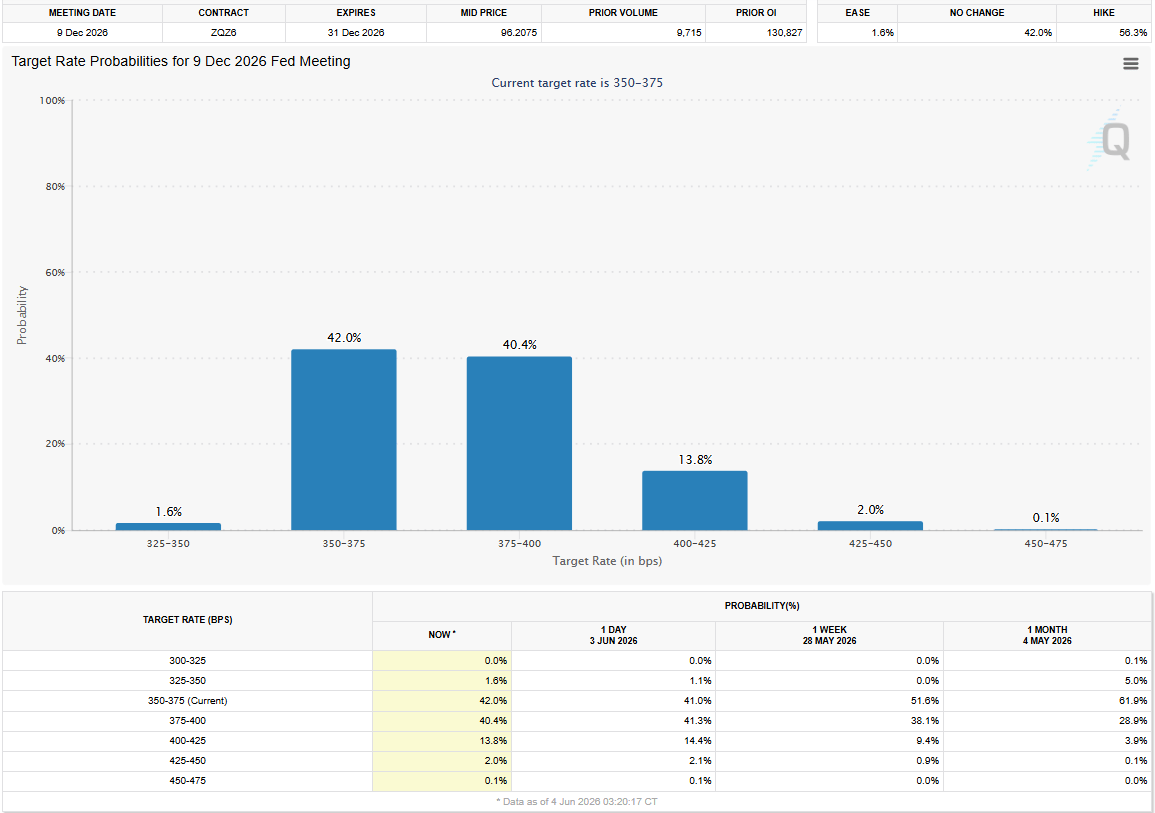
Unless there is a significant downside surprise in the headline NFP print, policymakers are likely to focus on taming inflation without worrying about labor market conditions.
Dallas Fed President Lorie Logan said earlier this week that the labor market is stable and noted that inflation is taking too long to return to 2%. “I am increasingly concerned that higher interest rates could be necessary later this year,” Logan added.
Similarly, New York Fed President John Williams stated that the job market is healthy and upside risks to inflation have increased. Furthermore, Cleveland Fed president Beth Hammack said that the Fed may need to act soon if inflation trends don’t cool and echoed the same sentiment about employment conditions, noting that “job market data point to stability.”
Overall, Fed policymakers are largely tilting toward the hawkish side due to persistent inflation pressures and signs that the labor market is holding up well.
Following two consecutive months of robust readings, a figure above 50K could be seen as a “good enough” growth in NFP. In this scenario, the USD could gather strength heading into the weekend and cause EUR/USD to stretch lower.
At this point, only consecutive dismal NFP figures could sway policymakers’ view about the policy outlook. Hence, even if the NFP data comes in below 50K, any negative impact on the USD could remain short-lived. While EUR/USD could gain traction with the immediate reaction, a steady recovery could be difficult to come by.
In summary, the USD shouldn’t have a hard time staying resilient against its peers in the near future.
A single disappointing NFP print might not be enough to shift the market conviction about a tighter Fed policy. Only a reopening of the Strait of Hormuz, whether by an extended ceasefire or a truce deal between the US and Iran, could trigger a deep correction in crude Oil prices and ease inflation concerns. In this market environment, this seems to be the only possible scenario in which the USD enters a bearish trend and opens the door to a decisive rally in EUR/USD.
Eren Sengezer, European Session Lead Analyst at FXStreet, offers a brief technical outlook for EUR/USD:
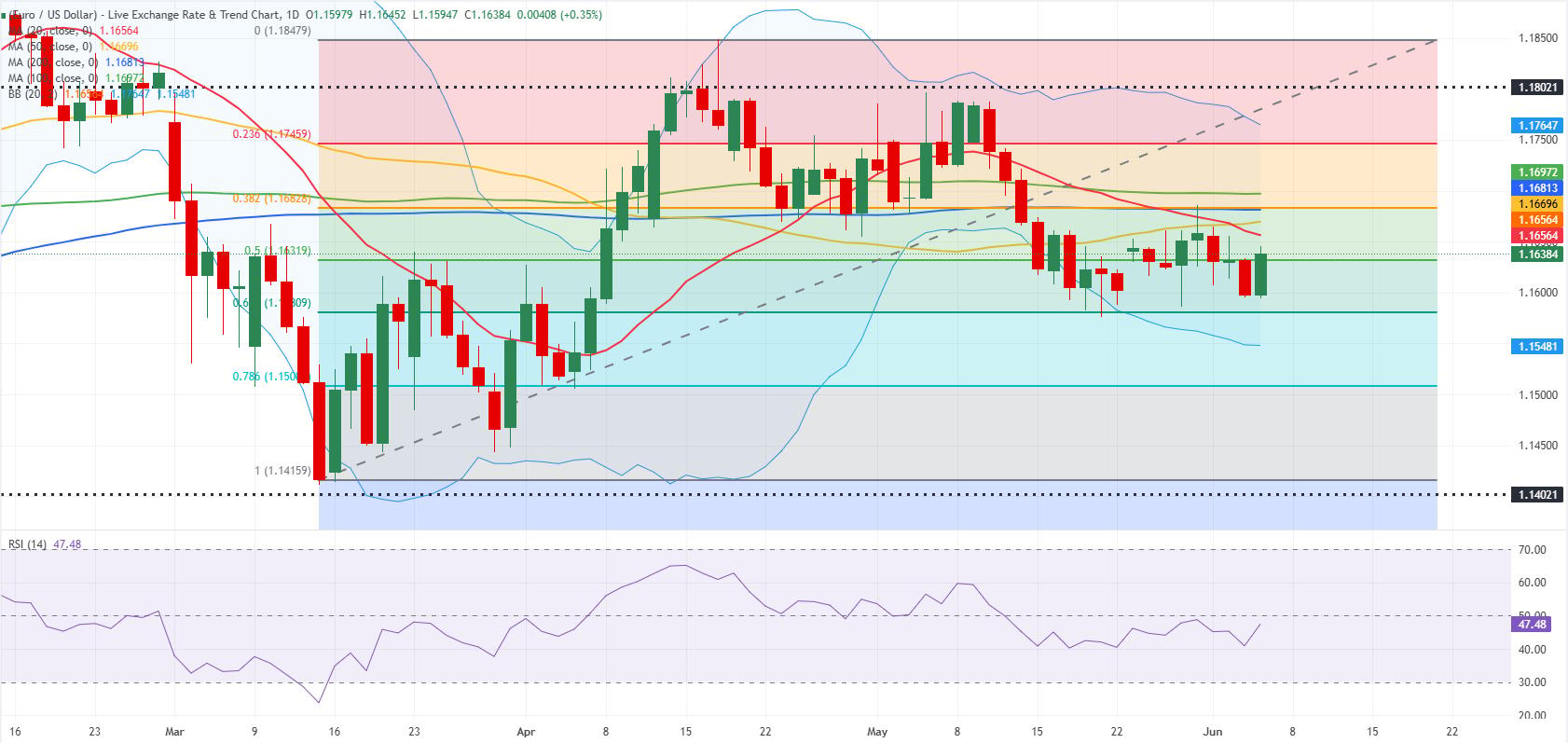
“EUR/USD’s near-term technical outlook suggests that the bearish bias stays intact but lacks momentum. The Relative Strength Index (RSI) indicator on the daily chart remains slightly below 50 after testing 40 and the pair stays in the lower half of Bollinger Bands, while trading below all key Simple Moving Averages (SMA).”
“On the downside, 1.1580 (Fibonacci 61.8% retracement of the mid-March – Mid-April recovery) aligns as an interim support level before 1.1500 (Fibonacci 78.6% retracement) and 1.1415-1.1400 (static level, March 13 low).”
“Looking north, a strong resistance area could be spotted at the 1.1680-1.1700 region, where the 200-day SMA, 100-day SMA and the Fibonacci 38.2% retracement level align. In case EUR/USD stabilizes above this region, it might be able to attract technical buyers and target 1.1750 (Fibonacci 23.6% retracement) ahead of 1.1800 (static level, round level).”
Nonfarm Payrolls FAQs
Nonfarm Payrolls (NFP) are part of the US Bureau of Labor Statistics monthly jobs report. The Nonfarm Payrolls component specifically measures the change in the number of people employed in the US during the previous month, excluding the farming industry.
The Nonfarm Payrolls figure can influence the decisions of the Federal Reserve by providing a measure of how successfully the Fed is meeting its mandate of fostering full employment and 2% inflation. A relatively high NFP figure means more people are in employment, earning more money and therefore probably spending more. A relatively low Nonfarm Payrolls’ result, on the either hand, could mean people are struggling to find work. The Fed will typically raise interest rates to combat high inflation triggered by low unemployment, and lower them to stimulate a stagnant labor market.
Nonfarm Payrolls generally have a positive correlation with the US Dollar. This means when payrolls’ figures come out higher-than-expected the USD tends to rally and vice versa when they are lower. NFPs influence the US Dollar by virtue of their impact on inflation, monetary policy expectations and interest rates. A higher NFP usually means the Federal Reserve will be more tight in its monetary policy, supporting the USD.
Nonfarm Payrolls are generally negatively-correlated with the price of Gold. This means a higher-than-expected payrolls’ figure will have a depressing effect on the Gold price and vice versa. Higher NFP generally has a positive effect on the value of the USD, and like most major commodities Gold is priced in US Dollars. If the USD gains in value, therefore, it requires less Dollars to buy an ounce of Gold. Also, higher interest rates (typically helped higher NFPs) also lessen the attractiveness of Gold as an investment compared to staying in cash, where the money will at least earn interest.
Nonfarm Payrolls is only one component within a bigger jobs report and it can be overshadowed by the other components. At times, when NFP come out higher-than-forecast, but the Average Weekly Earnings is lower than expected, the market has ignored the potentially inflationary effect of the headline result and interpreted the fall in earnings as deflationary. The Participation Rate and the Average Weekly Hours components can also influence the market reaction, but only in seldom events like the “Great Resignation” or the Global Financial Crisis.













