

Trading
Explorez une large gamme de marchés avec des prix compétitifs, une liquidité profonde et des outils de trading avancés.
En savoir plus 
Plateforme
Tradez en toute fluidité avec la plateforme puissante de TMGM, conçue pour la vitesse, la précision et une expérience de trading supérieure.
En savoir plus Plateforme de trading
Outils de trading
Académie
Apprenez les fondamentaux du trading avec des ressources adaptées aux débutants, incluant des guides, des webinaires et des analyses de marché.
En savoir plus Actualités et analyses
Obtenez des mises à jour de marché en temps réel et des analyses d'experts pour anticiper les opportunités de trading
En savoir plus Actualités et analyses
À propos
Découvrez ce qui distingue TMGM — notre présence mondiale, notre solidité réglementaire et notre engagement envers l'innovation dans le trading.
En savoir plus Pourquoi choisir TMGM
Ripple and Stellar outlook: XRP stalls at key resistance, XLM rally loses steam
- XRP faces rejection from the 50-day EMA at $1.18 after breaking above the upper boundary of the falling channel.
- XLM extends its pullback on Tuesday after a slight decline the previous day.
- Mixed on-chain and derivatives data suggest traders remain cautiously optimistic despite the ongoing price correction.
Ripple (XRP) and Stellar (XLM) are trading under pressure on Tuesday as bulls lose steam. XRP faces rejection near key resistance, while XLM continues its pullback so far this week. Despite the ongoing correction, mixed on-chain and derivatives metrics suggest traders remain cautiously optimistic for these altcoins.

Mixed sentiment among derivatives traders
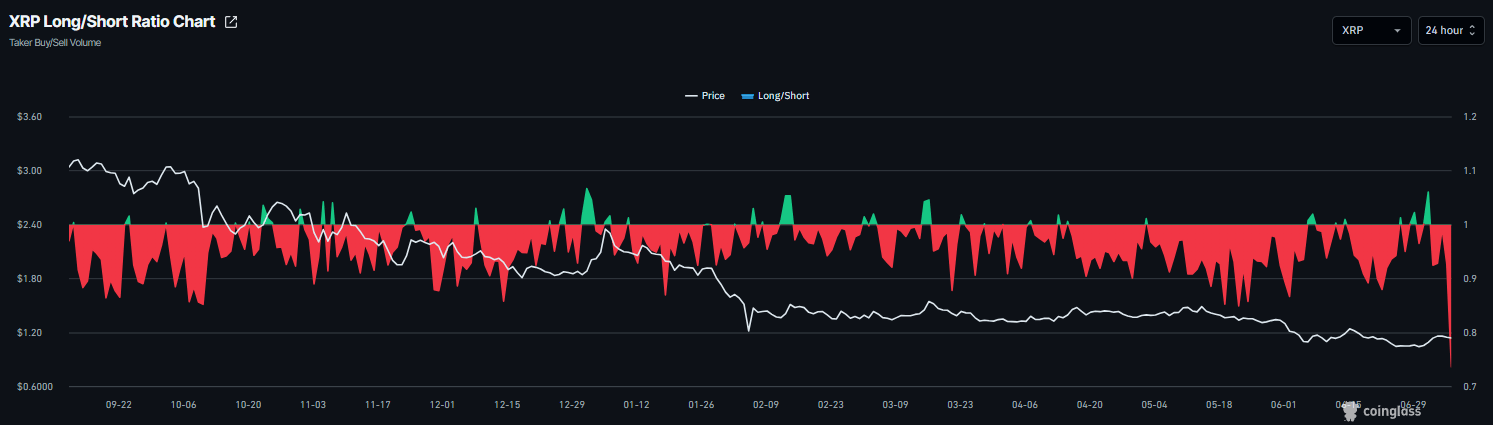
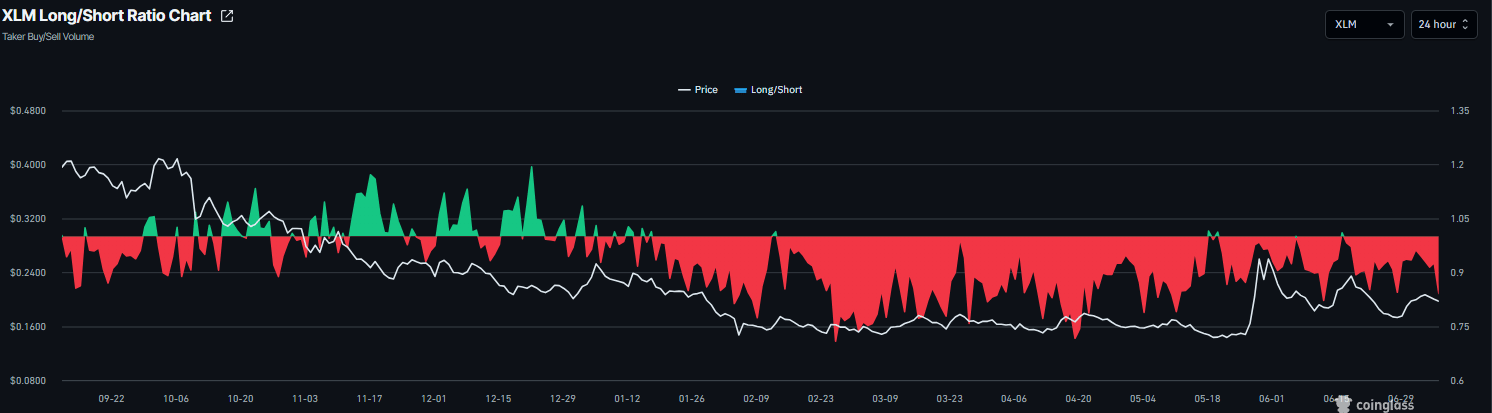
Derivatives data shows a mixed outlook. CoinGlass’ long-to-short ratio for XRP reads 0.73 on Tuesday, the lowest level over a month. During the same period, XLM's long-to-short ratio stands at 0.84, nearing the lowest level over a month. This ratio, being below 1, reflects bearish sentiment in the market, as more traders are betting the asset’s price will fall.
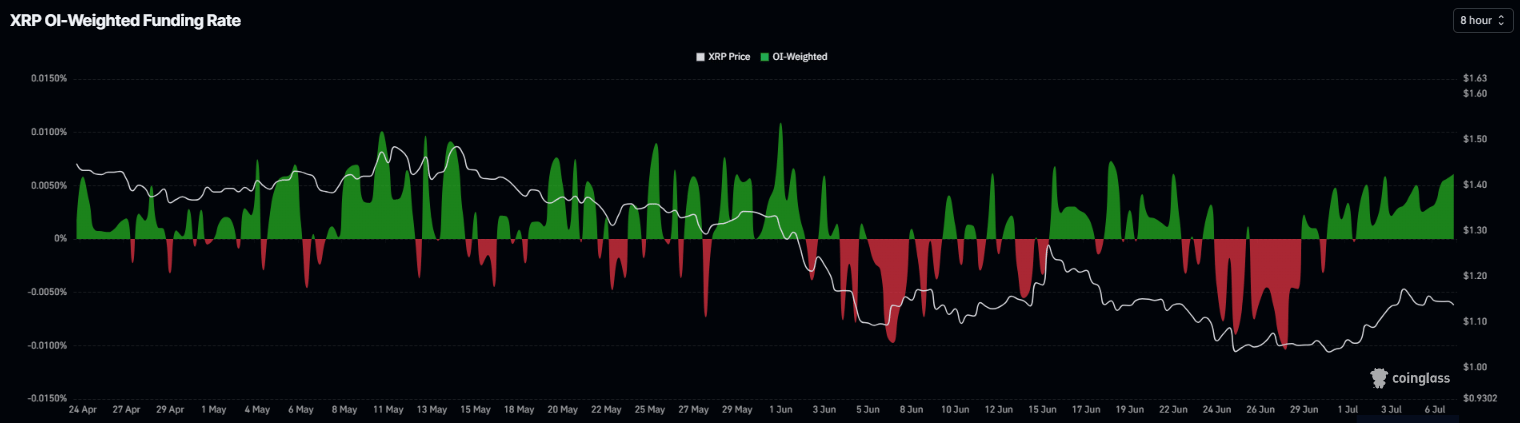
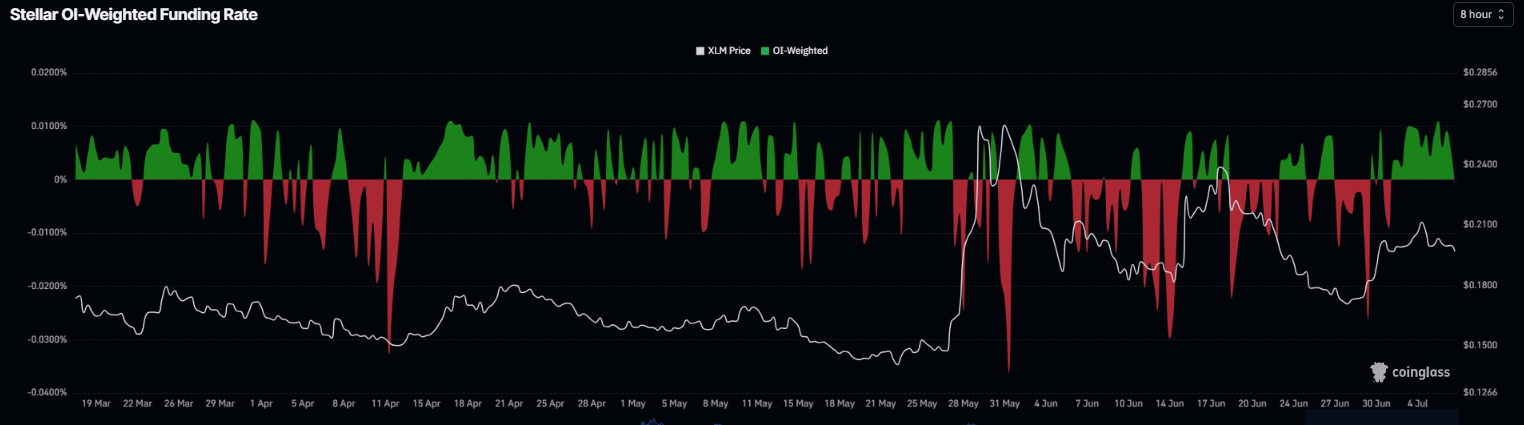
However, XRP and XLM funding rates remain positive, at 0.0061% and 0.0058%, respectively, on Tuesday. These positive rates indicate that longs are paying the shorts, suggesting bullish sentiment.
On-chain metrics show cautious optimism
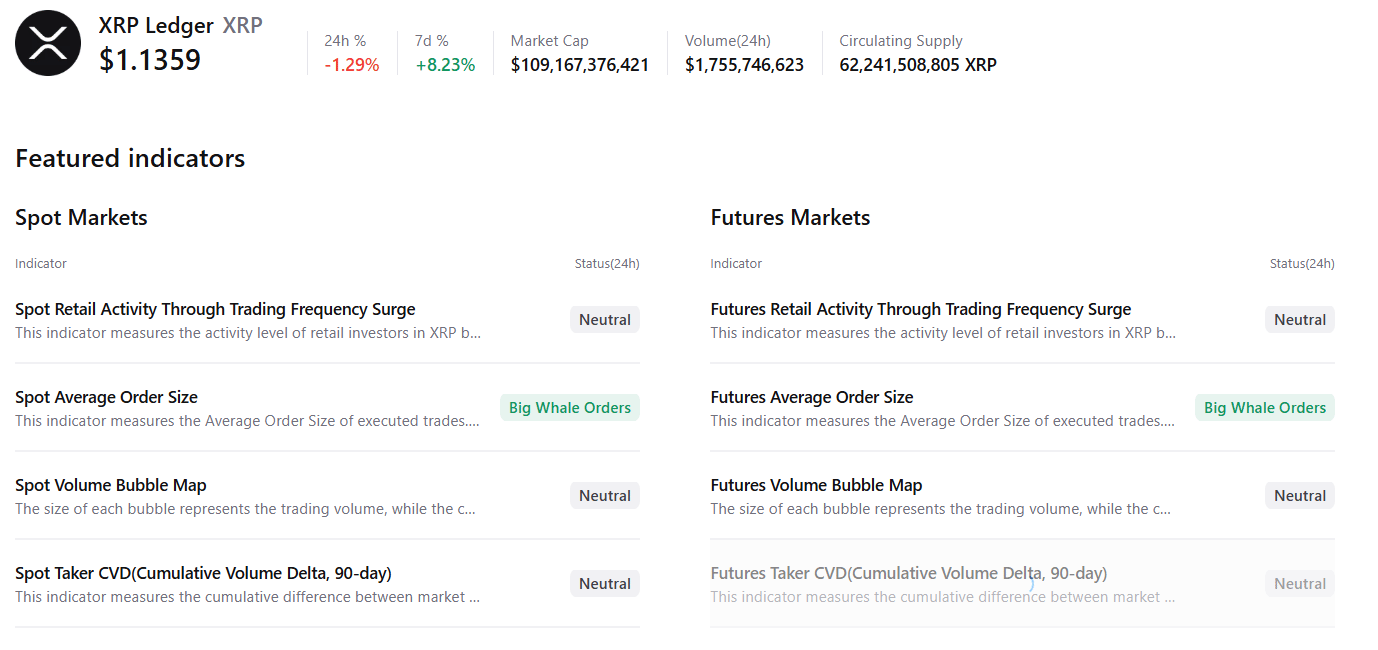
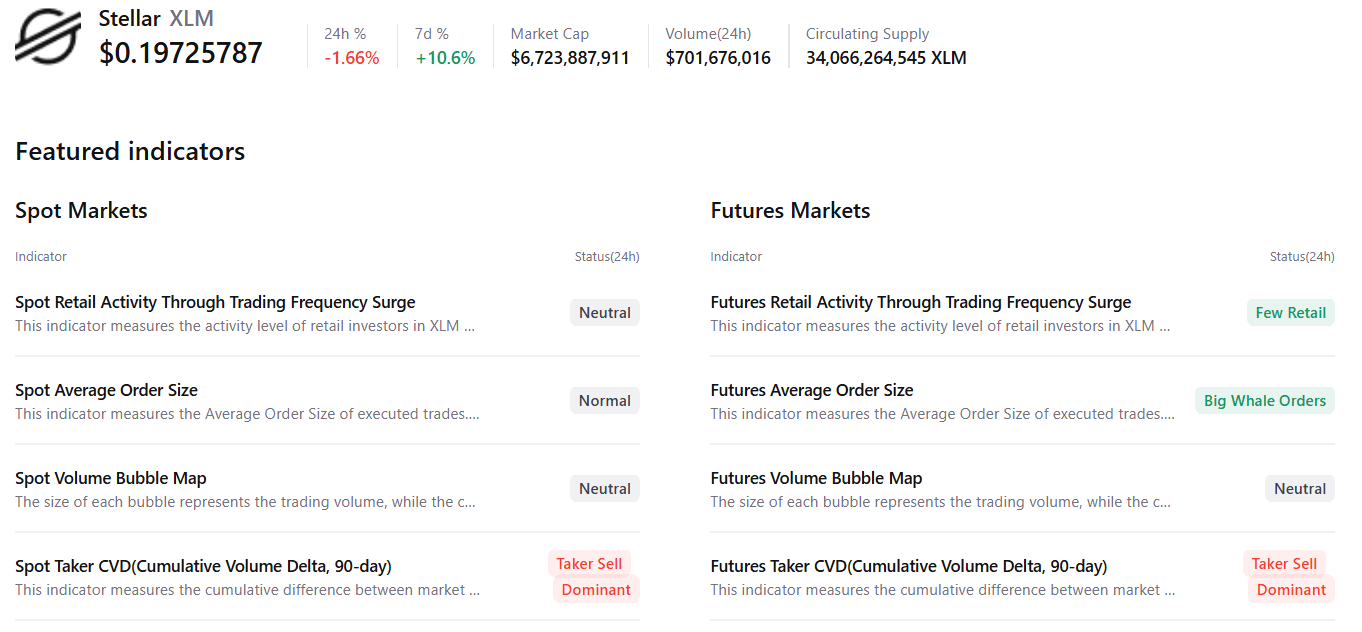
CryptoQuant’s summary data shows cautious optimism. XRP’s spot and futures markets show large-whale orders, with neutral conditions on other metrics, supporting a potential recovery. However, XLM shows selling-side dominance in both markets, with mixed retail activity and large-whale orders in the futures market, hinting at cautious sentiment among traders.
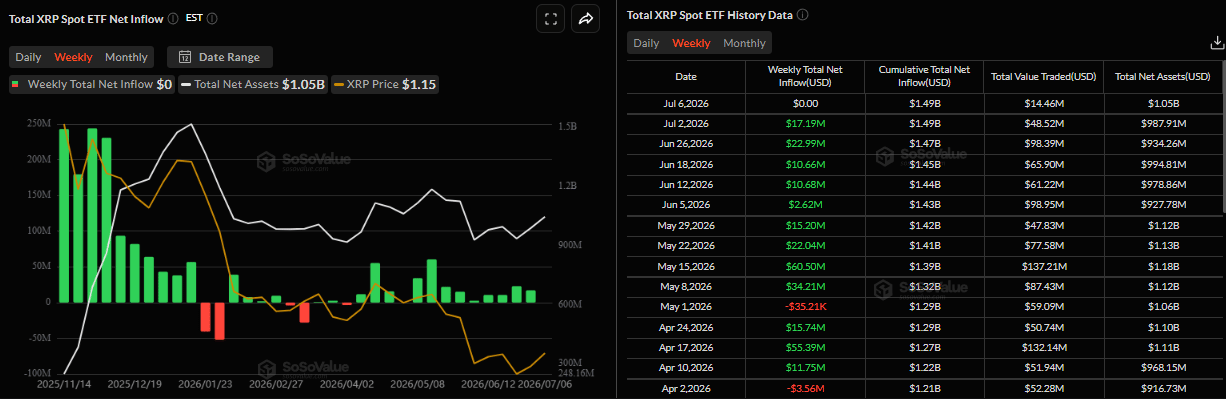
SoSoValue data shows institutional demand began the week with a neutral tone. Spot Exchange-Traded Funds (ETFs) were muted on Monday, following a net inflow of $17.19 million last week. If this inflow trend continues and intensifies this week, XRP could see a recovery ahead.
XRP technical outlook: Faces rejection from 50-day EMA
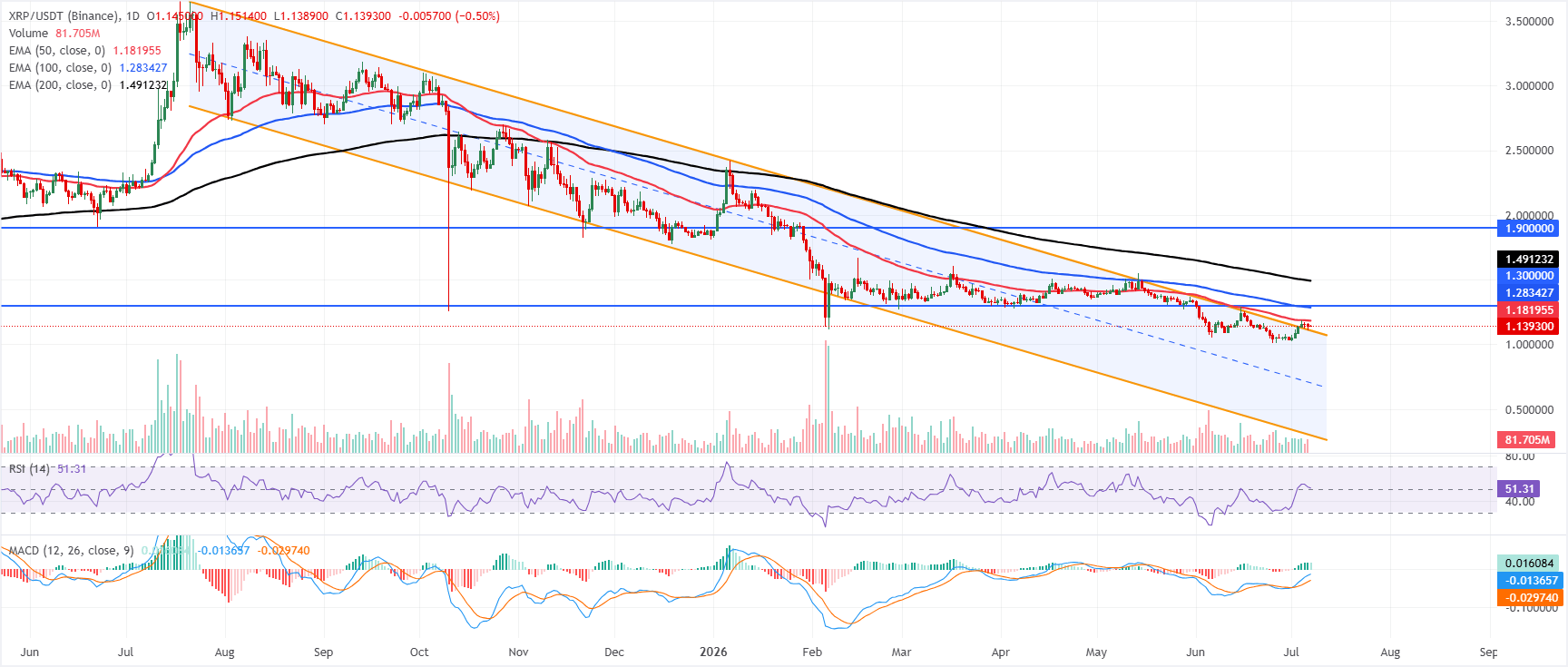
XRP price trades at $1.1393 on Tuesday, maintaining a bearish near-term tone as it remains below the 50-day Exponential Moving Average (EMA) at $1.1820, the 100-day EMA at $1.2834 and the longer-term 200-day EMA at $1.4912.
The downward parallel channel offers a modicum of structure, with price holding above its lower band around $1.1054, while the Relative Strength Index (RSI) hovers near a neutral 51, and the Moving Average Convergence Divergence (MACD) stays in positive territory but shows a slight loss of momentum, hinting at a capped recovery rather than a decisive trend reversal.
On the topside, immediate resistance emerges at the 50-day EMA at $1.1820, followed by the 100-day EMA at $1.2834 and the horizontal barrier at $1.3000, with the 200-day EMA at $1.4912 and the prior resistance line near $1.9000 marking higher hurdles for any sustained advance.
On the downside, initial support aligns with the lower boundary of the descending channel around $1.1054, and a clear break below this floor would reinforce the prevailing bearish bias and open the door to a deeper pullback in the coming sessions.
XLM technical outlook: Finds support around key levels
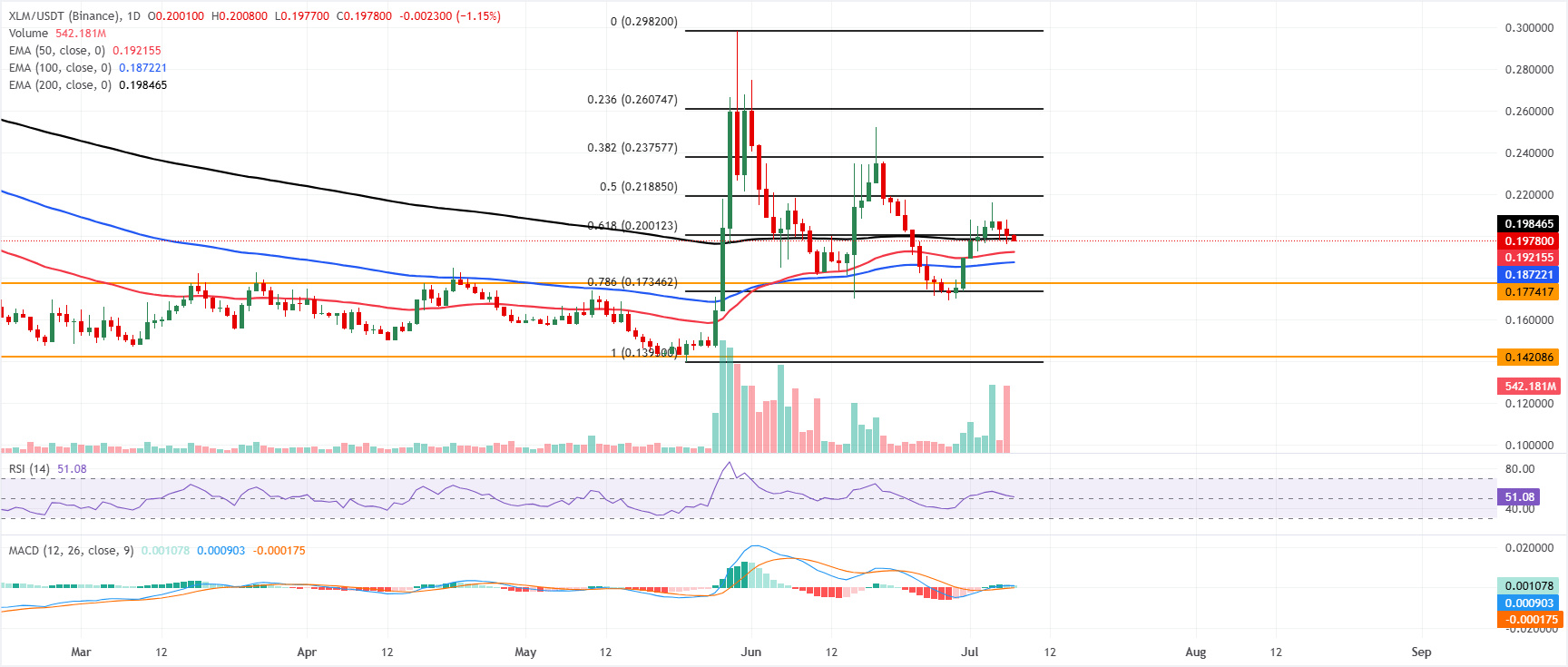
XLM price trades at $0.1978 on Tuesday, holding above the 50-day and 100-day EMAs at $0.1922 and $0.1872, reinforcing a mildly bullish near-term bias. The pair is still capped just underneath the 200-day EMA at $0.1985 and the 61.8% Fibonacci retracement at $0.2001, while the RSI around 51 and a positive MACD line above zero suggest steady but not overextended upside momentum.
On the topside, initial resistance is at the 200-day EMA at $0.1985, followed closely by the 61.8% Fibonacci retracement at $0.2001, with higher hurdles at $0.2188 and $0.2376 before the next Fibonacci barrier at $0.2607.
On the downside, immediate support is seen at the 50-day EMA at $0.1922, ahead of the 100-day EMA at $0.1872, while a horizontal level at $0.1774 and the 78.6% Fibonacci retracement at $0.1735 guard against a deeper pullback before the more distant structural floor near $0.1421.
(The technical analysis of this story was written with the help of an AI tool. Know more.)
Ripple FAQs
Ripple is a payments company that specializes in cross-border remittance. The company does this by leveraging blockchain technology. RippleNet is a network used for payments transfer created by Ripple Labs Inc. and is open to financial institutions worldwide. The company also leverages the XRP token.
XRP is the native token of the decentralized blockchain XRPLedger. The token is used by Ripple Labs to facilitate transactions on the XRPLedger, helping financial institutions transfer value in a borderless manner. XRP therefore facilitates trustless and instant payments on the XRPLedger chain, helping financial firms save on the cost of transacting worldwide.
XRPLedger is based on a distributed ledger technology and the blockchain using XRP to power transactions. The ledger is different from other blockchains as it has a built-in inflammatory protocol that helps fight spam and distributed denial-of-service (DDOS) attacks. The XRPL is maintained by a peer-to-peer network known as the global XRP Ledger community.
XRP uses the interledger standard. This is a blockchain protocol that aids payments across different networks. For instance, XRP’s blockchain can connect the ledgers of two or more banks. This effectively removes intermediaries and the need for centralization in the system. XRP acts as the native token of the XRPLedger blockchain engineered by Jed McCaleb, Arthur Britto and David Schwartz.
ARTICLES POPULAIRES
1Bitcoin targets $84,000 as Strive adds 3,311 BTC to treasury2Dollar Index slips from its 18-month high before US CPI3British Pound finds fresh momentum as BoE hawks set stage for US CPI4Neither a breakout nor a reversal: What OCBC, Commerzbank and ING expect from the US Dollar5Taiwan Dollar: Monetary tightening and housing recovery – DBS6Euro finds support from softer US Dollar, French fiscal risks linger7British Pound: Upside momentum builds against Euro – Societe Generale8Canadian Dollar: Modest gains against US Dollar - Scotiabank9Australian Dollar : Key support at 0.6935 in focus against US Dollar – UOB
COTATIONS EN DIRECT

Commencez !
Inscrivez-vous et accédez aux Marchés Mondiaux en moins de 3 minutes

Connectez-vous avec Nous









Contacts
Téléphone: +61 2 8036 8388
Fax: +61 2 8036 8388
Email: support@tmgm.com
Web: https://www.tmgm.com



Les informations fournies sur ce site web sont de nature générale uniquement et ne constituent pas un conseil financier personnalisé. Avant d’agir sur la base de toute information figurant sur ce site web, vous devez évaluer la pertinence de ces informations au regard de vos objectifs, de votre situation financière et de vos besoins. Investir dans les CFD et les contrats de marge sur le Forex comporte des risques importants et ne convient pas à tous les investisseurs. Vous pouvez perdre plus que votre dépôt initial. Vous ne détenez pas, et n’avez, aucun droit de propriété ou intérêt sur l’actif sous-jacent. Nous vous recommandons de solliciter un avis indépendant et de vous assurer que vous comprenez pleinement les risques encourus avant de trader. Il est important que vous lisiez et preniez en considération le document d’information avant d’acquérir tout produit présenté sur le site web. Les informations et publicités proposées sur ce site web ne sont pas destinées à être utilisées par toute personne dans tout pays ou toute juridiction où une telle utilisation serait contraire aux lois et réglementations locales. Les Produits et Services proposés sur ce site web ne sont pas destinés aux résidents des États-Unis, de la Malaisie et de la Thaïlande.
TMGM est autorisé et réglementé dans diverses juridictions.
Trademax Australia Limited, opérant sous le nom de TMGM, est réglementé par l'Australian Securities and Investments Commission (ASIC), AFSL no. 436416 et est situé au Level 28, One International Tower, 100 Barangaroo Avenue, 2000 Sydney, NSW Australie.
Email: support@tmgm.com.au
Trademax Global Limited, opérant sous le nom de TMGM, est autorisé et réglementé par la Vanuatu Financial Services Commission (VFSC), numéro d'enregistrement 40356 et enregistré au 1276, Kumul Highway, Port Vila, Vanuatu, République de Vanuatu.
Email: support@tmgm.com
Trademax Global Markets (SE) Limited, exerçant sous le nom TMGM, est autorisée et régulée par la Financial Services Authority (FSA) des Seychelles, sous le numéro de licence SD224. La société est enregistrée au bureau n° 13, Providence Estate ABIS Centre, Mahé, Seychelles.
Email: support@tmgm.com
Trademax Global Markets (International) Pty Ltd, opérant sous le nom de TMGM, est autorisé et réglementé par la Financial Services Commission, Maurice (FSC) avec la licence no. GB22201012, et enregistré au 33, Edith Cavell Street C/o IQ EQ Fund Services (Mauritius) Ltd Port Louis, 11324 Maurice.
Email: support@tmgm.com
Copyright © TMGM. Tous droits réservés