

Ripple Price Forecast: XRP edges higher but risks stalling amid cooling demand
- XRP rises above $1.10 on Friday, aligning with the broadly rebounding crypto market.
- XRP’s recovery lacks foundational support amid muted ETF activity and futures Open Interest softening to 2.10 billion XRP.
- The XRP technical structure stays weak, with falling moving averages capping the upside and the RSI indicator below the midline.
Ripple (XRP) is regaining momentum, trading above $1.10 at the time of writing on Monday. This modest rebound mirrors the broader recovery observed across the cryptocurrency market.
Yet, the limited institutional demand and waning retail interest suggest that investors remain cautious, closely monitoring the ongoing geopolitical tensions in the Middle East. While the United States (US) has reiterated its commitment to negotiations and diplomatic solutions, market participants appear to be weighing these assurances against persistent uncertainties.

XRP investor participation declines as demand cools
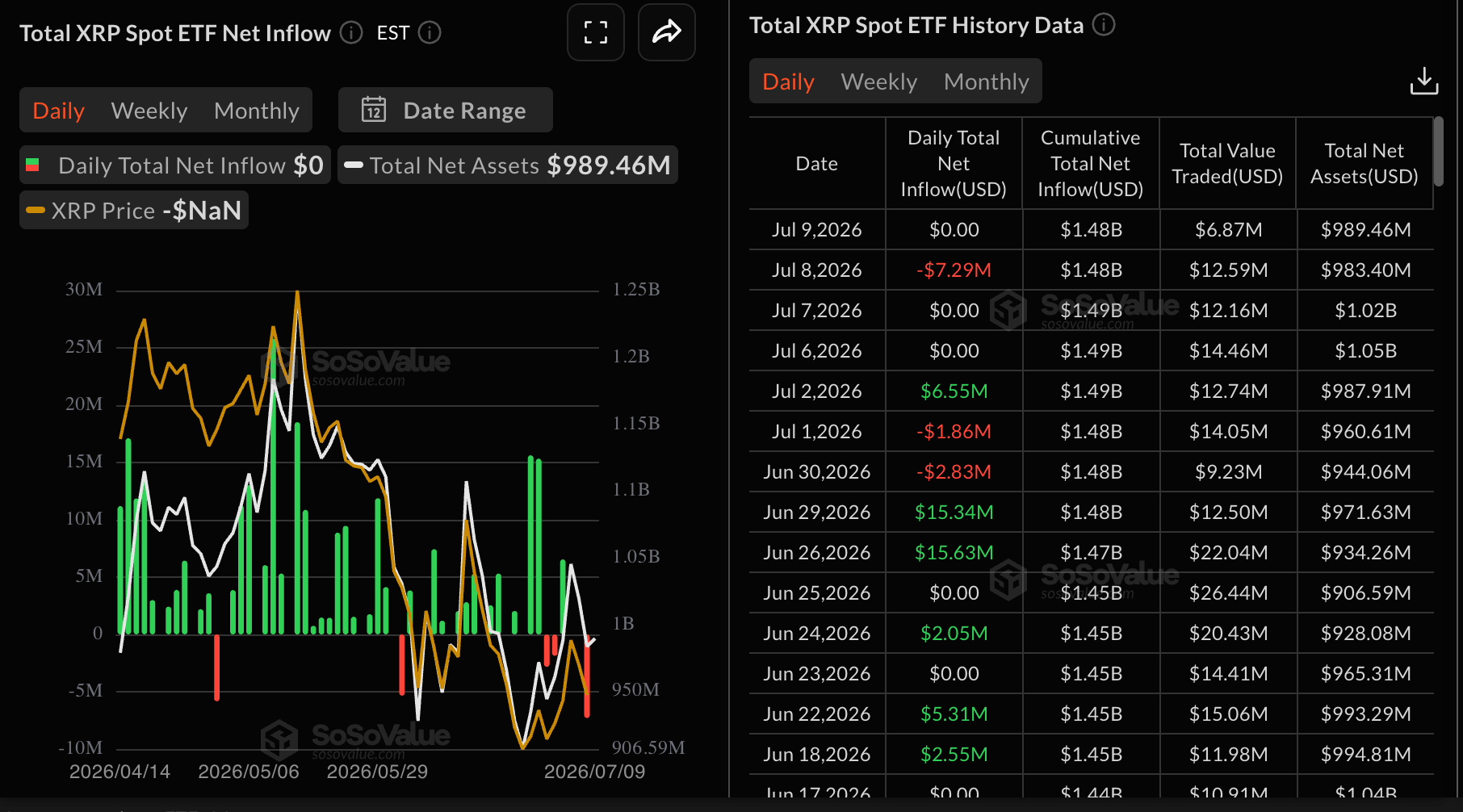
Institutional demand for XRP investment products continues to lag, as evidenced by subdued activity in spot Exchange-Traded Funds (ETFs) on Thursday. According to SoSoValue data, the remittance token also experienced approximately $7 million in outflows the previous day.
This persistent lack of institutional engagement, coupled with the cooling retail demand, poses a challenge for XRP’s short-term momentum, despite the modest recovery from its $1.07 support level.
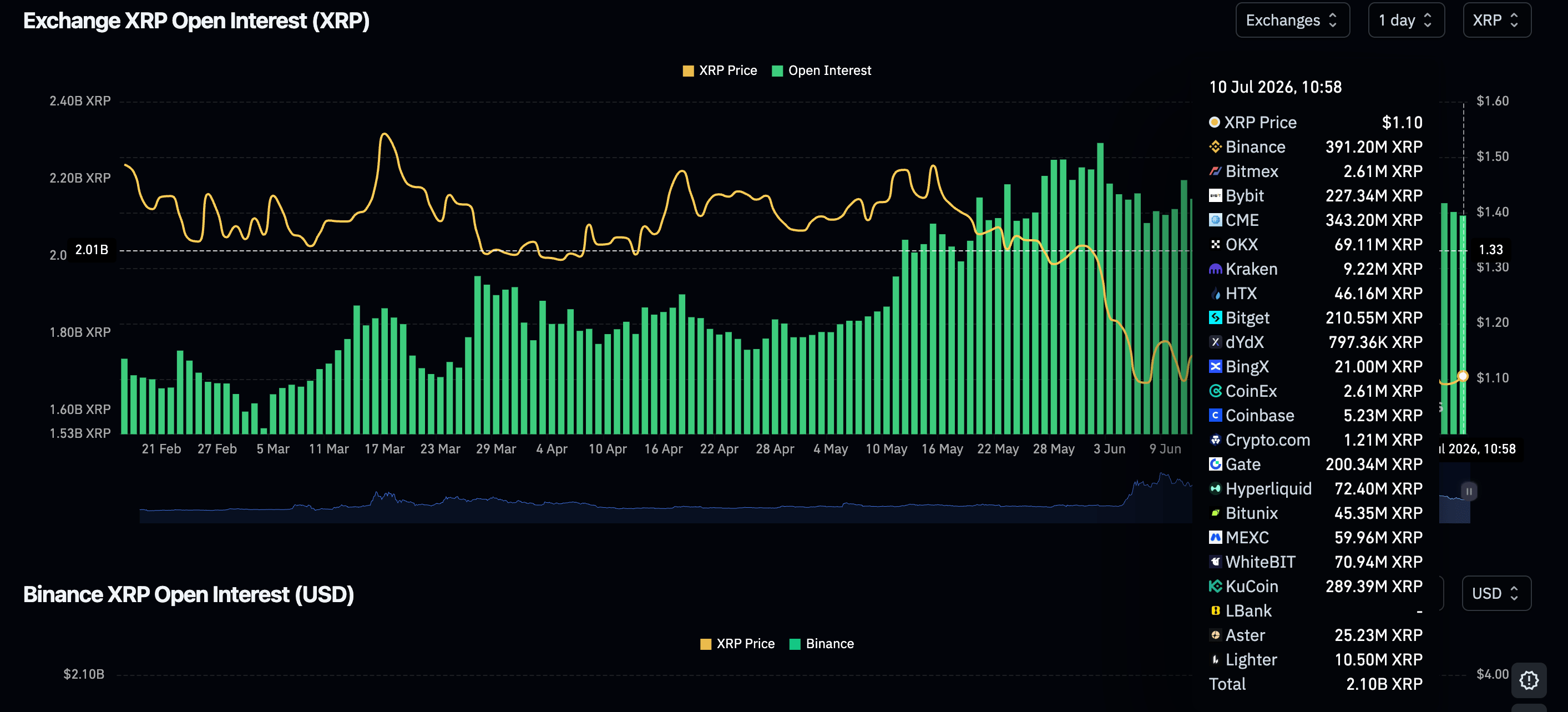
The derivatives market mirrors the drop in appetite, with futures Open Interest (OI) down to 2.1 billion XRP on Friday, from 2.14 billion the day before. CoinGlass highlights an incessant bearish trend, given OI stood at 2.38 billion XRP on June 23.
Should this subdued demand persist, it is likely to exert downward pressure on the XRP price, potentially curbing the current rebound. The interplay between institutional hesitation and broader market sentiment will be critical to monitor in upcoming sessions.
Price analysis: XRP reclaims short-term support
XRP retains a bearish near-term bias as it holds below the key Exponential Moving Averages (EMAs). Price remains under the downward resistance trendline that broke near $1.14, while the 50-day EMA at $1.17, the 100-day EMA at $1.27 and the 200-day EMA at $1.48 all sit overhead, suggesting rallies are still being capped within a broader corrective phase.
The Relative Strength Index (RSI) around 47 hints at only modest demand, while the Moving Average Convergence Divergence (MACD) stays marginally positive, indicating that any upside attempts lack a decisive trend shift as long as price trades beneath these longer-term averages.
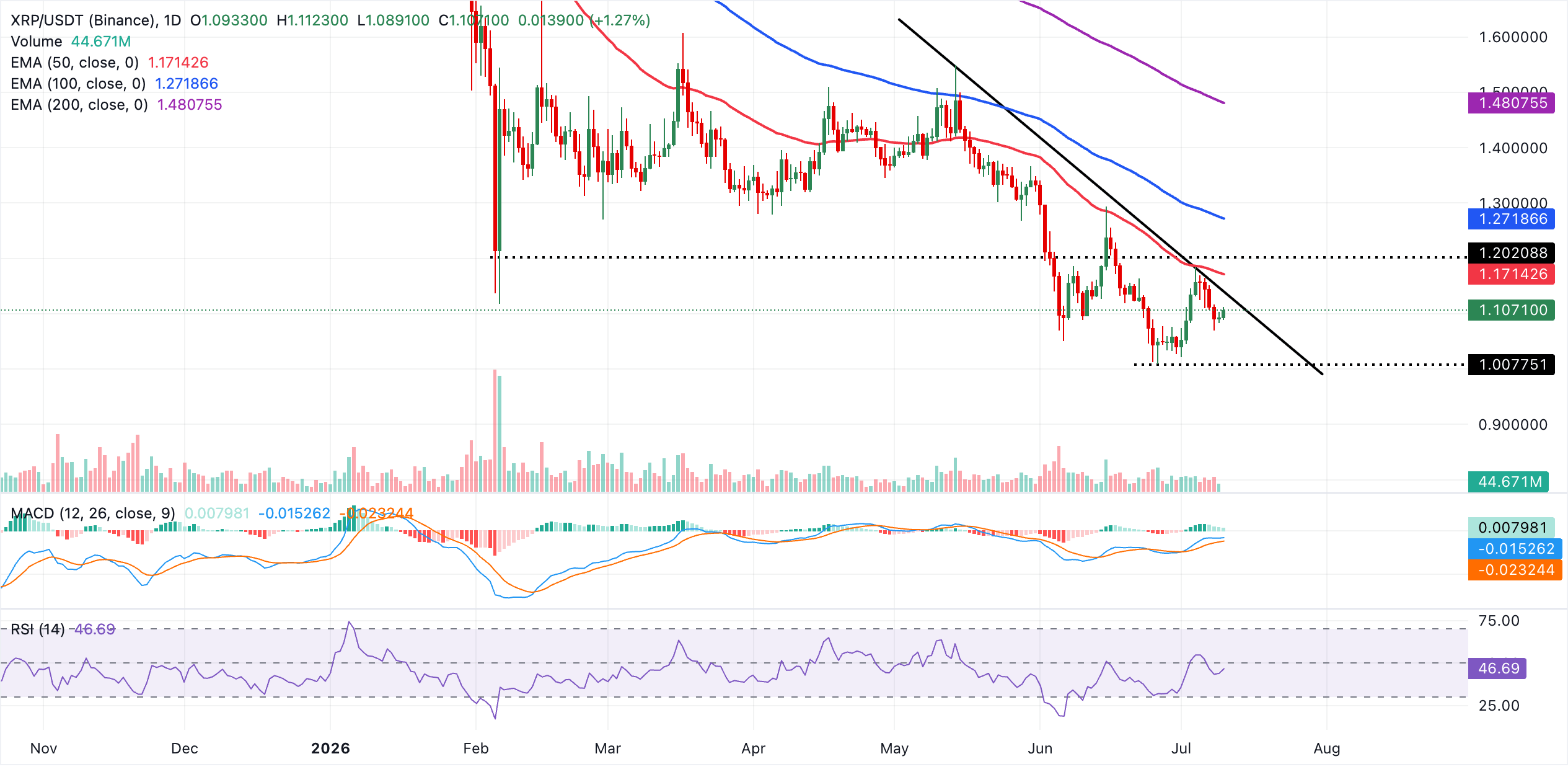
On the topside, initial resistance is seen at the broken downtrend line around $1.14, with further barriers at the 50-day EMA near $1.17 and then the 100-day EMA at $1.27, before the longer-term bearish cap defined by the 200-day EMA around $1.48. Looking down, traders may treat the recent low zone just under the $1.10 handle as a provisional floor, but the technical landscape suggests that failure to reclaim the $1.14–$1.17 band would keep XRP/USDT vulnerable to renewed downside pressure.
(The technical analysis of this story was written with the help of an AI tool. Know more.)
Crypto ETF FAQs
An Exchange-Traded Fund (ETF) is an investment vehicle or an index that tracks the price of an underlying asset. ETFs can not only track a single asset, but a group of assets and sectors. For example, a Bitcoin ETF tracks Bitcoin’s price. ETF is a tool used by investors to gain exposure to a certain asset.
Yes. The first Bitcoin futures ETF in the US was approved by the US Securities & Exchange Commission in October 2021. A total of seven Bitcoin futures ETFs have been approved, with more than 20 still waiting for the regulator’s permission. The SEC says that the cryptocurrency industry is new and subject to manipulation, which is why it has been delaying crypto-related futures ETFs for the last few years.
Yes. The SEC approved in January 2024 the listing and trading of several Bitcoin spot Exchange-Traded Funds, opening the door to institutional capital and mainstream investors to trade the main crypto currency. The decision was hailed by the industry as a game changer.
The main advantage of crypto ETFs is the possibility of gaining exposure to a cryptocurrency without ownership, reducing the risk and cost of holding the asset. Other pros are a lower learning curve and higher security for investors since ETFs take charge of securing the underlying asset holdings. As for the main drawbacks, the main one is that as an investor you can’t have direct ownership of the asset, or, as they say in crypto, “not your keys, not your coins.” Other disadvantages are higher costs associated with holding crypto since ETFs charge fees for active management. Finally, even though investing in ETFs reduces the risk of holding an asset, price swings in the underlying cryptocurrency are likely to be reflected in the investment vehicle too.














