

Strategy unveils plan allowing Bitcoin sales to fund stock buybacks, dividends and reserves
- Michael Saylor's Strategy has announced its Digital Credit Capital Framework to strengthen the company’s financial status amid Bitcoin’s decline.
- Bitcoin sales could help Strategy raise up to $1.25 billion to fund dividend payments on preferred stock and interest on outstanding debt.
- Strategy holds over 847,000 BTC acquired at an average cost of $75,651.
Strategy (MSTR) has unveiled a Digital Credit Framework to strengthen the company’s financial standing. Under the new framework, the world’s largest corporate holder of Bitcoin (BTC) will pivot from its previous accumulation strategy, opting to sell BTC in order to boost liquidity, fund dividend payments, execute stock buybacks, and strengthen cash reserves.

Strategy pivots eyeing Bitcoin sales
Strategy stated in the press release on Tuesday that its US Dollar (US) reserves had increased to $2.55 billion as of Sunday. The Board has greenlit the use of cash reserves specifically to cover dividend payments on Strategy’s preferred stock and to service outstanding debt. Any alternative allocation of these funds will require further board approval.
The Board now requires Strategy to maintain minimum cash reserves sufficient to cover at least 12 months of the current expected annual payments of preferred stock dividends and interest on outstanding debt.
Strategy plans to meet this threshold by combining USD reserves and board-authorized Bitcoin sales. A $1.25 billion BTC sale is expected to increase cash reserves to $3.80 billion from the current $2.55 billion.
Strategy announced a repurchase program of up to $1 billion of its Digital Credit Securities. Repurchases would be conducted frequently through open-market purchases, block trades or other legally permissible means, as per market conditions, liquidity and trading prices.
Strategy’s Bitcoin monetization program
Bitcoin sales would be used to subsequently replenish USD reserves. The sales will be conducted subject to market conditions and the assessment of long-term shareholder value.
Michael Saylor, Strategy’s Founder and Executive Chairman, emphasized that the company “remains committed to Bitcoin as its primary treasury reserve asset.”
“This framework is designed to strengthen credit quality and enable the Company to reduce expected preferred stock dividend payments when accretive,” Saylor said. “This framework also sets out how we plan to use our capital management toolkit while maintaining our commitment to long-term Bitcoin exposure,” he added.
The press release highlighted that the monetization program does not obligate Strategy to sell any Bitcoin, as sales will be backed by “market conditions, liquidity needs, tax, accounting considerations, applicable legal requirements and the management assessment of long-term shareholder value.”
Strategy is the world’s largest corporate holder of Bitcoin, with 847,363 BTC purchased at a cost basis of $75,651, according to SoSoValue data. At the current market level, Strategy’s BTC holdings are worth $50.97 billion.
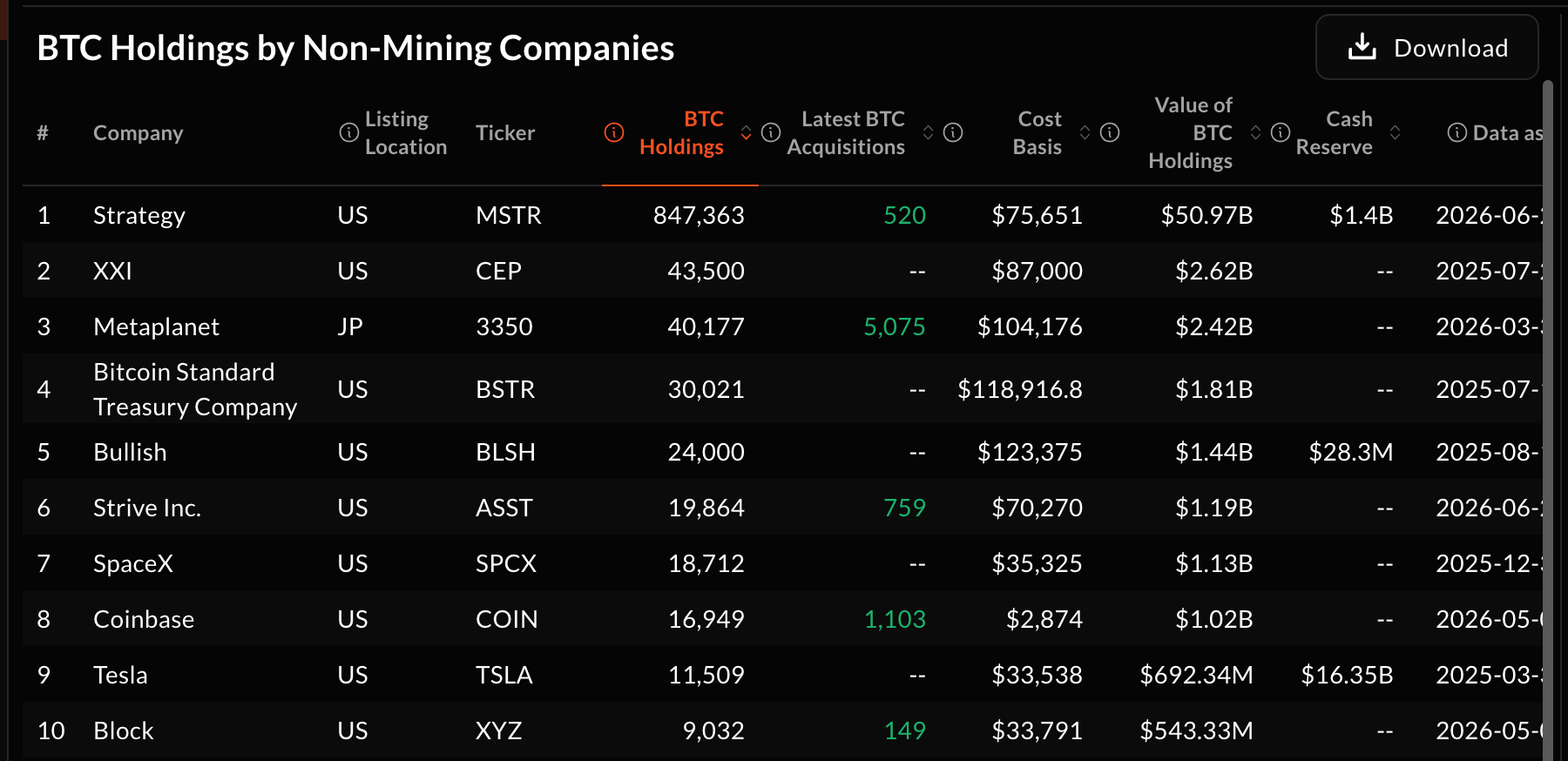
Despite Strategy’s aggressive accumulation of Bitcoin, the price has plunged below $60,000 against the backdrop of a record high of $126,199 reached in October. The sell-off can be attributed to various factors, including market conditions, macroeconomic uncertainty, geopolitical tensions and a lack of catalysts to sustain price recovery.
Bitcoin, altcoins, stablecoins FAQs
Bitcoin is the largest cryptocurrency by market capitalization, a virtual currency designed to serve as money. This form of payment cannot be controlled by any one person, group, or entity, which eliminates the need for third-party participation during financial transactions.
Altcoins are any cryptocurrency apart from Bitcoin, but some also regard Ethereum as a non-altcoin because it is from these two cryptocurrencies that forking happens. If this is true, then Litecoin is the first altcoin, forked from the Bitcoin protocol and, therefore, an “improved” version of it.
Stablecoins are cryptocurrencies designed to have a stable price, with their value backed by a reserve of the asset it represents. To achieve this, the value of any one stablecoin is pegged to a commodity or financial instrument, such as the US Dollar (USD), with its supply regulated by an algorithm or demand. The main goal of stablecoins is to provide an on/off-ramp for investors willing to trade and invest in cryptocurrencies. Stablecoins also allow investors to store value since cryptocurrencies, in general, are subject to volatility.
Bitcoin dominance is the ratio of Bitcoin's market capitalization to the total market capitalization of all cryptocurrencies combined. It provides a clear picture of Bitcoin’s interest among investors. A high BTC dominance typically happens before and during a bull run, in which investors resort to investing in relatively stable and high market capitalization cryptocurrency like Bitcoin. A drop in BTC dominance usually means that investors are moving their capital and/or profits to altcoins in a quest for higher returns, which usually triggers an explosion of altcoin rallies.














