

Trading
Explorez une large gamme de marchés avec des prix compétitifs, une liquidité profonde et des outils de trading avancés.
En savoir plus 
Plateforme
Tradez en toute fluidité avec la plateforme puissante de TMGM, conçue pour la vitesse, la précision et une expérience de trading supérieure.
En savoir plus Plateforme de trading
Outils de trading
Académie
Apprenez les fondamentaux du trading avec des ressources adaptées aux débutants, incluant des guides, des webinaires et des analyses de marché.
En savoir plus Actualités et analyses
Obtenez des mises à jour de marché en temps réel et des analyses d'experts pour anticiper les opportunités de trading
En savoir plus Actualités et analyses
À propos
Découvrez ce qui distingue TMGM — notre présence mondiale, notre solidité réglementaire et notre engagement envers l'innovation dans le trading.
En savoir plus Pourquoi choisir TMGM
Tokyo inflation is forecast to jump to 3% with the Yen under 160.00
- USD/JPY dips to 159.00 on BoJ board member Tamura's speech and recovers.
- Tamura wants rates near 2% soon, but December BoJ hike odds are about 71%.
- Tokyo's November CPI is due Thursday, forecast at 3% after October's 2.6%.
Tokyo's November inflation figures are forecast to jump to 3% from 2.6%, and they arrive after a call for faster rate rises failed to move the Yen for long. USD/JPY dipped to about 159.00 on a speech by Bank of Japan (BoJ) board member Tamura and is back between 159.00 and 159.50, inside Wednesday's range. It hasn't traded above 160.00 since November 13.

BoJ board member Tamura said in Kofu on Thursday that he wants the rate at about 2% as soon as possible. It is 1.25% now, and at one quarter-point rise a quarter, the fastest the BoJ has gone, 2% would arrive in June 2027, a month before his term ends. Traders put a December rise at about 71%, and the Yen's gain on the speech was gone within the session.
The gain didn't last because the rate gap is on the Dollar's side. The Fed's rate is 3.75%-4.00% against Japan's 1.25%, and the Fed is expected to raise first, on December 9. Wednesday's US figures, with growth revised up to 4.3% and core inflation at 3.3%, left USD/JPY flat as well, since Finance Minister Katayama warned against one-sided moves when the pair last crossed 160.00.
On the calendar
Tokyo's November Consumer Price Index (CPI) is due at 23:30 GMT on Thursday. The measure excluding fresh food is forecast at 3% after 2.6%, and the one excluding food and energy at 3% after 2.4%. Both feed the BoJ's December 18 decision, the Japanese side of the rate gap.
Friday is a shortened US session with nothing on the data calendar, and Fed officials go quiet from Saturday. The December 9 Fed decision is priced above 90% for a quarter-point rise, which would take the US rate to 4.00%-4.25% nine days before the BoJ decides.
On the charts
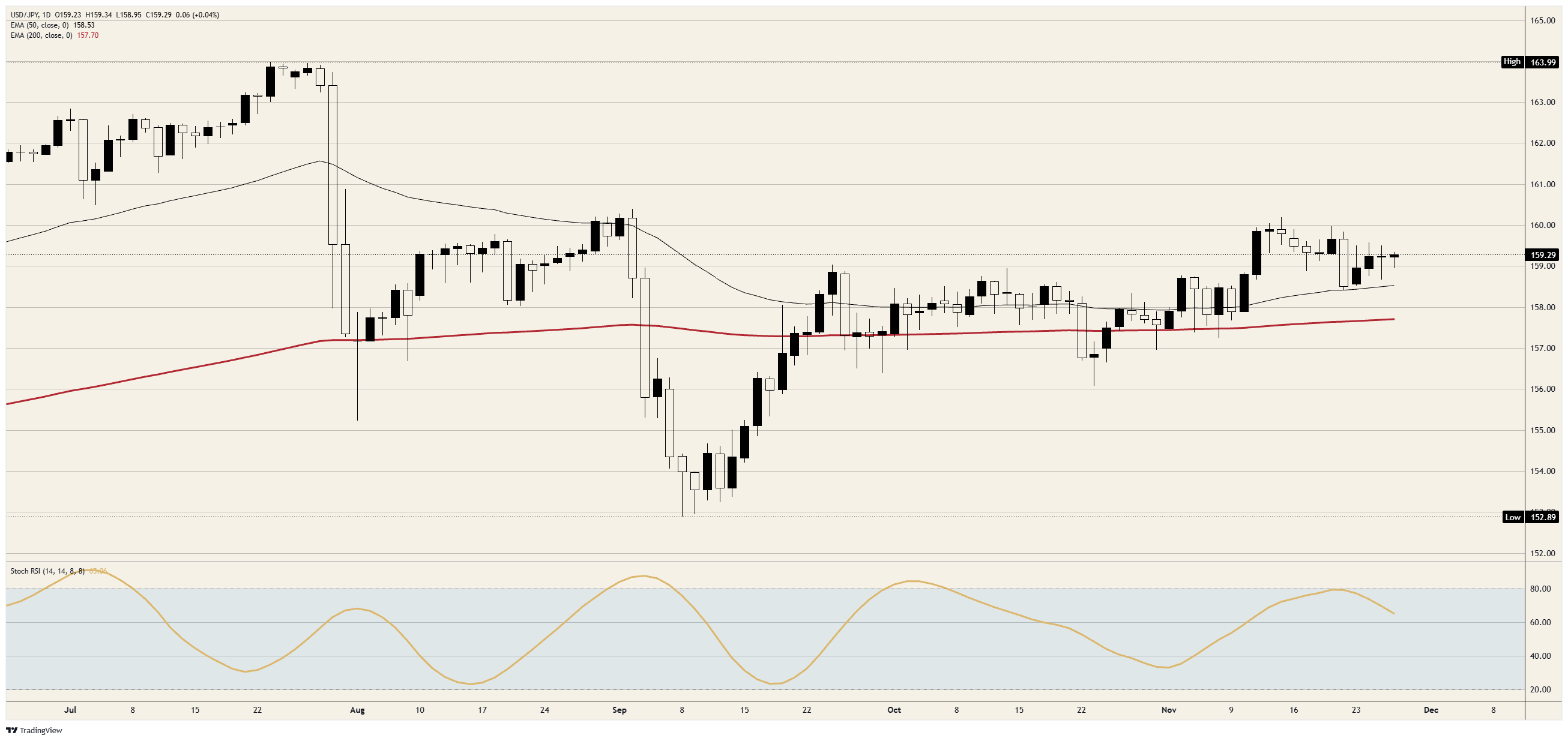
USD/JPY has recovered more than half of the drop from late July's high just under 164.00 to the September 8 low just under 153.00. Every daily close since November 10 has been above its 50-day Exponential Moving Average (EMA), near 158.50, and the 200-day is just under 158.00. Daily momentum has turned down from the edge of overbought.
USD/JPY daily chart
Japanese Yen FAQs
The Japanese Yen (JPY) is one of the world’s most traded currencies. Its value is broadly determined by the performance of the Japanese economy, but more specifically by the Bank of Japan’s policy, the differential between Japanese and US bond yields, or risk sentiment among traders, among other factors.
One of the Bank of Japan’s mandates is currency control, so its moves are key for the Yen. The BoJ has directly intervened in currency markets sometimes, generally to lower the value of the Yen, although it refrains from doing it often due to political concerns of its main trading partners. The BoJ ultra-loose monetary policy between 2013 and 2024 caused the Yen to depreciate against its main currency peers due to an increasing policy divergence between the Bank of Japan and other main central banks. More recently, the gradually unwinding of this ultra-loose policy has given some support to the Yen.
Over the last decade, the BoJ’s stance of sticking to ultra-loose monetary policy has led to a widening policy divergence with other central banks, particularly with the US Federal Reserve. This supported a widening of the differential between the 10-year US and Japanese bonds, which favored the US Dollar against the Japanese Yen. The BoJ decision in 2024 to gradually abandon the ultra-loose policy, coupled with interest-rate cuts in other major central banks, is narrowing this differential.
The Japanese Yen is often seen as a safe-haven investment. This means that in times of market stress, investors are more likely to put their money in the Japanese currency due to its supposed reliability and stability. Turbulent times are likely to strengthen the Yen’s value against other currencies seen as more risky to invest in.
ARTICLES POPULAIRES
1Forex aujourd’hui : le dollar américain se stabilise, l’IPC japonais pourrait secouer le yen2Après un rapport sans relief de la BoE, seule la période de réserve de la Fed se profile pour la livre sterling3Won sud-coréen : la Banque de Corée relève ses taux, les fondamentaux restent solides – ING4Les données de confiance font suite à un compte rendu de la BCE qui a laissé l’euro inchangé5Yen japonais : l’IPC de Tokyo en ligne de mire alors qu’un partisan de la fermeté à la BoJ évoque un resserrement – Scotiabank6Dollar taïwanais : les risques douaniers contrebalancent l’important excédent – Commerzbank7Prévisions USD/CHF : un harami haussier laisse entrevoir un retour à 0,84008Dollar de Singapour : la consolidation se poursuit dans une fourchette face au dollar américain – UOB9Prévisions du cours de l’argent : un marteau laisse entrevoir un rebond vers 45 $ malgré la tendance baissière


Commencez !
Inscrivez-vous et accédez aux Marchés Mondiaux en moins de 3 minutes

Connectez-vous avec Nous









Contacts
Téléphone: +61 2 8036 8388
Fax: +61 2 8036 8388
Email: support@tmgm.com
Web: https://www.tmgm.com



Les informations fournies sur ce site web sont de nature générale uniquement et ne constituent pas un conseil financier personnalisé. Avant d’agir sur la base de toute information figurant sur ce site web, vous devez évaluer la pertinence de ces informations au regard de vos objectifs, de votre situation financière et de vos besoins. Investir dans les CFD et les contrats de marge sur le Forex comporte des risques importants et ne convient pas à tous les investisseurs. Vous pouvez perdre plus que votre dépôt initial. Vous ne détenez pas, et n’avez, aucun droit de propriété ou intérêt sur l’actif sous-jacent. Nous vous recommandons de solliciter un avis indépendant et de vous assurer que vous comprenez pleinement les risques encourus avant de trader. Il est important que vous lisiez et preniez en considération le document d’information avant d’acquérir tout produit présenté sur le site web. Les informations et publicités proposées sur ce site web ne sont pas destinées à être utilisées par toute personne dans tout pays ou toute juridiction où une telle utilisation serait contraire aux lois et réglementations locales. Les Produits et Services proposés sur ce site web ne sont pas destinés aux résidents des États-Unis, de la Malaisie et de la Thaïlande.
TMGM est autorisé et réglementé dans diverses juridictions.
Trademax Australia Limited, opérant sous le nom de TMGM, est réglementé par l'Australian Securities and Investments Commission (ASIC), AFSL no. 436416 et est situé au Level 28, One International Tower, 100 Barangaroo Avenue, 2000 Sydney, NSW Australie.
Email: support@tmgm.com.au
Trademax Global Limited, opérant sous le nom de TMGM, est autorisé et réglementé par la Vanuatu Financial Services Commission (VFSC), numéro d'enregistrement 40356 et enregistré au Law Partners House, Kumul Highway, BP 212, Port Vila, Vanuatu.
Email: support@tmgm.com
Trademax Global Markets (SE) Limited, exerçant sous le nom TMGM, est autorisée et régulée par la Financial Services Authority (FSA) des Seychelles, sous le numéro de licence SD224. La société est enregistrée au bureau n° 13, Providence Estate ABIS Centre, Mahé, Seychelles.
Email: support@tmgm.com
Trademax Global Markets (International) Pty Ltd, opérant sous le nom de TMGM, est autorisé et réglementé par la Financial Services Commission, Maurice (FSC) avec la licence no. GB22201012, et enregistré au 33, Edith Cavell Street C/o IQ EQ Fund Services (Mauritius) Ltd Port Louis, 11324 Maurice.
Email: support@tmgm.com
Copyright © TMGM. Tous droits réservés