

USD/INR recovers amid uncertainty over US-Iran ceasefire
- The Indian Rupee corrects against the US Dollar as investors doubt the sustainability of the US-Iran truce.
- Iran alleges that the US violates three clauses of the 10-point proposal.
- The amount of FIIs selling on Wednesday was significantly lower than the average selling seen in the April 1-7 period.
The Indian Rupee (INR) trades lower against the US Dollar (USD) in the opening trade on Thursday. The USD/INR pair rebounds to near 92.65 from the three-week low of 92.20 posted on Wednesday, following the announcement of a ceasefire between the United States (US) and Iran.

The Indian currency weakens in the early trade due to growing doubts over the sustainability of the US-Iran ceasefire and the continuous outflow of foreign funds from the Indian stock market.
Iran alleges that US violates three clauses of 10-point proposal
Iran’s parliament speaker and chief negotiator, Mohammad Bagher Qalibaf, said in a post on X on Wednesday, that the US has violated three clauses of the 10-point proposal, shared by Tehran as demands in consideration of a permanent ceasefire while agreeing to reopen the Strait of Hormuz.
Iran’s Qalibaf explicitly criticized the US for non-compliance with the first clause of the 10-point proposal, which was “an immediate ceasefire everywhere, including Lebanon and other regions, effective immediately”. He warned that a ceasefire in these conditions is “unreasonable”.
This has raised uncertainty regarding the sustainability of the US-Iran ceasefire, which has revived risk-off impulse, weighing on riskier assets.
Meanwhile, the White House announced on Wednesday that it is sending a team, which will be led by Vice President (VP) JD Vance, to Pakistan for the first round of negotiations on Saturday.
FIIs remain net sellers despite the Iran ceasefire announcement
Foreign Institutional Investors (FIIs) continue to remain net sellers in the Indian stock market despite the US and Iran announcing a two-week ceasefire. On Wednesday, FIIs offloaded their stake worth Rs. 2,811.97 crore. However, the amount sold by foreign investors was significantly lower than the average selling seen in the past trading days of April. In the first four trading days of this month, the average selling by overseas investors was worth Rs. 8,780.39 crore.
RBI leaves interest rates unchanged on Wednesday
In the monetary policy announcement on Wednesday, the Reserve Bank of India (RBI) maintained the status quo, leaving the Repo Rate unchanged at 5.25% for the second time in a row. The Indian central bank was expected to do so as higher oil prices due to the Middle East war had de-anchored inflation expectations globally.
RBI Governor Sanjay Malhotra warned that elevated energy prices could prompt imported inflation and widen the current account deficit.
Technical Analysis: USD/INR stays below 20-day EMA
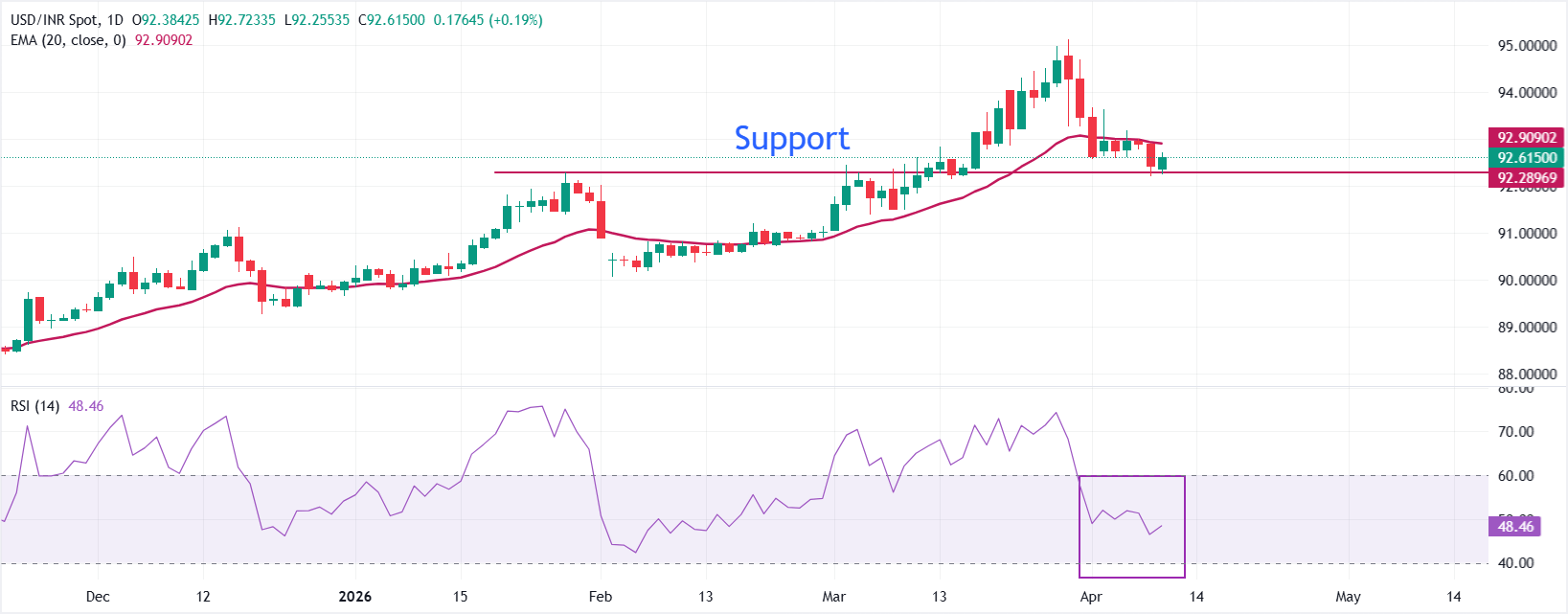
In the early trade, USD/INR trades higher at around 92.60. However, the near-term tone seems bearish as spot holds beneath the 20-day exponential moving average (EMA) at 92.90. The pair’s inability to reclaim this dynamic resistance after the recent pullback suggests upside attempts remain capped for now, while the Relative Strength Index (RSI) around the mid-40s hints at fading bullish momentum rather than outright oversold conditions.
On the topside, the 20-day EMA at 92.90 is the first level buyers need to clear to ease immediate downside pressure and open the way for a more sustained recovery toward 94.00. On the downside, Wednesday's low at 92.20 is the immediate support, followed by the March 5 low at 91.40.
(The technical analysis of this story was written with the help of an AI tool.)
Indian Rupee FAQs
The Indian Rupee (INR) is one of the most sensitive currencies to external factors. The price of Crude Oil (the country is highly dependent on imported Oil), the value of the US Dollar – most trade is conducted in USD – and the level of foreign investment, are all influential. Direct intervention by the Reserve Bank of India (RBI) in FX markets to keep the exchange rate stable, as well as the level of interest rates set by the RBI, are further major influencing factors on the Rupee.
The Reserve Bank of India (RBI) actively intervenes in forex markets to maintain a stable exchange rate, to help facilitate trade. In addition, the RBI tries to maintain the inflation rate at its 4% target by adjusting interest rates. Higher interest rates usually strengthen the Rupee. This is due to the role of the ‘carry trade’ in which investors borrow in countries with lower interest rates so as to place their money in countries’ offering relatively higher interest rates and profit from the difference.
Macroeconomic factors that influence the value of the Rupee include inflation, interest rates, the economic growth rate (GDP), the balance of trade, and inflows from foreign investment. A higher growth rate can lead to more overseas investment, pushing up demand for the Rupee. A less negative balance of trade will eventually lead to a stronger Rupee. Higher interest rates, especially real rates (interest rates less inflation) are also positive for the Rupee. A risk-on environment can lead to greater inflows of Foreign Direct and Indirect Investment (FDI and FII), which also benefit the Rupee.
Higher inflation, particularly, if it is comparatively higher than India’s peers, is generally negative for the currency as it reflects devaluation through oversupply. Inflation also increases the cost of exports, leading to more Rupees being sold to purchase foreign imports, which is Rupee-negative. At the same time, higher inflation usually leads to the Reserve Bank of India (RBI) raising interest rates and this can be positive for the Rupee, due to increased demand from international investors. The opposite effect is true of lower inflation.














