

Trade The World
USD/JPY climbs as improved risk appetite, firm US Dollar weigh on Yen
Par Tammy Da Costa, CFTe®
Date de publication: 25 Jul 2025 | Date de modification: 25 Jul 2025


POPULAR ARTICLES

The Japanese Yen (JPY) is weakening against the US Dollar (USD) on Friday as risk-on sentiment and widening interest rate differentials continue to pressure the Yen.
- USD/JPY climbs as risk-on sentiment and a firm US Dollar weigh on the safe-haven Yen.
- Monetary policy divergence and interest rate differentials remain in focus ahead of Fed and BoJ decisions.
- USD/JPY heads toward 148.00 resistance as bullish momentum builds
The Japanese Yen (JPY) is weakening against the US Dollar (USD) on Friday as risk-on sentiment and widening interest rate differentials continue to pressure the Yen.
At the time of writing, USD/JPY is trading back above 147.00, with the June swing high at 148.03 acting as immediate resistance.
Monetary policy divergence and interest rate differentials remain in focus ahead of Federal Reserve (Fed) and Bank of Japan (BoJ) decisions
With both the BoJ and the Fed scheduled to hold policy meetings next week, interest rate differentials remain a key driver for USD/JPY.
Traders continue to favor the USD as the Fed maintains a higher-for-longer stance, while the BoJ remains cautious amid signs of stabilizing inflation.
Japan’s July Tokyo Consumer Price Index (CPI), released Thursday, came in slightly softer than expected, with headline and core inflation easing to 2.9% from 3.1%.
The data suggests that inflationary pressure may be leveling off, which could give the BoJ further justification to delay any near-term policy tightening.
The figures supported USD/JPY as the divergence in policy outlook between Japan and the US continues to widen.
Meanwhile, markets are also digesting Friday's US Durable Goods Orders for June, a key gauge of business investment.
Although the headline figure showed a steep monthly decline of 9.3%, markets had already anticipated a sharp correction following May’s outsized 16.5% gain. The fact that the decline was less severe than expected helped cushion investor reaction.
USD/JPY heads toward 148.00 resistance as bullish momentum builds
USD/JPY is climbing after rebounding from the 38.2% Fibonacci retracement of the January-April decline at 147.14, with buyers now targeting the 148.03 resistance zone. The pair remains above the 50-day Simple Moving Average (SMA) at 145.23, reinforcing bullish momentum.
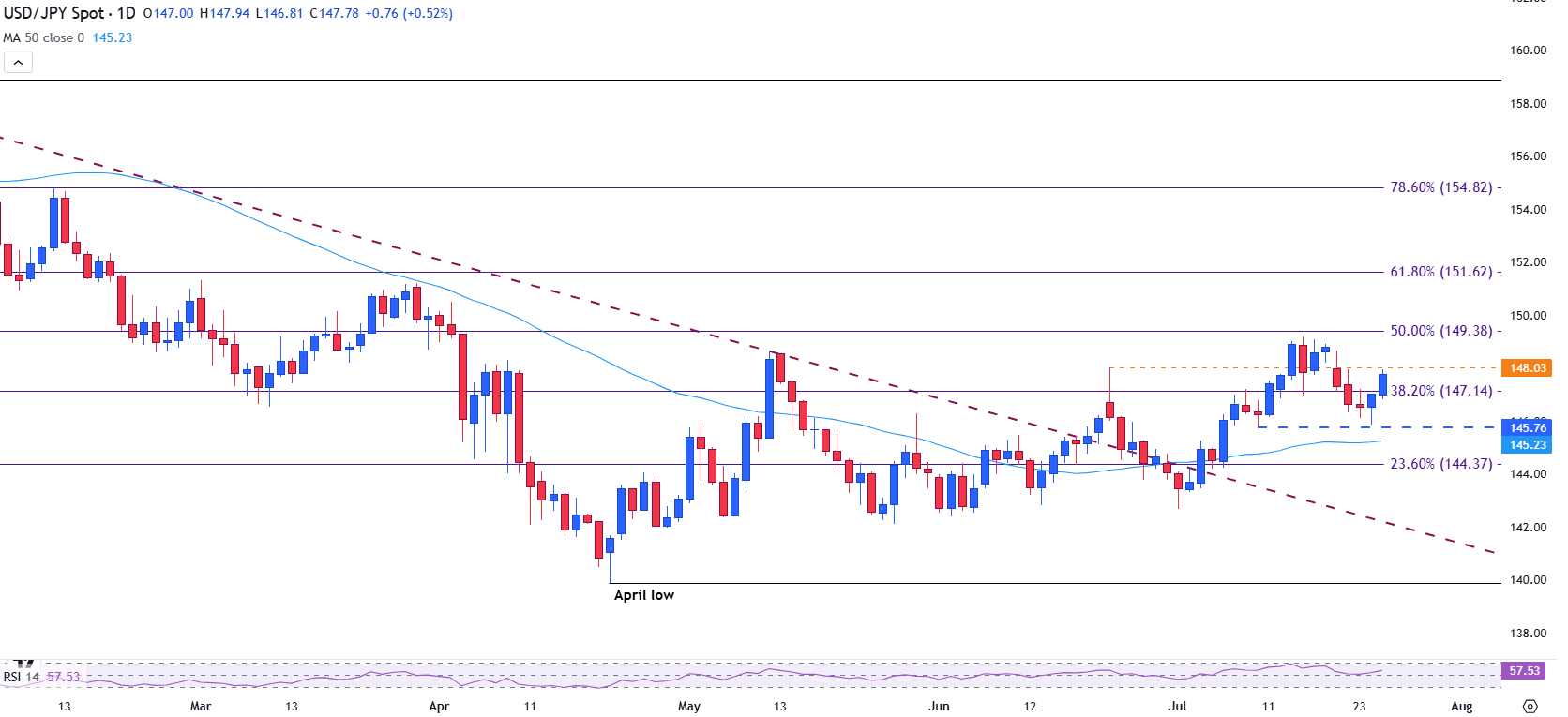
USD/JPY daily chart
If 148.00 is breached, the next upside level sits at the 50% retracement near 149.38. On the downside, initial support is seen at 145.75, followed by the 23.6% retracement at 144.37.
The Relative Strength Index (RSI) has firmed to 57, suggesting there’s room for further gains before entering overbought territory.
US Dollar FAQs
The US Dollar (USD) is the official currency of the United States of America, and the ‘de facto’ currency of a significant number of other countries where it is found in circulation alongside local notes. It is the most heavily traded currency in the world, accounting for over 88% of all global foreign exchange turnover, or an average of $6.6 trillion in transactions per day, according to data from 2022. Following the second world war, the USD took over from the British Pound as the world’s reserve currency. For most of its history, the US Dollar was backed by Gold, until the Bretton Woods Agreement in 1971 when the Gold Standard went away.
The most important single factor impacting on the value of the US Dollar is monetary policy, which is shaped by the Federal Reserve (Fed). The Fed has two mandates: to achieve price stability (control inflation) and foster full employment. Its primary tool to achieve these two goals is by adjusting interest rates. When prices are rising too quickly and inflation is above the Fed’s 2% target, the Fed will raise rates, which helps the USD value. When inflation falls below 2% or the Unemployment Rate is too high, the Fed may lower interest rates, which weighs on the Greenback.
In extreme situations, the Federal Reserve can also print more Dollars and enact quantitative easing (QE). QE is the process by which the Fed substantially increases the flow of credit in a stuck financial system. It is a non-standard policy measure used when credit has dried up because banks will not lend to each other (out of the fear of counterparty default). It is a last resort when simply lowering interest rates is unlikely to achieve the necessary result. It was the Fed’s weapon of choice to combat the credit crunch that occurred during the Great Financial Crisis in 2008. It involves the Fed printing more Dollars and using them to buy US government bonds predominantly from financial institutions. QE usually leads to a weaker US Dollar.
Quantitative tightening (QT) is the reverse process whereby the Federal Reserve stops buying bonds from financial institutions and does not reinvest the principal from the bonds it holds maturing in new purchases. It is usually positive for the US Dollar.

FXStreet
Plus d’un million d’utilisateurs se tournent vers FXStreet pour des données de marché en temps réel, des outils de graphiques, des analyses d’experts et des actualités Forex. Leur calendrier économique complet et leurs webinaires éducatifs aident les traders à rester informés et à prendre des décisions éclairées. FXStreet s’appuie sur une équipe d’environ 60 professionnels répartis entre le siège de Barcelone et diverses régions du monde.
Read More








