What Traders Should Know Before Starting CFD Trading
How CFD Trading Works In Simple Terms
A CFD is a trading contract that tracks the price of an underlying market such as forex, indices, commodities, shares, or crypto. Instead of buying the asset itself, the trader opens a position based on whether the market is expected to rise or fall. If the market moves in the expected direction, the trade can make a profit. If the market moves against the position, the trade makes a loss.
This is why CFDs are often used for short term market exposure. A trader can go long when expecting price to rise or go short when expecting price to fall. The result is based on the difference between the opening price and the closing price, multiplied by the position size.
Why Leverage And Margin Matter Before Opening A Trade
CFDs are usually traded on margin. Margin is the deposit needed to open and maintain a position, while leverage increases market exposure relative to the cash committed. This can make CFDs capital efficient, but it also means that gains and losses are amplified. Higher leverage does not make a trade safer. It only reduces the capital required to open it. A trader should understand CFD leverage and margin before entering any trade.
What Costs Can Affect A CFD Trade
A CFD trade is not only about direction. Trading costs also affect the result. The most common cost is the spread, which is the difference between the buy price and the sell price. Some markets may also involve commission. If a position is kept open overnight, financing or swap charges may apply. In fast markets, slippage can also affect the final entry or exit price. A trader should know these costs before placing the trade, not after.
Important: A lower margin requirement does not reduce market risk. A small price move against a highly leveraged position can still create a large percentage loss on the account.
How To Start Online CFD Trading
Choose A Regulated CFD Broker And Trading Platform
How to start CFD trading begins with choosing the right broker. A trader should look for regulation, clear pricing, stable execution, usable charts, practical order types, and risk management tools such as stop loss and take profit orders. The platform should also make it easy to monitor margin, open positions, and running profit or loss from desktop or mobile.
Open And Fund A CFD Trading Account
Once the broker is chosen, the next step is opening the account, completing verification, and funding it. Before placing the first trade, a trader should become familiar with the platform layout, especially the watchlist, chart area, order ticket, positions window, and account summary. Online CFD trading becomes easier when the platform workflow is already understood before money is at risk.
Choose A Market To Trade First
A trader does not need to start with every asset class. It is usually better to begin with one liquid market that is easy to follow and easy to research. That could be a major forex pair, a widely watched index, gold, or a familiar share CFD. Starting with one clear setup from the available CFD markets is often more manageable than jumping between multiple products without a process.
Start With A Demo Account Or A Small Live Position
A demo account helps a trader practise order entry, position management, and platform navigation without risking live capital. A small live position adds the emotional side of trading, which a demo cannot fully replicate. Both approaches can be useful. The key is to keep the first few trades simple, controlled, and easy to review.
Ready to start trading CFDs?
Open a live trading account with TMGM or practise first with a demo account before trading live markets.
Open a trading accountOr try our demo account first.
How To Trade CFDs Step By Step
Once the account is ready and the market is chosen, the trading workflow is straightforward. The process below shows how to trade CFDs in a structured way.
1. Analyse the market and define the trade idea.
2. Decide whether to buy or sell.
3. Choose the trade size and check the margin required.
4. Set stop loss and take profit levels before entry.
5. Place the trade on the platform.
6. Monitor the position and close the trade when the plan or market condition changes.
Step 1: Analyse The Market And Define The Trade Idea
A trade should begin with a reason, not with the order ticket. The trader needs to know what is being traded, what price behaviour supports the idea, and what condition would prove the idea wrong. This can come from trend structure, support and resistance, a breakout level, or a scheduled news catalyst. A trade idea should be clear before any position size is entered.
Step 2: Decide Whether To Buy Or Sell
If the market is expected to rise, the trader buys. If the market is expected to fall, the trader sells. This long or short decision should follow the trade idea, not emotion. For example, if a market is holding support and showing strength, a buy setup may make sense. If a market is failing at resistance and momentum is weakening, a sell setup may be more logical.
Step 3: Choose The Trade Size And Check The Margin Required
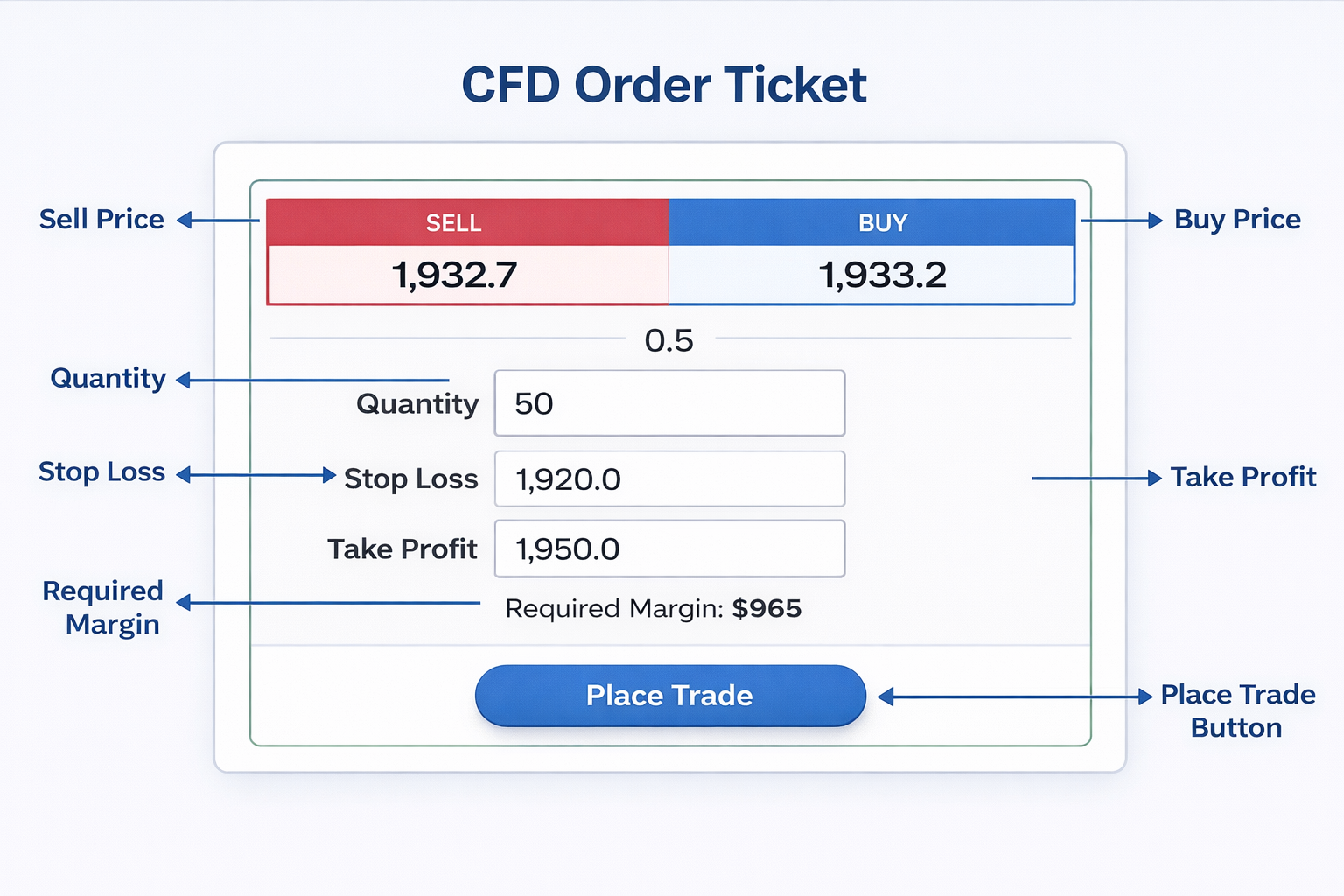
Position size should be based on risk, not confidence. A trader first defines the stop loss distance, then chooses a size that keeps the maximum loss within an acceptable amount. This is one of the most important parts of learning how to trade CFDs because too much size can make a normal market move feel unmanageable. The platform should also show the margin required before the order is placed, so the trader can confirm that there is enough free margin available.
Step 4: Set Stop Loss And Take Profit Levels Before Entering
A stop loss defines where the trade idea is no longer valid. A take profit defines where the trader plans to realise gains if the market moves as expected. Both levels should be set using market structure, not guesswork. A good setup does not only have upside potential. It also has a clear exit if the trade is wrong. This helps control losses and keeps decision making consistent.
Step 5: Place The Trade On The Platform
At this stage, the trader enters the market selection, direction, size, and exit orders into the platform. A market order is used to enter at the current price, while a pending order can be used to wait for a chosen level. Before clicking the final confirmation, the trader should review the trade direction, size, stop loss, take profit, and required margin one more time.
Step 6: Monitor The Position And Close The Trade
Once the position is live, the trader should monitor whether the original setup is still valid. If the market reaches the take profit or stop loss, the trade closes according to plan. A trader can also close the position manually if price action or market conditions change enough to invalidate the idea. The goal is not to stay in every trade for as long as possible. The goal is to manage the trade according to a defined process.
What Should Traders Check Before Opening A CFD Trade?
The order ticket may look simple, but several small fields determine the real risk of the trade. Before placing any position, a trader should review the details below.
• The live price and current spread.
• The order type and trade direction.
• The required margin and total market exposure.
• Any existing positions that could increase overall risk.
The Live Price And Spread
The spread is the gap between the buy price and the sell price. This matters because the trade usually starts slightly negative by the size of that spread. A wider spread means the market needs to move further before the position reaches break even. This is especially important for short term trades where small price moves matter.
The Order Ticket And Order Type
A trader should check whether the platform is set to market order or pending order, and confirm the direction is correct before placing the trade. Buying instead of selling, or using the wrong order type, creates avoidable mistakes. It also helps to check whether stop loss and take profit levels are already attached before the order is submitted.
Margin Required And Total Exposure
The platform should show the margin required for the new position. This helps the trader see how much capital will be tied to the trade and whether enough free margin remains in the account. Exposure matters just as much as the deposit used. A small margin requirement can still control a large market position.
Open Positions And Running Profit Or Loss
A new trade should not be viewed in isolation. If the account already holds other positions, especially correlated ones, total risk can become larger than expected. For example, multiple long positions across risk sensitive assets may all react to the same market event. Checking the full account picture helps prevent hidden overexposure.
CFD Trading Example
The example below shows how a CFD trade can be planned from entry to exit. For more worked scenarios across different markets, traders can review these CFD trading examples. This sample is simplified for education, but it shows the logic behind direction, sizing, margin, and profit or loss.
| Item | Example | What It Means |
|---|---|---|
| Market | US 500 CFD | A major index that many traders can follow through chart structure and market news. |
| Direction | Buy | The trader expects the index to rise from support. |
| Entry Price | 5,200 | This is the level where the trade is opened. |
| Position Size | 2 contracts | For illustration, assume each contract is worth USD 1 per point. |
| Stop Loss | 5,170 | Risk is 30 points. At USD 2 per point total, the maximum planned loss is about USD 60 before costs. |
| Take Profit | 5,260 | Potential gain is 60 points. At USD 2 per point total, the planned profit is about USD 120 before costs. |
| Margin Used | USD 520 | For illustration, assume a 5 percent margin rate on total notional exposure of 10,400. |
| Closing Result | Exit at 5,260 | Price moves 60 points in favour of the trade, creating about USD 120 gross profit before spread, commission where applicable, and overnight charges. |
Note: Actual contract size, point value, margin rate, spread, and overnight holding costs vary by market and platform. The example above is for education only, so the numbers should be treated as illustration rather than a live quote.
How To Manage Risk When Trading CFDs
Risk A Small Portion Of Capital On Each Trade
A trader should decide the maximum acceptable loss before opening the position. This helps position size stay aligned with the account balance. If the planned stop loss implies too large a loss, the position size should be reduced. This creates a process where the account survives normal losing trades and remains available for the next setup.
Use Leverage Carefully
Leverage makes small price moves more meaningful, but it can also make losses build quickly. This is why traders should think in terms of exposure and risk, not only margin required. A position that looks affordable because it uses little margin can still be too large for the account if the stop loss is wide or volatility increases.
Understand Spread, Commission, And Overnight Holding Costs
Costs matter more than many new traders expect. Spread affects the initial entry, commission can reduce the net return on some markets, and overnight holding charges can change the economics of a longer hold. A trader should always judge a setup on the likely net result, not only the headline move on the chart.
Avoid Overtrading And Emotional Decisions
More trades do not automatically mean better results. Many avoidable losses come from trading without a clear setup, moving stops out of frustration, or increasing size after a losing trade. A trader should wait for conditions that match the plan, then execute consistently instead of reacting to every market move.
Why A CFD Trading Plan Matters
A simple trading plan gives structure to every decision from market choice to exit. A trader who is new to CFDs does not need a complex model, but does need a repeatable process. For broader methods and setup ideas, traders can explore these CFD trading strategies and use them as a framework for building a clear plan.
What A Simple CFD Trading Plan Should Include
• The market or small group of markets to trade.
• The type of setup that justifies entry.
• How stop loss and take profit levels will be set.
• The maximum risk allowed on one trade.
• The conditions that mean no trade should be taken.
How A Trading Plan Helps Traders Stay Consistent
A written plan reduces impulsive decisions because the trader already knows what a valid setup looks like. It also makes post trade review possible. When every trade follows a process, it becomes easier to see whether the issue came from the market, the execution, or the plan itself. Consistency begins before the order is placed.
Common Mistakes When Starting CFD Trading
Trading Without A Stop Loss
A trade without a stop loss leaves the downside open ended. Even if the trader plans to exit manually, fast market movement can make that harder than expected. A stop loss turns the trade into a defined risk decision rather than an open hope.
Using Too Much Leverage
New traders sometimes confuse low margin with low risk. In reality, high leverage can turn a small market move into a large account swing. A position should be sized around acceptable loss, not around the largest size the platform allows.
Choosing A Market Without Understanding It
Some markets react strongly to economic releases, company news, earnings, or broader risk sentiment. If a trader does not understand what moves the market being traded, the position is harder to manage. Starting with a market that is familiar and widely followed usually leads to better learning.
Ignoring Trading Costs
A trade can look attractive on the chart but still become weak after costs are considered. Spread, commission where applicable, and overnight financing all affect the final result. Ignoring these costs can lead to poor expectations and poor trade selection.
Opening A Trade Without A Clear Exit Plan
Every trade should answer two exit questions before entry: where does the trader take profit if the idea works, and where does the trader accept the trade is wrong? Without those answers, decisions are more likely to be driven by hope, fear, or hesitation after the trade is already live.