


Key Takeaways
Oil prices in 2026 surged because the Iran US conflict disrupted the Strait of Hormuz, tightened supply, and increased the market risk premium.
Oil may still suit short term investors who accept high volatility, follow macro and geopolitical news closely, and are looking for tactical opportunities rather than stable income.
Oil may not suit investors who want stable returns, lower volatility, predictable income, or a simple long term portfolio because oil prices can reverse quickly on headlines, supply changes, and policy action.
Long term, oil looks less attractive as a buy and hold position because extreme prices are likely to trigger supply responses, reserve releases, or policy intervention that could push prices lower later in 2026.
Oil Prices in 2026: Should you Invest in Oil in 2026? (Short Term vs Long Term Outlook)
Short term, yes, you can invest in Oil for a few months, but Long term, no, unless you expect to trade a bearish trend.
Oil prices already surged above $115 and then pulled back to around $102 per barrel. Oil price has found a strong support level after exploring the $85 to $90 range.
The short term bull case is more obvious than 2 weeks ago, supporting the investing of oil because supply remains constrained and the Strait of Hormuz risk has not fully cleared. As long as that disruption remains unresolved, oil prices are likely to stay elevated.
That said, this is not a stable long term breakout. It is a war driven market with violent headline sensitivity. Tight stop losses remain necessary because Brent Oil Futures are still implying lower prices later in 2026 anticipating supply stabilization.
Who May Consider Oil Investing in 2026
Oil investing in 2026 will suit investors who have a higher risk profile, are comfortable with price swings and want exposure to a market driven by supply shocks, geopolitics, and global demand, which is basically news trading.
This may be more relevant for investors looking for macro opportunities rather than steady income. Oil investing can also be useful for diversification, especially for those who are currently looking for short term capital rotation opportunities.
Who May Want to Avoid Oil Investing in 2026
Investors who prefer stable returns and lower short term risk should avoid investing in oil in 2026. Oil prices in 2026 can move quickly on news about geopolitical conflict, shipping disruptions, production outages, and economic growth, which can make the market hard to hold during sudden reversals.
For those focused on predictable income, lower volatility, or a simpler long term portfolio, oil may add more uncertainty than benefit. In 2026, the outlook remains highly sensitive to events that are hard to predict.
Key Risks Investors Should Watch
Investors should closely monitor developments in the Middle East, especially any disruption to flows through the Strait of Hormuz. A longer disruption could tighten supply and push prices higher, while easing tensions or the release of oil reserves by the US or IEA could remove some of the risk premium from oil prices.
Production trends are also important. Higher U.S. output and any supply changes from major producers could weigh on oil prices. At the same time, weaker global growth could reduce oil demand and limit upside even if supply stays tight.
Other key risks include inventory levels, refinery demand, currency moves, and broader market sentiment.
In 2026, oil is likely to remain a market shaped by both geopolitics and supply and demand fundamentals.
Short Term Case for Investing in Oil in 2026
Technical Analysis (Original Research & Analysis)
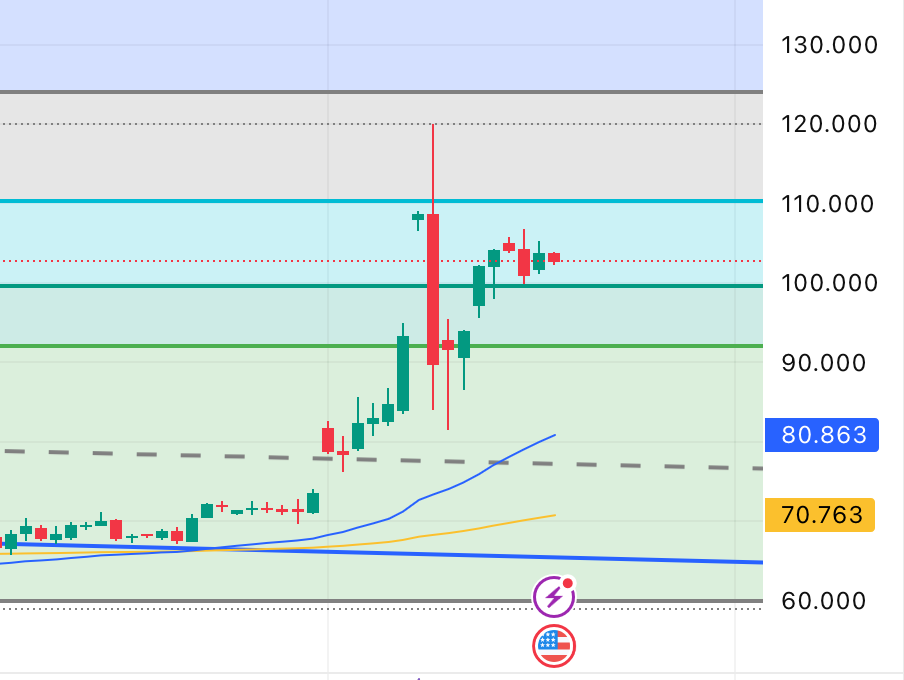
Technical Analysis from TMGM Team’s Expert Analyst of oil price charts has shown that the price action followed a typical geopolitical move: a strong breakout, a sharp rally, and then a steep pullback.
Oil Price broke above a major multi month resistance level, briefly retested support, and then moved higher. After the rejection near the latest resistance, the market now consolidated into a low cheat and might be seeking the next breakout soon, exploring the range of $110 to $120.
Fundamental Analysis: What Will Oil Prices Be in 2026?
Short term fundamental analysis by our research shows that oil prices will remain elevated because supply remains tight and markets are still nervous about disruption.
The US International Energy Agency stated that: “Global oil supply is projected to plunge by 8 mb/d in March, with curtailments in the Middle East partly offset by higher output from non-OPEC+ producers, Kazakhstan and Russia following disruptions at the start of the year.”
The main risk is whether this remains a short term shock or becomes a broader economic problem. Asia is already feeling the impact first because it depends more heavily on Middle Eastern crude oil, which means higher import costs, refinery pressure, and inflation risk could appear before the full effect is felt in the United States.
One line takeaway:
The short term outlook remains bullish, while the longer term direction depends on whether supply disruption persists or starts to normalize.
Long Term Risks of Investing in Oil in 2026
We project a long term bearish case for Brent Crude Oil price in 2026. Data from US Energy Information Administration supported this bearish case, with their quote:
“We forecast the Brent crude oil price will remain above $95/b over the next two months, before falling below $80/b in the third quarter of 2026 and around $70/b by the end of the year.” – U.S. Energy Information Administration.
Besides that, our Commodities Analyst has mentioned that with long-standing crisis level oil price, it will severely devastate the global economy. Due to the political structure of the United States, the US Government will eventually be forced to either release oil reserves or alter the political approach to the US Iran War in order to stabilize the Global Economy.
However, this may not come too soon, as the US is also an oil producing country, so this will impact the US later than sooner, supporting the forecast of $95/b for the next 2 months.
How the Iran U.S. Conflict Is Affecting Oil Prices in 2026?
Oil is rising steeply because the market is pricing in the supply shortage from the Closure of Strait of Hormuz. The current move is being driven by two linked forces: physical disruption to oil production and exports across the Gulf, and the disruption of Strait of Hormuz, affecting 1/5 of Global Crude Oil and LNG supply.
Brent Price and WTI Price both exploded higher as the war escalated.
On March 9, Brent and WTI futures each traded as high as about $119.50 intraday, their highest levels since 2022, before falling sharply on March 10 to roughly $92.45 for Brent and $88.65 for WTI. On March 18, 2026, Brent Crude Oil price stabilized at around $110.
That price action matters because it shows the market is still highly sensitive to every headline, and that the war premium is now firmly priced into oil.
1. Strait of Hormuz: The core reason oil spiked
The daily tanker traffic through the strait dropped to zero from 37 within days of the first attacks. This is the most important reason oil surged, because traders are worried about the entire Gulf export system, including flows from Iraq, Kuwait, Saudi Arabia, the UAE and Qatar.
2. Production Cuts and Regional Infrastructure Damage
Iraq’s main southern oilfield production reduced by 70% to about 1.3 million barrels per day because exports via Hormuz were blocked and storage filled up.
Kuwait also began reducing output and declared force majeure.
Saudi Arabia has started trimming output.
Bahrain’s Bapco declared force majeure after an attack on its refinery complex.
Does Oil Fit a Portfolio in 2026?
The final verdict is simple. The short term outlook remains supportive for oil while disruption lasts. The longer term outlook is more neutral because extreme oil prices tend to trigger the very response that brings them back down.
The reason is also simple: Oil prices above crisis levels eventually become politically and economically intolerable. If prices stay too high for too long, they begin to crush the global economy by raising inflation, therefore forcing governments to intervene and increase the incentive for emergency stock releases, sanction adjustments and diplomatic pressure.
That is why we lean towards eventual emergency reserve releases, coordinated intervention, and stronger peace efforts being likely to be more serious once the economic damage becomes obvious.