Dow Jones Industrial Average rebounds as Trump hints at Iran discussions
Oleh Joshua Gibson
Diperbarui: 30 Mar 2026


ARTIKEL POPULER

The Dow Jones Industrial Average (DJIA) traded higher on Monday, adding back around 415 points in a thin recovery from last week's late plunge as President Donald Trump suggested a resolution to the war with Iran may be within reach. The S&P 500 rose 0.5% and the Nasdaq Composite gained 0.3%.
- The Dow added over 400 points on Monday as hopes grew for a ceasefire with Iran.
- Oil prices continued to climb, with Brent crude holding above $112 per barrel.
- Federal Reserve Chair Jerome Powell said interest rates are well-positioned given current conditions.
- Markets face a packed data week capped by Friday's Nonfarm Payrolls release on Good Friday.
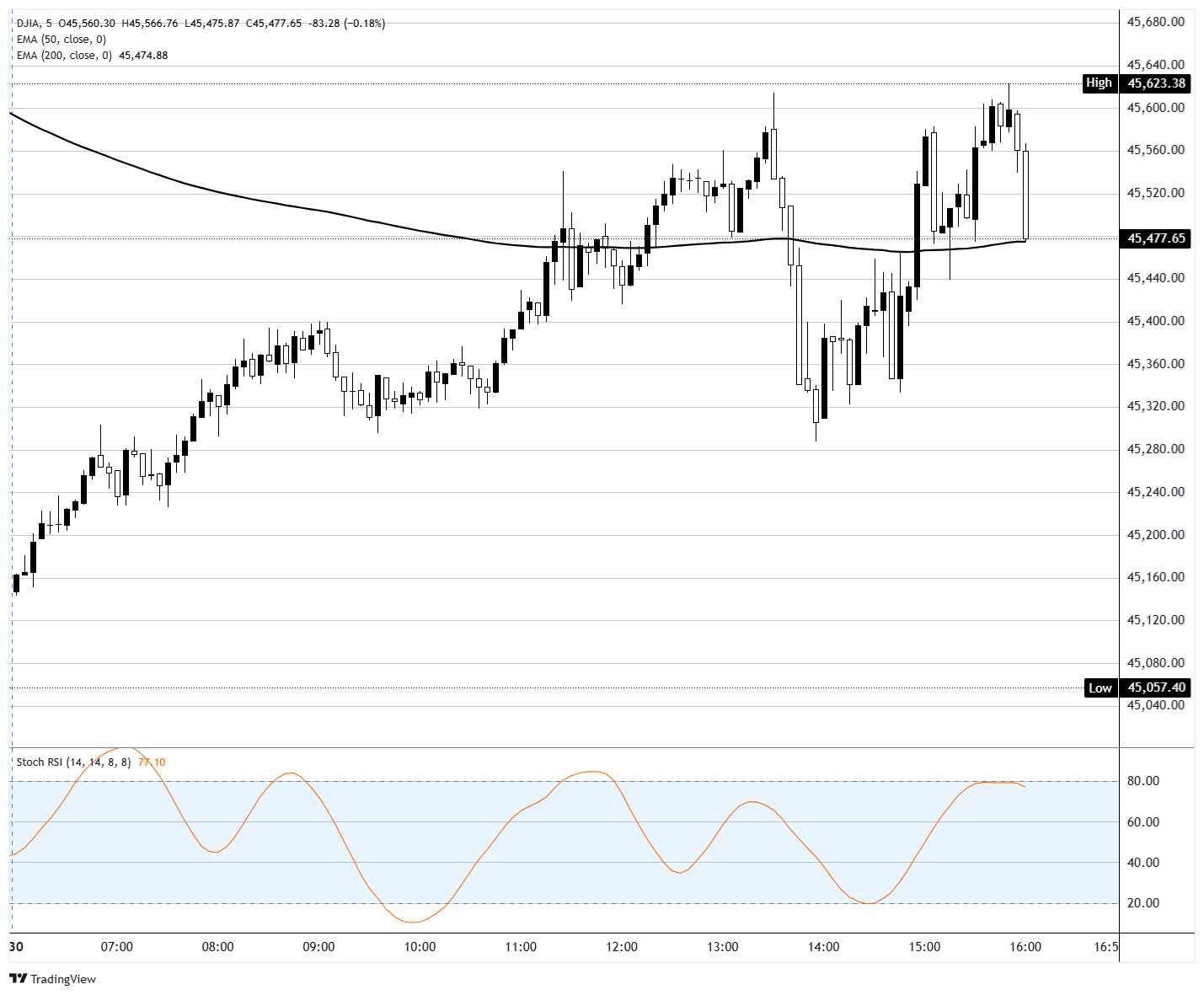
The Dow Jones Industrial Average (DJIA) traded higher on Monday, adding back around 415 points in a thin recovery from last week's late plunge as President Donald Trump suggested a resolution to the war with Iran may be within reach. The S&P 500 rose 0.5% and the Nasdaq Composite gained 0.3%. The Dow rallied from an early session low near 45,100, grinding steadily higher through the session to tag a high above 45,600 before settling just above 45,500. All three major indices entered the session having posted five consecutive weekly declines, with the Dow and Nasdaq both tipping into correction territory last week.
Trump signals progress on Iran peace deal
The rally was driven by a Truth Social post from Trump claiming the US is in discussions with what he described as a new, more reasonable regime in Iran. The president said great progress had been made, though he warned that if a deal is not reached shortly and the Strait of Hormuz is not immediately reopened, the US would escalate by targeting Iranian infrastructure including electric generating plants, Oil wells, and Kharg Island. The comments followed Sunday reports that Tehran had accepted most of a 15-point US plan and agreed to allow an additional 20 Pakistani-flagged tanker ships through the Strait over a ten-day period. Markets have been under sustained pressure from the conflict, and any de-escalation headlines are being treated as a catalyst for relief rallies.
Oil prices rise as Strait of Hormuz remains in focus
Despite the optimism around peace talks, crude prices moved higher to start the week. Brent crude futures edged up to above $112 per barrel, while West Texas Intermediate (WTI) futures rose around 2% to above $102. The Strait of Hormuz remains effectively constrained, and even partial progress toward reopening has not been enough to meaningfully ease supply fears. Mohamed El-Erian, chief economic advisor at Allianz, warned that the real economic tipping point would be physical shortages, particularly in Asia, which could then feed through to higher import prices and supply disruptions in the US. El-Erian also flagged limited policy flexibility, noting the US is already running a 6% deficit and questioning how much room policymakers have to offset an extended energy shock.
Powell strikes a patient tone at Harvard
Federal Reserve (Fed) Chair Jerome Powell, speaking at Harvard University on Monday, said he believes the current interest rate stance is appropriate given the swirl of economic conditions, particularly elevated energy prices. Powell noted that tightening policy now to address an Oil price shock would risk weighing on the economy after the shock has passed, and said the Fed's tendency is to look through supply-driven price spikes. The comments reinforce the Federal Open Market Committee's (FOMC) decision to hold rates steady at 3.50%-3.75% at its March 18 meeting, where the dot plot median continued to point to just one 25 basis-point cut in 2026, and officials revised their headline Personal Consumption Expenditures Price Index (PCE) inflation forecast up to 2.7% from 2.4% in December.
Miran and Powell: a growing policy divergence
Powell's patient posture stands in sharp contrast to Fed Governor Stephen Miran, who also spoke on Monday and has dissented at every FOMC meeting since his appointment, voting in favor of rate cuts each time. Miran entered the March meeting projecting four cuts for 2026, well above the committee median, and was the sole dissenter in the 11-1 vote to hold. He has argued that policy remains clearly restrictive and that the Oil shock should not alter the Fed's rate path, saying the central bank should not make policy based on short-term headlines. However, Miran acknowledged on March 25 that he had raised his year-end rate projection by 50 basis points in response to disappointing inflation data, putting his forecast at roughly neutral. The split highlights a widening gap between the committee's wait-and-see majority and a dovish minority that sees the labor market cooling faster than the headline data suggest.
A heavy data week ahead of Good Friday
This is a shortened but data-heavy trading week, with US markets closed on Good Friday. Tuesday brings the Conference Board Consumer Confidence Index for March, the first reading to fully capture the war's impact on household sentiment, alongside the Job Openings and Labor Turnover Survey (JOLTS) for February, where consensus expects 6.87 million openings, down slightly from 6.946 million. Wednesday is the busiest session, with ADP Non-Farm Employment for March expected at 40K, down from 63K, followed by February retail sales, forecast at 0.4% month-over-month after a -0.2% print in January. The Institute for Supply Management (ISM) Manufacturing Purchasing Managers Index (PMI) for March is also due Wednesday, with the prices paid component forecast at 73.5, up from 70.5, highlighting persistent input cost pressures. Thursday features initial jobless claims, expected at 212K. Friday's March Nonfarm Payrolls (NFP) report from the Bureau of Labor Statistics (BLS) will be released at 12:30 GMT as scheduled despite the market holiday, with consensus looking for 55K new jobs after a surprise -92K reading last month. Average hourly earnings are expected at 0.3% month-over-month, and the unemployment rate is forecast to hold steady at 4.4%. Traders will have the entire Easter weekend to digest the data before markets reopen on Monday.
Dow Jones 5-minute chart
Dow Jones FAQs
The Dow Jones Industrial Average, one of the oldest stock market indices in the world, is compiled of the 30 most traded stocks in the US. The index is price-weighted rather than weighted by capitalization. It is calculated by summing the prices of the constituent stocks and dividing them by a factor, currently 0.152. The index was founded by Charles Dow, who also founded the Wall Street Journal. In later years it has been criticized for not being broadly representative enough because it only tracks 30 conglomerates, unlike broader indices such as the S&P 500.
Many different factors drive the Dow Jones Industrial Average (DJIA). The aggregate performance of the component companies revealed in quarterly company earnings reports is the main one. US and global macroeconomic data also contributes as it impacts on investor sentiment. The level of interest rates, set by the Federal Reserve (Fed), also influences the DJIA as it affects the cost of credit, on which many corporations are heavily reliant. Therefore, inflation can be a major driver as well as other metrics which impact the Fed decisions.
Dow Theory is a method for identifying the primary trend of the stock market developed by Charles Dow. A key step is to compare the direction of the Dow Jones Industrial Average (DJIA) and the Dow Jones Transportation Average (DJTA) and only follow trends where both are moving in the same direction. Volume is a confirmatory criteria. The theory uses elements of peak and trough analysis. Dow’s theory posits three trend phases: accumulation, when smart money starts buying or selling; public participation, when the wider public joins in; and distribution, when the smart money exits.
There are a number of ways to trade the DJIA. One is to use ETFs which allow investors to trade the DJIA as a single security, rather than having to buy shares in all 30 constituent companies. A leading example is the SPDR Dow Jones Industrial Average ETF (DIA). DJIA futures contracts enable traders to speculate on the future value of the index and Options provide the right, but not the obligation, to buy or sell the index at a predetermined price in the future. Mutual funds enable investors to buy a share of a diversified portfolio of DJIA stocks thus providing exposure to the overall index.

Lebih dari satu juta pengguna mengandalkan FXStreet untuk data pasar real-time, alat charting, wawasan ahli, dan berita forex. Kalender ekonomi komprehensif dan webinar edukatif membantu trader tetap mendapat informasi dan membuat keputusan terukur. FXStreet memiliki sekitar 60 profesional yang tersebar antara kantor pusat Barcelona dan berbagai wilayah global.
Baca Selengkapnya