Gold rebounds from six-month low as Trump threats rattle markets
Oleh Christian Borjon Valencia
Diperbarui: 11 Jun 2026


ARTIKEL POPULER

Gold (XAU/USD) price trims some of its earlier losses, turning positive on Thursday, up by 0.58% as the resolution of the Middle East conflict seems far off amid US-Iran exchanges of fire, which could delay negotiations. The XAU/USD trades at $4,091 after reaching a six-month low of $4,023.
- Trump weighs Kharg Island seizure as Iran warns retaliation.
- Hot PPI keeps Fed rate-hike expectations alive into year-end.
- US Dollar strength and central-bank tightening risks cap Gold rebound.
Gold (XAU/USD) price trims some of its earlier losses, turning positive on Thursday, up by 0.58% as the resolution of the Middle East conflict seems far off amid US-Iran exchanges of fire, which could delay negotiations. The XAU/USD trades at $4,091 after reaching a six-month low of $4,023.
XAU/USD recovers as US-Iran escalation revives haven demand
During the overnight session, hostilities between Washington and Tehran continued, while US President Donald Trump vowed to continue the attacks on Iran, stating that he’s contemplating the seizure of Kharg Island. Iran attacked US military bases around the Gulf region and warned via the Chairman of the Parliament's National Security Commission that “Iran will give a decisive, crushing, painful, and regretful response to any action or threat,” according to Nour News reports.
US inflation data showed that prices on the produce side rose by 6.5% YoY in May, exceeding April’s 5.7% print and forecasts of 6.4%. Excluding energy and food items, the so-called core Producer Price Index (PPI) expanded by 4.9% YoY for the same period, below the consensus of 5.4% and unchanged compared to April’s.
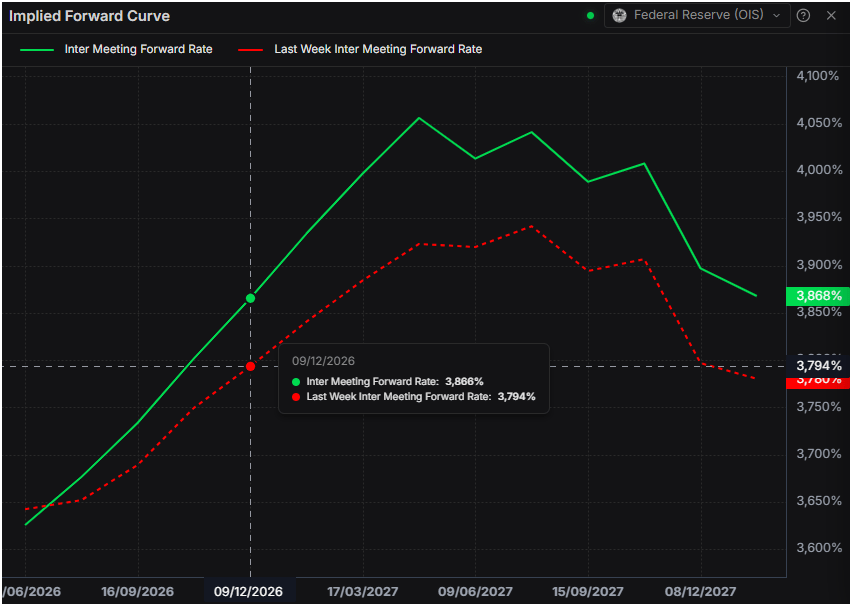
Worth noting that the PPI report, along with the CPI revealed a day ago, kept investors' expectations for a rate increase by the Federal Reserve (Fed) towards the end of 2026, according to Prime Terminal data.
The US economic schedule also included job figures, with Initial Jobless Claims for the week ending June 6 rising by 229K, exceeding the 219K expected by analysts.
Bullion’s advance has been capped by speculation that major central banks will raise interest rates amid the energy crisis. Also, overall US Dollar strength, underpinned by the recovery of Oil prices, is a headwind for Gold.
The US Dollar Index (DXY), which tracks the Greenback’s value against a basket of currencies, is up 0.20% at 100.28.
Ahead in the week, the US economic docket will feature the release of the University of Michigan Consumer Sentiment for June on its preliminary reading, ahead of the Federal Reserve's monetary policy
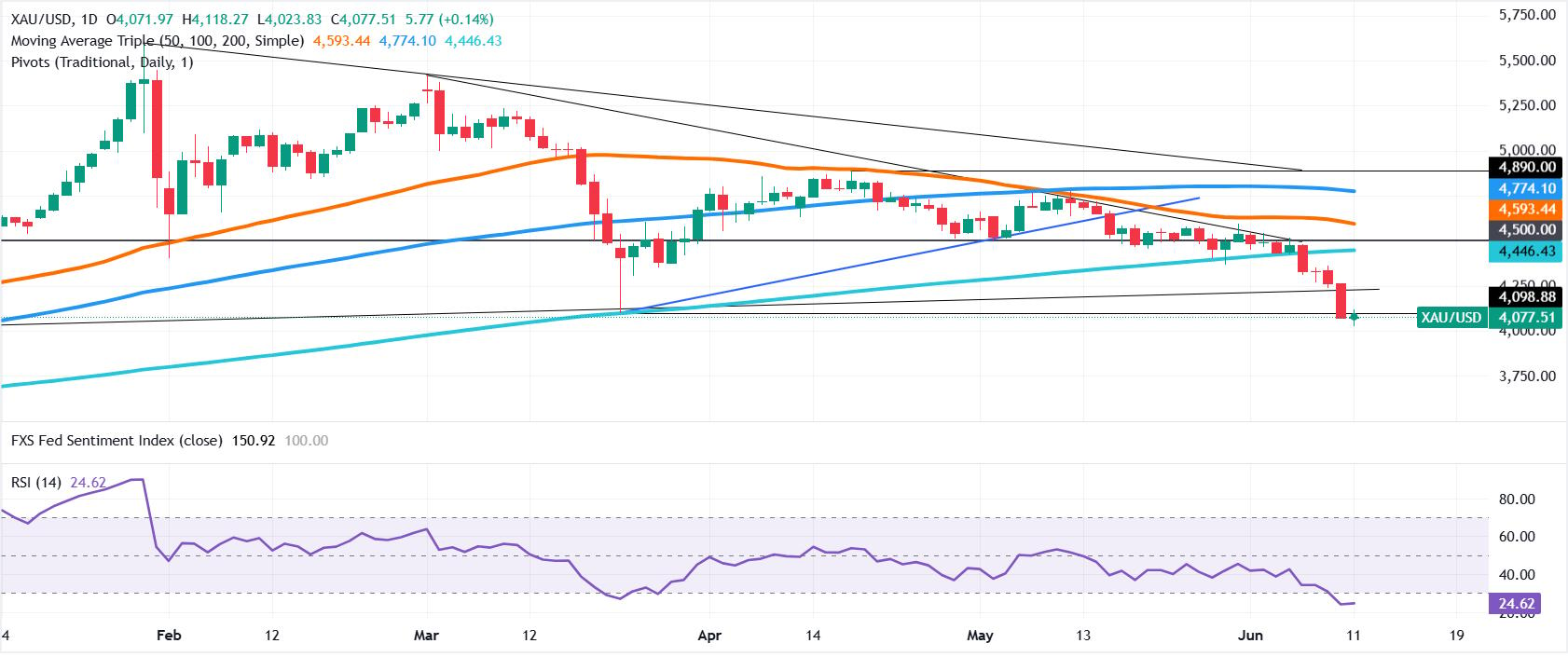
XAU/USD technical outlook: Gold consolidates below $4,100, sellers eye $4,000
Gold has shifted bearish after reaching a six-month low of $4,023, with sellers driving the price below the previous low of $4,098, opening the door to further downside. Momentum favors further downside, as indicated by the Relative Strength Index (RSI), which is oversold yet shy of the most extreme level below the 20 area. Hence, the downtrend remains intact, and further losses are expected.
If bullion prices plummet below $4,000, the next significant support level from supply and demand dynamics is the October 28, 2025, swing low at $3,886.
Upwards, XAU/USD must reclaim the 200-day Simple Moving Average (SMA) at $4,443, paving the way to test $4,500.
Gold FAQs
Gold has played a key role in human’s history as it has been widely used as a store of value and medium of exchange. Currently, apart from its shine and usage for jewelry, the precious metal is widely seen as a safe-haven asset, meaning that it is considered a good investment during turbulent times. Gold is also widely seen as a hedge against inflation and against depreciating currencies as it doesn’t rely on any specific issuer or government.
Central banks are the biggest Gold holders. In their aim to support their currencies in turbulent times, central banks tend to diversify their reserves and buy Gold to improve the perceived strength of the economy and the currency. High Gold reserves can be a source of trust for a country’s solvency. Central banks added 1,136 tonnes of Gold worth around $70 billion to their reserves in 2022, according to data from the World Gold Council. This is the highest yearly purchase since records began. Central banks from emerging economies such as China, India and Turkey are quickly increasing their Gold reserves.
Gold has an inverse correlation with the US Dollar and US Treasuries, which are both major reserve and safe-haven assets. When the Dollar depreciates, Gold tends to rise, enabling investors and central banks to diversify their assets in turbulent times. Gold is also inversely correlated with risk assets. A rally in the stock market tends to weaken Gold price, while sell-offs in riskier markets tend to favor the precious metal.
The price can move due to a wide range of factors. Geopolitical instability or fears of a deep recession can quickly make Gold price escalate due to its safe-haven status. As a yield-less asset, Gold tends to rise with lower interest rates, while higher cost of money usually weighs down on the yellow metal. Still, most moves depend on how the US Dollar (USD) behaves as the asset is priced in dollars (XAU/USD). A strong Dollar tends to keep the price of Gold controlled, whereas a weaker Dollar is likely to push Gold prices up.

Lebih dari satu juta pengguna mengandalkan FXStreet untuk data pasar real-time, alat charting, wawasan ahli, dan berita forex. Kalender ekonomi komprehensif dan webinar edukatif membantu trader tetap mendapat informasi dan membuat keputusan terukur. FXStreet memiliki sekitar 60 profesional yang tersebar antara kantor pusat Barcelona dan berbagai wilayah global.
Baca Selengkapnya