NZD/USD climbs above 0.59 as hot CPI fuels RBNZ hike bets ahead of Fed
Oleh Joshua Gibson
Diperbarui: 27 Apr 2026


ARTIKEL POPULER

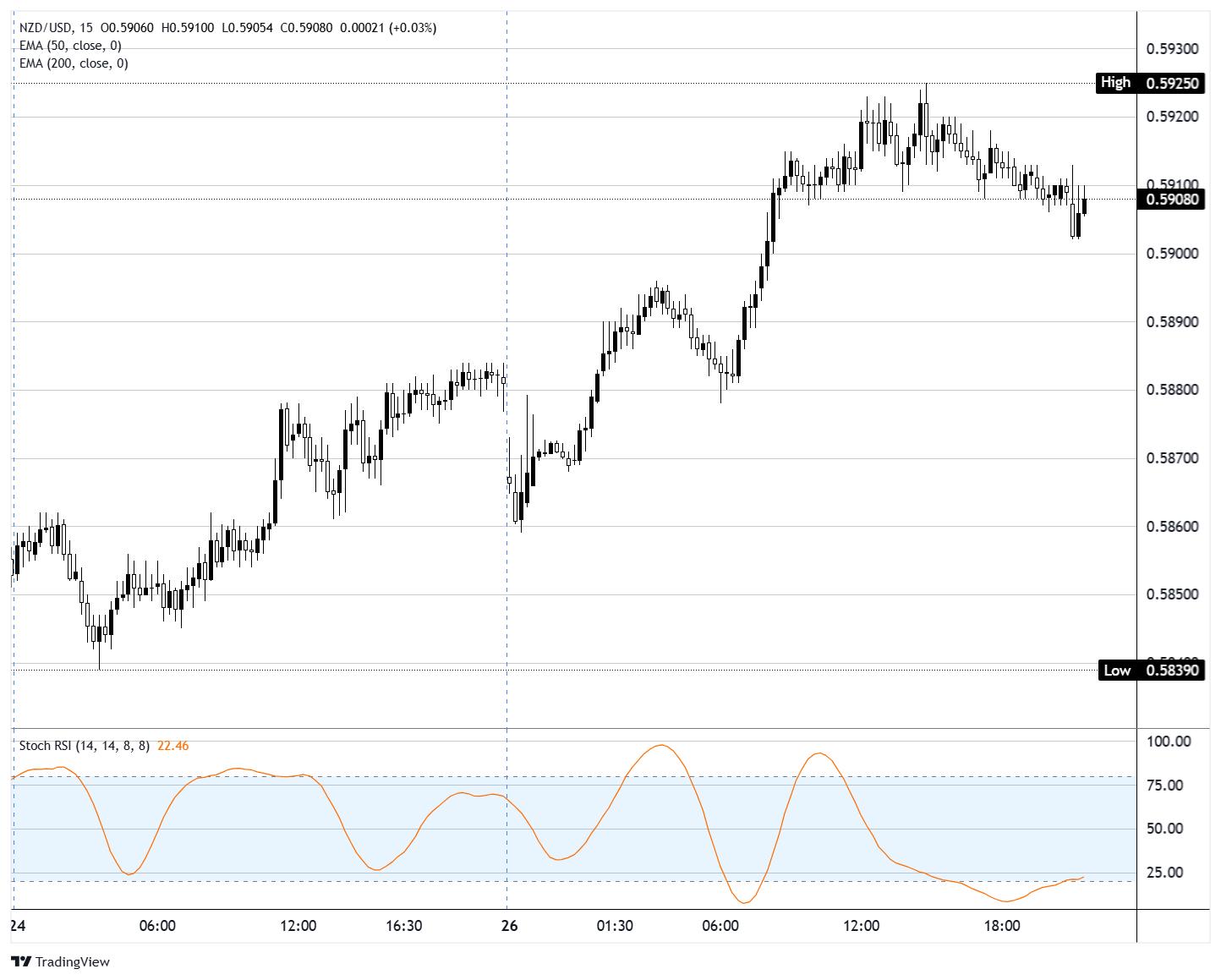
NZD/USD posted limited gains of around 0.4% on Monday, settling close to 0.5905 but stalling just below the 0.5925 area that capped last week's recovery.
- New Zealand's hot Q1 CPI print lifted RBNZ May rate hike odds to roughly 60%, with a July move now fully priced.
- The Fed is set to hold at 3.50% to 3.75% Wednesday in Powell's final meeting before his May 15 chair term ends.
- Thursday's US Core PCE and Q1 GDP data round out the week, with ISM Manufacturing PMI and Iran headlines also in focus.
NZD/USD posted limited gains of around 0.4% on Monday, settling close to 0.5905 but stalling just below the 0.5925 area that capped last week's recovery. The pair has been trapped in the upper bound of a near-term range, with momentum fading near the 0.5900 handle as buyers struggle to extend the rebound. Daily candles continue to print higher lows since the early-April trough at 0.5680, though the rally is showing signs of exhaustion at range highs from earlier this month.
On the New Zealand Dollar side, last week's hotter-than-expected Q1 Consumer Price Index (CPI) print pushed market pricing for a Reserve Bank of New Zealand (RBNZ) rate hike at the May meeting from below 30% before the release to roughly 60%, with a July move now fully priced. The Strait of Hormuz blockade is feeding through to imported energy costs, and policymakers expect Q2 inflation pressures to intensify as the energy shock filters into the data. RBNZ Deputy Governor Karen Breman's Wednesday speech and Thursday's ANZ Roy Morgan Consumer Confidence reading are the domestic catalysts ahead of the May meeting, though the RBNZ has previously warned it would act decisively if inflation accelerates further.
On the US Dollar side, the Federal Open Market Committee (FOMC) is widely expected to hold the federal funds rate at 3.50% to 3.75% on Wednesday in Chair Jerome Powell's final meeting before his term expires May 15. April brings no Summary of Economic Projections, leaving the statement and press conference to carry the message amid March headline inflation at a two-year high of 3.3% and Q4 2025 Gross Domestic Product (GDP) revised to just 0.5%. Thursday's advance Q1 GDP read (consensus 2.2%), Core Personal Consumption Expenditures (PCE) print (forecast 3.2% YoY), and Friday's ISM Manufacturing Purchasing Managers Index (PMI) round out a packed US data calendar. The Senate Banking Committee is also scheduled to vote on Kevin Warsh's nomination as Powell's successor on Wednesday, with the still-fragile US-Iran ceasefire and ongoing Strait of Hormuz blockade providing the backdrop for risk sentiment through the week.
NZD/USD 15-minute chart
New Zealand Dollar FAQs
The New Zealand Dollar (NZD), also known as the Kiwi, is a well-known traded currency among investors. Its value is broadly determined by the health of the New Zealand economy and the country’s central bank policy. Still, there are some unique particularities that also can make NZD move. The performance of the Chinese economy tends to move the Kiwi because China is New Zealand’s biggest trading partner. Bad news for the Chinese economy likely means less New Zealand exports to the country, hitting the economy and thus its currency. Another factor moving NZD is dairy prices as the dairy industry is New Zealand’s main export. High dairy prices boost export income, contributing positively to the economy and thus to the NZD.
The Reserve Bank of New Zealand (RBNZ) aims to achieve and maintain an inflation rate between 1% and 3% over the medium term, with a focus to keep it near the 2% mid-point. To this end, the bank sets an appropriate level of interest rates. When inflation is too high, the RBNZ will increase interest rates to cool the economy, but the move will also make bond yields higher, increasing investors’ appeal to invest in the country and thus boosting NZD. On the contrary, lower interest rates tend to weaken NZD. The so-called rate differential, or how rates in New Zealand are or are expected to be compared to the ones set by the US Federal Reserve, can also play a key role in moving the NZD/USD pair.
Macroeconomic data releases in New Zealand are key to assess the state of the economy and can impact the New Zealand Dollar’s (NZD) valuation. A strong economy, based on high economic growth, low unemployment and high confidence is good for NZD. High economic growth attracts foreign investment and may encourage the Reserve Bank of New Zealand to increase interest rates, if this economic strength comes together with elevated inflation. Conversely, if economic data is weak, NZD is likely to depreciate.
The New Zealand Dollar (NZD) tends to strengthen during risk-on periods, or when investors perceive that broader market risks are low and are optimistic about growth. This tends to lead to a more favorable outlook for commodities and so-called ‘commodity currencies’ such as the Kiwi. Conversely, NZD tends to weaken at times of market turbulence or economic uncertainty as investors tend to sell higher-risk assets and flee to the more-stable safe havens.

Lebih dari satu juta pengguna mengandalkan FXStreet untuk data pasar real-time, alat charting, wawasan ahli, dan berita forex. Kalender ekonomi komprehensif dan webinar edukatif membantu trader tetap mendapat informasi dan membuat keputusan terukur. FXStreet memiliki sekitar 60 profesional yang tersebar antara kantor pusat Barcelona dan berbagai wilayah global.
Baca Selengkapnya