Silver Price Forecast: XAG/USD trades firmly near two-month high of $86.50 ahead of US CPI
Oleh Sagar Dua
Diperbarui: 12 May 2026


ARTIKEL POPULER
Silver price (XAG/USD) holds onto its almost week-long rally to near $86.50 during the Asian trading session on Tuesday. The white metal trades firmly even as oil prices are broadly stable amid fears that military actions between the United States (US) and Iran could resume.
- Silver price clings to gains near $86.50 in the countdown to the US CPI data for April.
- The white metal reflects strength despite oil prices remaining elevated.
- Investors will pay close attention to the Trump-Xi meeting during the May 13-15 period.
Silver price (XAG/USD) holds onto its almost week-long rally to near $86.50 during the Asian trading session on Tuesday. The white metal trades firmly even as oil prices are broadly stable amid fears that military actions between the United States (US) and Iran could resume.
According to a report from CNN, US President Donald Trump has grown increasingly frustrated with how the Iranians are handling talks to end the conflict, and some Trump aides say that he is now more seriously considering a resumption of major combat operations than he has in recent weeks.
The resumption of the war in the Middle East would prompt fears of a prolonged closure of the Strait of Hormuz, a vital passage to almost 20% of global energy supply.
Higher oil prices bode poorly for non-yielding assets, such as Silver, as they boost global inflation expectations, which discourage central bankers from easing monetary conditions.
Meanwhile, investors await the US Consumer Price Index (CPI) data for April, which will be published at 12:30 GMT. The CPI report is expected to show that the headline inflation rose to 3.7% Year-on-Year (YoY) from the previous reading of 3.3%.
This week, the major trigger for the Silver price and global markets would be the bilateral meeting between US President Donald Trump and Chinese leader Xi Jinping, which is expected during the May 13-15 period.
Silver technical analysis
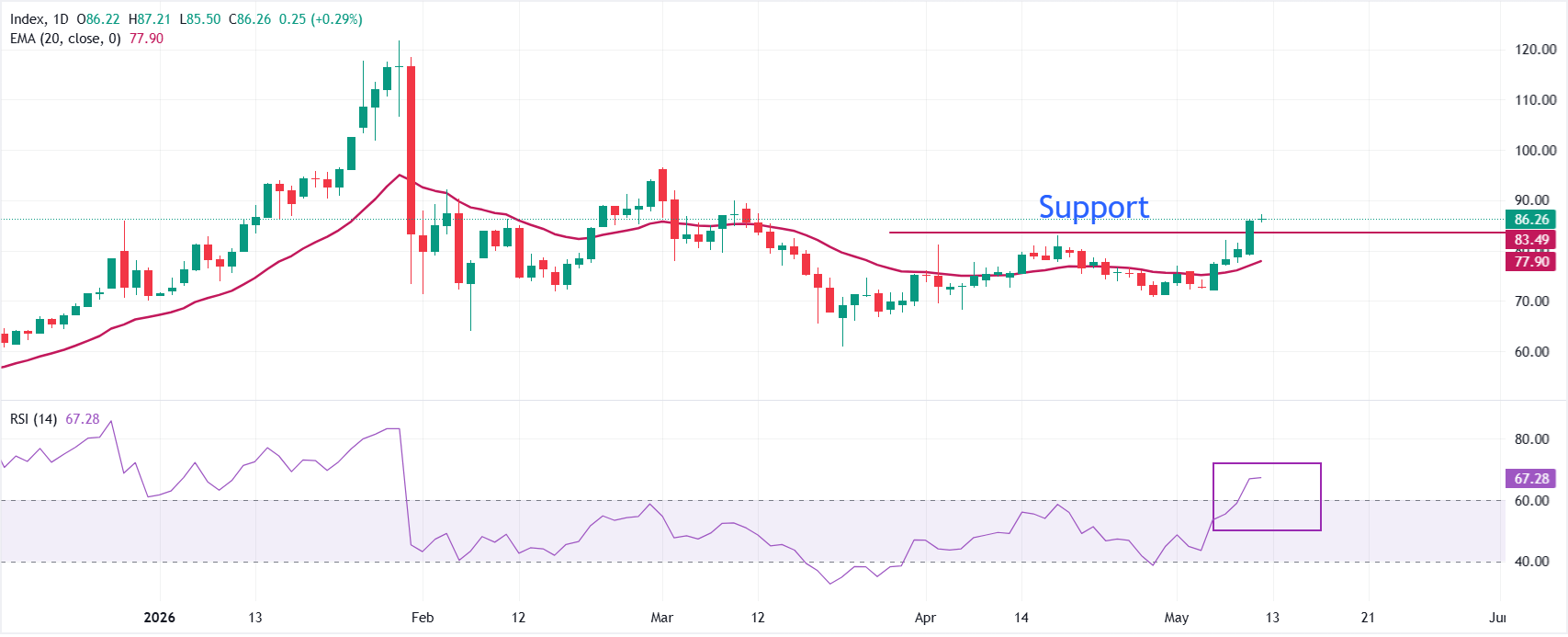
XAG/USD trades at around $86.50 in the Asian trade. The white metal holds a firm bullish bias as it is well above the 20-day Exponential Moving Average (EMA) at roughly $77.90. The clustering of the spot above this short-term trend gauge suggests underlying demand remains constructive, while the Relative Strength Index (RSI) near 67 stays shy of overbought territory, hinting that upside momentum is strong and not yet exhausted.
On the downside, initial support is at the April 17 high of $83.06, with stronger backing at the 20-day EMA near $77.90, which reinforces the broader uptrend as long as it holds. Looking up, the Silver price aims to extend its advance towards $90.00, followed by the March 3 high of $92.06.
(The technical analysis of this story was written with the help of an AI tool.)
Silver FAQs
Silver is a precious metal highly traded among investors. It has been historically used as a store of value and a medium of exchange. Although less popular than Gold, traders may turn to Silver to diversify their investment portfolio, for its intrinsic value or as a potential hedge during high-inflation periods. Investors can buy physical Silver, in coins or in bars, or trade it through vehicles such as Exchange Traded Funds, which track its price on international markets.
Silver prices can move due to a wide range of factors. Geopolitical instability or fears of a deep recession can make Silver price escalate due to its safe-haven status, although to a lesser extent than Gold's. As a yieldless asset, Silver tends to rise with lower interest rates. Its moves also depend on how the US Dollar (USD) behaves as the asset is priced in dollars (XAG/USD). A strong Dollar tends to keep the price of Silver at bay, whereas a weaker Dollar is likely to propel prices up. Other factors such as investment demand, mining supply – Silver is much more abundant than Gold – and recycling rates can also affect prices.
Silver is widely used in industry, particularly in sectors such as electronics or solar energy, as it has one of the highest electric conductivity of all metals – more than Copper and Gold. A surge in demand can increase prices, while a decline tends to lower them. Dynamics in the US, Chinese and Indian economies can also contribute to price swings: for the US and particularly China, their big industrial sectors use Silver in various processes; in India, consumers’ demand for the precious metal for jewellery also plays a key role in setting prices.
Silver prices tend to follow Gold's moves. When Gold prices rise, Silver typically follows suit, as their status as safe-haven assets is similar. The Gold/Silver ratio, which shows the number of ounces of Silver needed to equal the value of one ounce of Gold, may help to determine the relative valuation between both metals. Some investors may consider a high ratio as an indicator that Silver is undervalued, or Gold is overvalued. On the contrary, a low ratio might suggest that Gold is undervalued relative to Silver.

Lebih dari satu juta pengguna mengandalkan FXStreet untuk data pasar real-time, alat charting, wawasan ahli, dan berita forex. Kalender ekonomi komprehensif dan webinar edukatif membantu trader tetap mendapat informasi dan membuat keputusan terukur. FXStreet memiliki sekitar 60 profesional yang tersebar antara kantor pusat Barcelona dan berbagai wilayah global.
Baca Selengkapnya