USD/INR edges lower at open ahead of Trump’s Iran deadline
Oleh Sagar Dua
Diperbarui: 7 Apr 2026


ARTIKEL POPULER

The Indian Rupee (INR) ticks up against the US Dollar (USD) in the opening trade on Tuesday.
- The Indian Rupee trades marginally higher against the US Dollar in the opening trade.
- Investors await Iran’s final decision on Trump’s deadline at 08:00 PM ET, 05:30 AM IST on Wednesday.
- The RBI is expected to maintain the status quo on Wednesday.
The Indian Rupee (INR) ticks up against the US Dollar (USD) in the opening trade on Tuesday. The USD/INR pair edges down to near 93.00, while it is expected to remain range bound as investors stay on sidelines ahead of United States (US) President Donald Trump’s ultimatum to Iran either to reopen the Strait of Hormuz or face brutal consequences whose deadline is Tuesday, April 7, 08:00 PM Eastern Time (ET), which will be 05:30 AM IST on Wednesday.
Trump threatens hell if Iran misses deadline
Over the weekend, US President Trump warned, through a post on Truth.Social, that Washington will bomb Iranian power plants and bridges, if it doesn’t reopen the Strait of Hormuz before the deadline.
Meanwhile, comments from Iran signal that it won’t back down, as it threatened reciprocal attacks on the regional US infrastructure and its allies. An advisor to Iran's Parliament Speaker Mohammad Bagher Ghalibaf stated that “Trump has about 20 hours to either surrender to Iran, or his allies will return to the Paleolithic Age”.
Market participants worry that a fresh escalation in the ongoing war would boost oil prices, a scenario that is unfavorable for the Indian Rupee, being the currency of a nation that caters its 88%-89% of its domestic energy needs through oil imports.
The ongoing tensions in the Middle East have dampened the interest of foreign investors in the Indian stock market. Foreign Institutional Investors (FIIs) continue to dump their stake in the Indian equity market, and have offloaded their stake worth Rs. 26,429.45 crore in the three trading days of April gone by.
Investors await RBI’s policy decision and FOMC minutes
On the domestic front, the next major trigger for the Indian Rupee will be the Reserve Bank of India’s (RBI) monetary policy announcement on Wednesday. The RBI is expected to leave its Repo Rate unchanged at 5.25%, as higher energy prices have prompted inflation expectations globally.
As the RBI is highly anticipated to maintain the status quo, investors will pay close attention to comments from the Indian central bank regarding the outlook of inflation, economic growth and key borrowing rates.
In the US, the Federal Open Market Committee (FOMC) minutes of the March policy meeting will be published on late Wednesday. In the policy meeting, the Fed decided to leave interest rates unchanged in the range of 3.50%-3.75% and stated that “higher energy prices will push up inflation in the near term”.
Technical Analysis: USD/INR turns range bound as RSI sifts into 40.00-60.00 zone
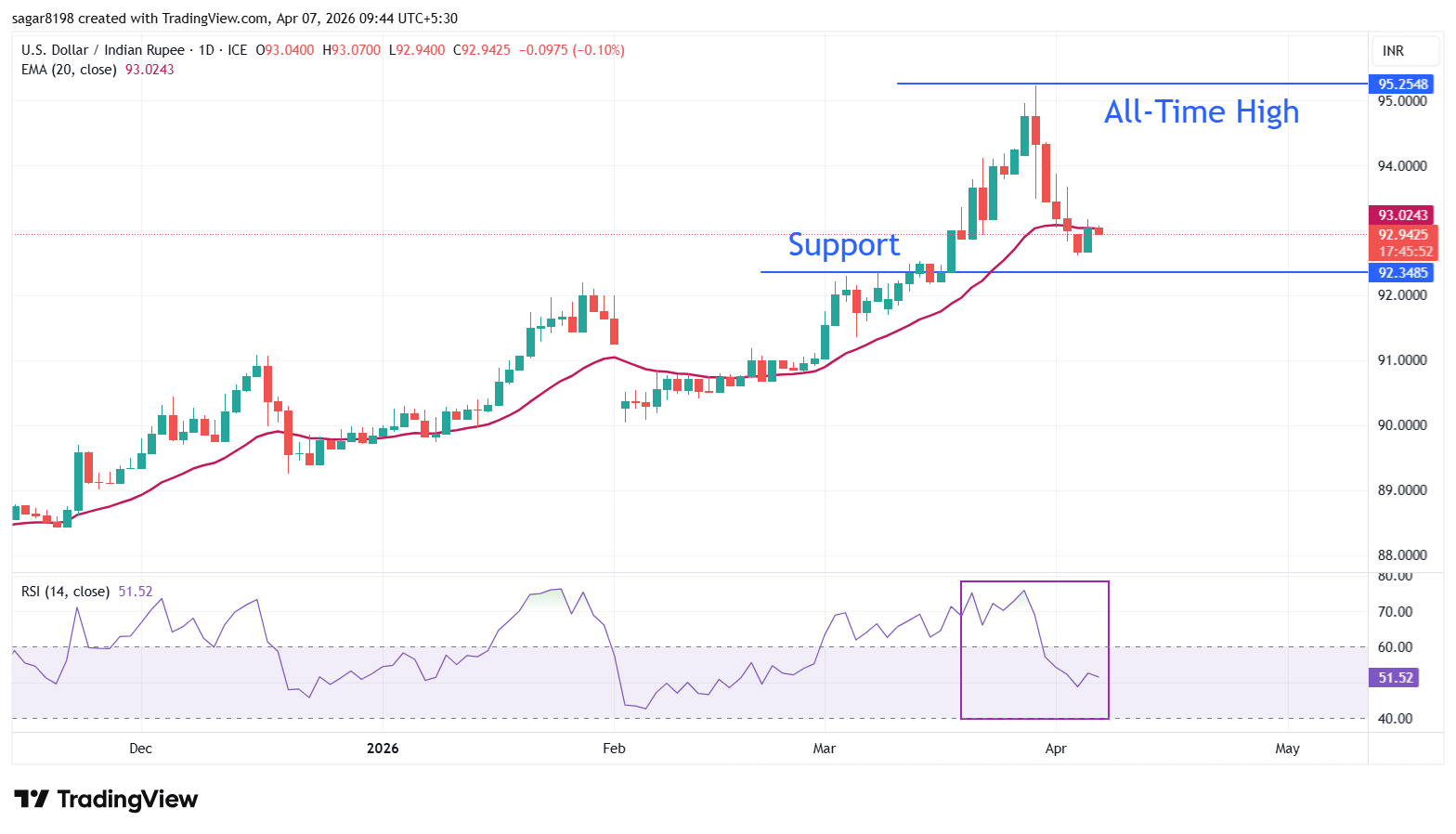
USD/INR edges down to near 93.00 in the opening trade on Tuesday. The near-term bias appears neutral as the pair trades close to the 20-day Exponential Moving Average (EMA), which is at 92.95, capping rebounds. The overall trend remains bullish as the higher highs and higher lows structure has not broken yet.
The 14-day Relative Strength Index (RSI) shifts into the 40.00-60.00 zone from the bullish territory above 60.00, signifying that momentum has cooled down, but the bullish bias remains intact.
Initial support emerges at the March 9 high of 92.35, with a daily close below this level opening the room toward the March 5 low of 91.35. On the topside, immediate resistance stands at the April 2 high of 93.66; a break above that level would reassert the bullish trend, which will improve the odds of the price reclaiming the all-time high of 95.22.
Indian Rupee FAQs
The Indian Rupee (INR) is one of the most sensitive currencies to external factors. The price of Crude Oil (the country is highly dependent on imported Oil), the value of the US Dollar – most trade is conducted in USD – and the level of foreign investment, are all influential. Direct intervention by the Reserve Bank of India (RBI) in FX markets to keep the exchange rate stable, as well as the level of interest rates set by the RBI, are further major influencing factors on the Rupee.
The Reserve Bank of India (RBI) actively intervenes in forex markets to maintain a stable exchange rate, to help facilitate trade. In addition, the RBI tries to maintain the inflation rate at its 4% target by adjusting interest rates. Higher interest rates usually strengthen the Rupee. This is due to the role of the ‘carry trade’ in which investors borrow in countries with lower interest rates so as to place their money in countries’ offering relatively higher interest rates and profit from the difference.
Macroeconomic factors that influence the value of the Rupee include inflation, interest rates, the economic growth rate (GDP), the balance of trade, and inflows from foreign investment. A higher growth rate can lead to more overseas investment, pushing up demand for the Rupee. A less negative balance of trade will eventually lead to a stronger Rupee. Higher interest rates, especially real rates (interest rates less inflation) are also positive for the Rupee. A risk-on environment can lead to greater inflows of Foreign Direct and Indirect Investment (FDI and FII), which also benefit the Rupee.
Higher inflation, particularly, if it is comparatively higher than India’s peers, is generally negative for the currency as it reflects devaluation through oversupply. Inflation also increases the cost of exports, leading to more Rupees being sold to purchase foreign imports, which is Rupee-negative. At the same time, higher inflation usually leads to the Reserve Bank of India (RBI) raising interest rates and this can be positive for the Rupee, due to increased demand from international investors. The opposite effect is true of lower inflation.

Lebih dari satu juta pengguna mengandalkan FXStreet untuk data pasar real-time, alat charting, wawasan ahli, dan berita forex. Kalender ekonomi komprehensif dan webinar edukatif membantu trader tetap mendapat informasi dan membuat keputusan terukur. FXStreet memiliki sekitar 60 profesional yang tersebar antara kantor pusat Barcelona dan berbagai wilayah global.
Baca Selengkapnya