

USD/JPY Price Forecast: Bearish momentum builds as price slips below key daily SMAs
Oleh Vishal Chaturvedi
Tanggal Diterbitkan: 12 Feb 2026 | Tanggal Dimodifikasi: 12 Feb 2026


ARTIKEL POPULER

The Japanese Yen (JPY) stays on the front foot against the US Dollar (USD) on Wednesday, extending its three-day winning streak as broad-based Yen demand keeps the pair under pressure.
- USD/JPY extends losses for a third straight day, as the Japanese Yen stays supported after Japan’s election outcome.
- The US Dollar struggles to capitalize on a stronger-than-expected US jobs report.
- The near-term technical outlook has turned bearish, with USD/JPY slipping below key daily moving averages.
The Japanese Yen (JPY) stays on the front foot against the US Dollar (USD) on Wednesday, extending its three-day winning streak as broad-based Yen demand keeps the pair under pressure. At the time of writing, USD/JPY trades around 152.84, near a two-week low, with the pair down more than 2.5% so far this week.
Renewed support for the Yen reflects improved market confidence after Prime Minister Sanae Takaichi secured a decisive election victory, reducing political uncertainty and lifting investor confidence in her policy agenda and the outlook for economic growth.
Meanwhile, the Greenback struggles to capitalize on the stronger-than-expected US jobs report, as persistent structural headwinds and still-dovish Federal Reserve (Fed) expectations continue to weigh on sentiment. The US Dollar Index (DXY) is trading near 96.75, after briefly jumping to 97.27 in the immediate reaction to the labor data.
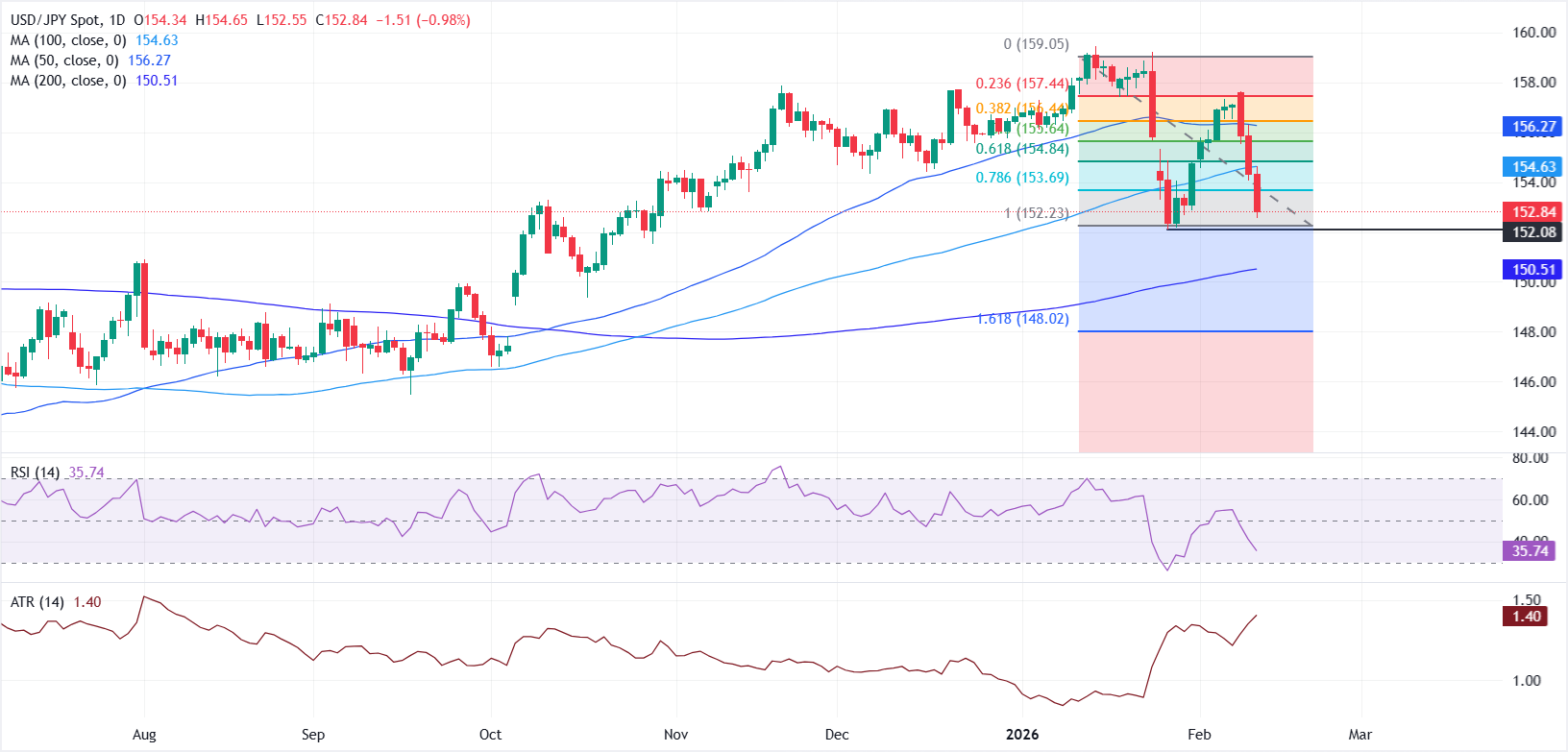
From a technical perspective, the near-term outlook for USD/JPY has turned bearish after the pair slipped below its key daily moving averages.
Momentum indicators also remain weak. The Relative Strength Indes (RSI) is hovering near 35, staying in bearish territory and pointing to room for further losses, while the pair is not yet deeply oversold. Meanwhile, the Average True Range (14) has widened to around 1.38, flagging broader daily swings.
On the downside, a clean break below the 152.00 handle would expose the 200-day Simple Moving Average (SMA) near 150.50. A decisive move below 150.00 would reinforce the bearish bias and open the door for a deeper corrective pullback toward the 1.618 Fibonacci retracement near 148.00.
Measured from the 152.23 low to the 159.05 high, the 78.6% retracement at 153.69 and the 61.8% retracement at 154.84 are the near-term thresholds to watch during any rebound. The 100-day SMA around 154.60 also stands as an important intermediate resistance in this zone.
Failure to reclaim 153.69 would keep downside pressure in place, whereas a daily close above 154.84 could open the door for a recovery toward the 50-day SMA at 156.27 and help ease the bearish tone.
Japanese Yen FAQs
The Japanese Yen (JPY) is one of the world’s most traded currencies. Its value is broadly determined by the performance of the Japanese economy, but more specifically by the Bank of Japan’s policy, the differential between Japanese and US bond yields, or risk sentiment among traders, among other factors.
One of the Bank of Japan’s mandates is currency control, so its moves are key for the Yen. The BoJ has directly intervened in currency markets sometimes, generally to lower the value of the Yen, although it refrains from doing it often due to political concerns of its main trading partners. The BoJ ultra-loose monetary policy between 2013 and 2024 caused the Yen to depreciate against its main currency peers due to an increasing policy divergence between the Bank of Japan and other main central banks. More recently, the gradually unwinding of this ultra-loose policy has given some support to the Yen.
Over the last decade, the BoJ’s stance of sticking to ultra-loose monetary policy has led to a widening policy divergence with other central banks, particularly with the US Federal Reserve. This supported a widening of the differential between the 10-year US and Japanese bonds, which favored the US Dollar against the Japanese Yen. The BoJ decision in 2024 to gradually abandon the ultra-loose policy, coupled with interest-rate cuts in other major central banks, is narrowing this differential.
The Japanese Yen is often seen as a safe-haven investment. This means that in times of market stress, investors are more likely to put their money in the Japanese currency due to its supposed reliability and stability. Turbulent times are likely to strengthen the Yen’s value against other currencies seen as more risky to invest in.

Lebih dari satu juta pengguna mengandalkan FXStreet untuk data pasar real-time, alat charting, wawasan ahli, dan berita forex. Kalender ekonomi komprehensif dan webinar edukatif membantu trader tetap mendapat informasi dan membuat keputusan terukur. FXStreet memiliki sekitar 60 profesional yang tersebar antara kantor pusat Barcelona dan berbagai wilayah global.
Baca Selengkapnya








