USD/JPY Price Forecast: Momentum cools as price slips below short-term average
Oleh Vishal Chaturvedi
Diperbarui: 1 Apr 2026


ARTIKEL POPULER

USD/JPY trades in a narrow range on Wednesday, as the Japanese Yen (JPY) struggles to capitalize on a softer US Dollar (USD). At the time of writing, the pair is trading around 158.50 after retreating from the 160.00 handle touched earlier this week.
- USD/JPY is on the defensive as the US Dollar weakens amid improved risk sentiment.
- US Dollar Index slips to a one-week low near 99.30 after hitting ten-month highs earlier this week.
- Technical bias turns mildly bearish, with price holding just below the 21-day SMA while momentum indicators soften.
USD/JPY trades in a narrow range on Wednesday, as the Japanese Yen (JPY) struggles to capitalize on a softer US Dollar (USD). At the time of writing, the pair is trading around 158.50 after retreating from the 160.00 handle touched earlier this week.
The Greenback weakens across the board as risk sentiment improves on growing hopes that the US-Iran conflict could end soon, following comments from US President Donald Trump that military operations may conclude within two to three weeks.
The US Dollar Index (DXY), which tracks the Greenback's value against a basket of six major currencies, is hovering near 99.34, close to a one-week low after touching ten-month highs of 100.64 on Monday.
Market focus is now shifting to Trump’s scheduled address to the nation at 01:00 GMT on Thursday, where he is expected to provide “an important update on Iran.”
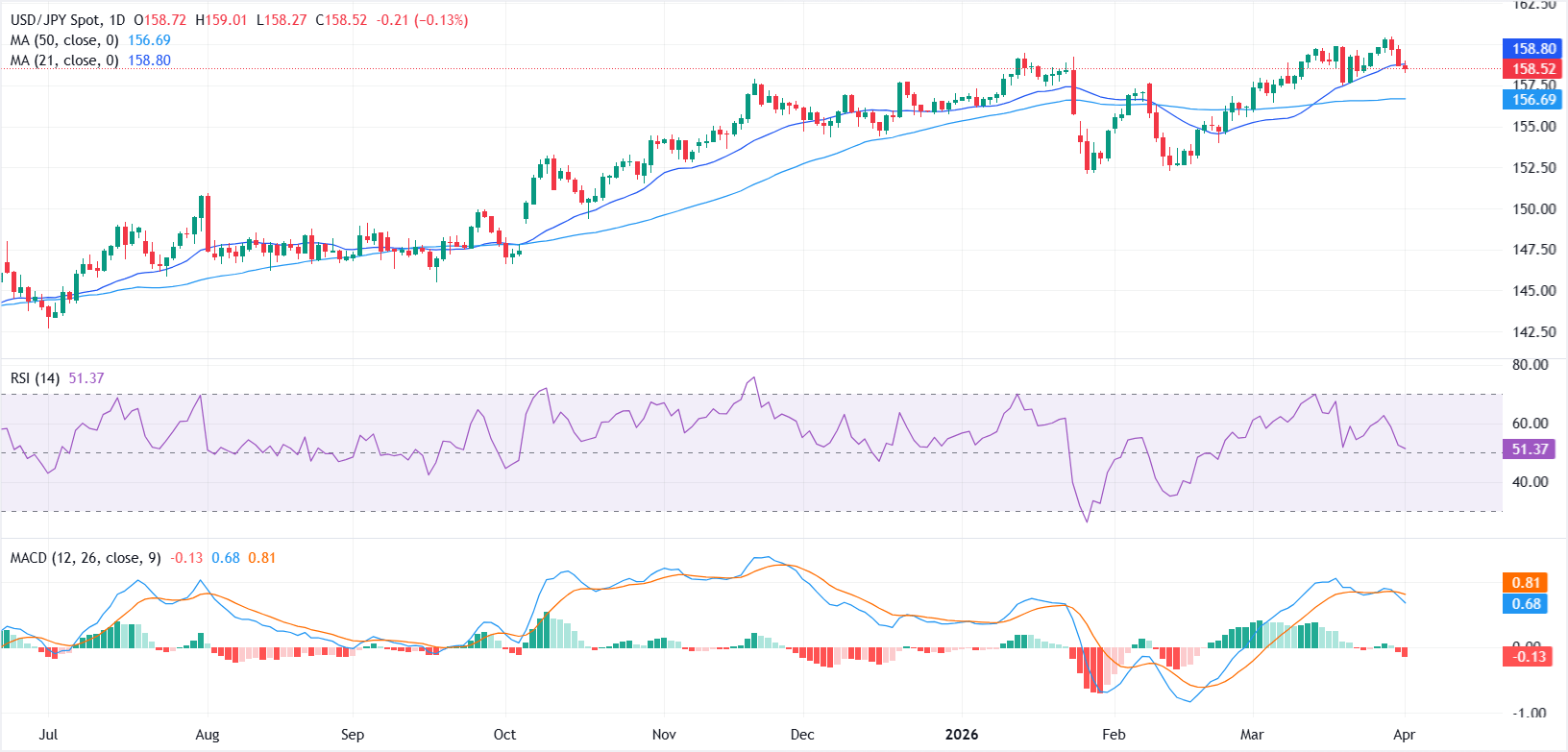
From a technical perspective, USD/JPY is mildly bearish after failing to sustain gains above the 160.00 psychological level, a zone that has previously triggered intervention by Japanese authorities.
The daily chart shows price hovering just below the 21-day Simple Moving Average (SMA) around 158.80, suggesting a short-term loss of momentum within a broader uptrend.
Momentum has eased from late-March peaks but remains broadly constructive, with the Relative Strength Index (RSI) hovering near the neutral 50 mark. The Moving Average Convergence Divergence (MACD) has slipped marginally below its signal but remains near the zero line, hinting at consolidation rather than a full-fledged reversal.
On the upside, the 21-day SMA acts as immediate resistance, and a close above this level could open the door for a retest of the 160.00 psychological mark.
On the downside, a strong close below the 21-day SMA would strengthen bearish pressure, bringing the 50-day SMA near 156.96 into focus as the next support level.
Japanese Yen FAQs
The Japanese Yen (JPY) is one of the world’s most traded currencies. Its value is broadly determined by the performance of the Japanese economy, but more specifically by the Bank of Japan’s policy, the differential between Japanese and US bond yields, or risk sentiment among traders, among other factors.
One of the Bank of Japan’s mandates is currency control, so its moves are key for the Yen. The BoJ has directly intervened in currency markets sometimes, generally to lower the value of the Yen, although it refrains from doing it often due to political concerns of its main trading partners. The BoJ ultra-loose monetary policy between 2013 and 2024 caused the Yen to depreciate against its main currency peers due to an increasing policy divergence between the Bank of Japan and other main central banks. More recently, the gradually unwinding of this ultra-loose policy has given some support to the Yen.
Over the last decade, the BoJ’s stance of sticking to ultra-loose monetary policy has led to a widening policy divergence with other central banks, particularly with the US Federal Reserve. This supported a widening of the differential between the 10-year US and Japanese bonds, which favored the US Dollar against the Japanese Yen. The BoJ decision in 2024 to gradually abandon the ultra-loose policy, coupled with interest-rate cuts in other major central banks, is narrowing this differential.
The Japanese Yen is often seen as a safe-haven investment. This means that in times of market stress, investors are more likely to put their money in the Japanese currency due to its supposed reliability and stability. Turbulent times are likely to strengthen the Yen’s value against other currencies seen as more risky to invest in.

Lebih dari satu juta pengguna mengandalkan FXStreet untuk data pasar real-time, alat charting, wawasan ahli, dan berita forex. Kalender ekonomi komprehensif dan webinar edukatif membantu trader tetap mendapat informasi dan membuat keputusan terukur. FXStreet memiliki sekitar 60 profesional yang tersebar antara kantor pusat Barcelona dan berbagai wilayah global.
Baca Selengkapnya