

What is priced in for the Reserve Bank of New Zealand policy meeting?
Oleh Christian Borjon Valencia
Tanggal Diterbitkan: 17 Feb 2026 | Tanggal Dimodifikasi: 17 Feb 2026


ARTIKEL POPULER

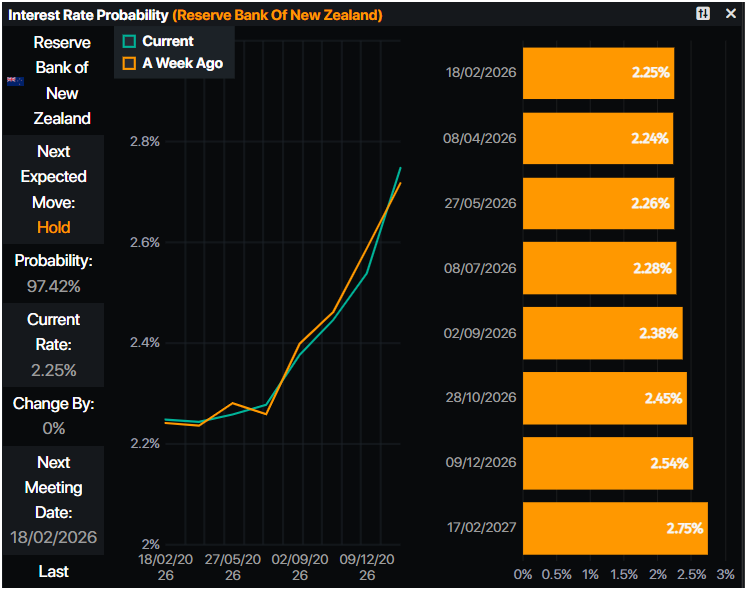
On Wednesday, the Reserve Bank of New Zealand (RBNZ) will unveil its latest monetary policy meeting decision, and so far, money markets have priced in a 99% chance to hold the Overnight Cash Rate (OCR) unchanged at 2.25%, according to Prime Market Terminal interest rate probability tool.
On Wednesday, the Reserve Bank of New Zealand (RBNZ) will unveil its latest monetary policy meeting decision, and so far, money markets have priced in a 99% chance to hold the Overnight Cash Rate (OCR) unchanged at 2.25%, according to Prime Market Terminal interest rate probability tool.
RBNZ remains neutral, despite red-hot CPI print
Economic data in New Zealand provided mixed signals, yet on the hawkish side, GDP figures in Q3 surpassed the bank’s forecast, while the Consumer Price Index (CPI) for Q4 cleared the 3% threshold, coming hotter than expected at 3.1%.
This prompted a slight hawkish reaction by the RBNZ’s incoming new Governor Anna Breman, who said in her first speech that “Our directive is explicitly to prioritize maintaining low and stable inflation,” in a speech on December 1, 2025.
However, on December 15, despite saying that “indicators show ongoing recovery in economic growth,” it poured cold water on RBNZ’s previously hawkish view, saying that the “OCR is expected to stay at 2.25% for an extended period if economic conditions develop as anticipated.”
A Reuters poll revealed that thirty-one economists surveyed predicted the RBNZ will keep the cash rate steady at 2.25% at the February 18 meeting.
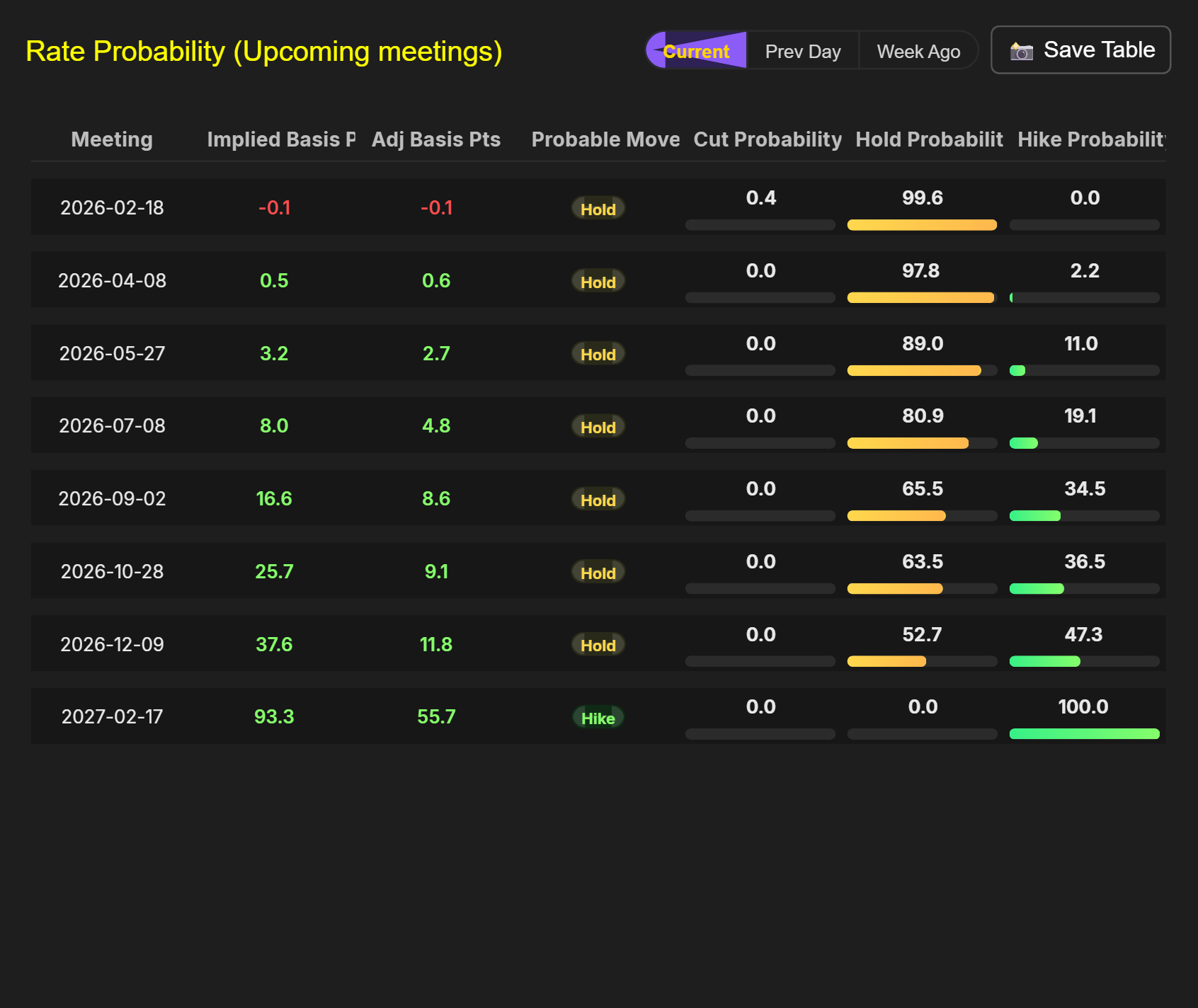
However, money markets had priced in 37.6 basis points of rate hikes by the RBNZ towards the year’s end, according to Capital Edge Rate Probability tool.
(This story was corrected on February 16 at 21:06 GMT to fix a mispelling in RBNZ’s incoming new Governor, Anna Breman)
RBNZ FAQs
The Reserve Bank of New Zealand (RBNZ) is the country’s central bank. Its economic objectives are achieving and maintaining price stability – achieved when inflation, measured by the Consumer Price Index (CPI), falls within the band of between 1% and 3% – and supporting maximum sustainable employment.
The Reserve Bank of New Zealand’s (RBNZ) Monetary Policy Committee (MPC) decides the appropriate level of the Official Cash Rate (OCR) according to its objectives. When inflation is above target, the bank will attempt to tame it by raising its key OCR, making it more expensive for households and businesses to borrow money and thus cooling the economy. Higher interest rates are generally positive for the New Zealand Dollar (NZD) as they lead to higher yields, making the country a more attractive place for investors. On the contrary, lower interest rates tend to weaken NZD.
Employment is important for the Reserve Bank of New Zealand (RBNZ) because a tight labor market can fuel inflation. The RBNZ’s goal of “maximum sustainable employment” is defined as the highest use of labor resources that can be sustained over time without creating an acceleration in inflation. “When employment is at its maximum sustainable level, there will be low and stable inflation. However, if employment is above the maximum sustainable level for too long, it will eventually cause prices to rise more and more quickly, requiring the MPC to raise interest rates to keep inflation under control,” the bank says.
In extreme situations, the Reserve Bank of New Zealand (RBNZ) can enact a monetary policy tool called Quantitative Easing. QE is the process by which the RBNZ prints local currency and uses it to buy assets – usually government or corporate bonds – from banks and other financial institutions with the aim to increase the domestic money supply and spur economic activity. QE usually results in a weaker New Zealand Dollar (NZD). QE is a last resort when simply lowering interest rates is unlikely to achieve the objectives of the central bank. The RBNZ used it during the Covid-19 pandemic.

Lebih dari satu juta pengguna mengandalkan FXStreet untuk data pasar real-time, alat charting, wawasan ahli, dan berita forex. Kalender ekonomi komprehensif dan webinar edukatif membantu trader tetap mendapat informasi dan membuat keputusan terukur. FXStreet memiliki sekitar 60 profesional yang tersebar antara kantor pusat Barcelona dan berbagai wilayah global.
Baca Selengkapnya








