

Black Wednesday Hits AI Stocks as Semiconductors Slide and Market Logic Shifts
Di Michael Rodriguez
Data di Pubblicazione: 5 Feb 2026 | Data di Modifica: 5 Feb 2026


ARTICOLI POPOLARI

On Wednesday (U.S. Eastern Time), U.S. equities delivered a tale of two markets: traditional value sectors represented by the Dow Jones Industrial Average bucked the trend and closed up 0.53%, while the tech-growth stronghold centered on the Nasdaq was routed, marking the first time since last April that the index posted declines of more than 1% for two consecutive sessions.
The epicenter of the disaster was semiconductors. The Philadelphia Semiconductor Index sank 4.4% in a single day, and star names were awash in red: AMD plunged 17% after guidance disappointed the market, Nvidia is down 9% so far this week, and Meta fell 6.6%. This was not a simple round of profit-taking; rather, it reflected a repricing of the AI industry’s overcrowded valuations, mounting concerns over companies’ massive capital expenditures, and a renewed assessment of technological disruption risk.
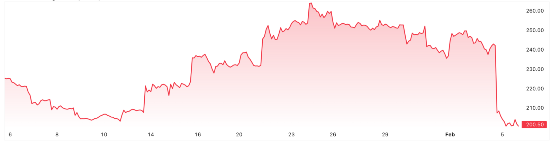
(AMD Stock Price Chart)
Market Performance Snapshot:
Index / Sector / Stock | Key Performance | Explanation and Impact |
Nasdaq Composite Index | Consecutive two-day decline of more than one percent, closing down 1.51% on February fourth. | This marks the first occurrence since April two thousand twenty-five, indicating that the sell-off has sector-wide characteristics and persistence, rather than being a one-day anomaly. |
Philadelphia Semiconductor Index | Single-day plunge of 4.36%. | As a core indicator of AI hardware, its sharp decline signals a rapid weakening of market confidence in the AI infrastructure narrative. |
Advanced Micro Devices | Plunged 17.31%, marking the largest single-day drop since May two thousand seventeen. | Directly triggered by earnings results; guidance that fell short of extreme expectations reignited concerns over the strength and sustainability of AI chip demand. |
Nvidia | Down 9% cumulatively for the week. | As the bellwether of AI chips, its decline shows the market is reassessing the valuation logic of the entire AI industry chain. |
Meta Platforms | Down 6.6% cumulatively for the week. | Although not directly exposed to AMD, as a core AI beneficiary its stock was dragged lower amid a systematic downward repricing of technology valuations. |
Software and Services Sector | Continued weakness with broad-based declines. | Deeply impacted by AI substitution concerns, signaling that TMT valuations are shifting from hype-driven expectations toward practical application scrutiny. |
The Logic Behind the AI Sector Meltdown
High Valuations and Fragile Confidence
The immediate trigger for this plunge is clear and formed a “software + hardware” double hit:
“Substitution panic” in software stocks: AI startup Anthropic released a new productivity tool designed to automate legal work. This touched the market’s most sensitive nerve — AI technology is beginning to materially replace high-end white-collar work, posing an existential threat to many listed companies whose core business is providing enterprise software and services. Investors fear that the core revenue base and profit margins of many software firms will suffer irreversible erosion. This panic quickly spread, sparking a broad sell-off in software stocks.
“Expectation collapse” in hardware stocks: AMD’s earnings report became the final straw that broke the hardware sector. Although its fourth-quarter results and the midpoint of its first-quarter revenue guidance (USD 9.8 billion) both exceeded broad market expectations, the AI investment boom had pushed expectations to a “perfect” level, with some analysts previously looking for guidance above USD 10 billion. This report — “only” strong rather than “stunning” — was interpreted as a signal that AI chip demand growth may be falling short of expectations. CEO Lisa Su’s defense that AI acceleration is “beyond imagination” also failed to stabilize confidence that had become extraordinarily fragile under ultra-high valuations.
A Profound Shift in Market Logic
“Capex anxiety” intensifies: On the same day AMD sparked turbulence, Google parent Alphabet released an astonishing 2026 capital expenditure outlook of USD 175–185 billion, far above market expectations. Instead of boosting sentiment, it deepened concerns: in the foreseeable future, every AI giant must continue pouring in astronomical sums to stay competitive, severely eroding free cash flow and near-term profits. Investors are starting to question whether the long-term returns from these investments can justify today’s valuations.
A “great reallocation” of capital flows: Market risk appetite has cooled markedly. Funds are rotating out of mega-run-up, richly valued tech-growth names and into more defensive healthcare and value stocks, as well as small caps benefiting from “value rotation.” This violent style shift amplified selling pressure on tech stocks, especially AI-themed names. Saxo Bank’s chief investment strategist captured it aptly: “The market hasn’t abandoned artificial intelligence, but it is pricing it more cautiously.”
The Arrival of an “Stock Picking” Era
Another key feature of this sell-off is sharp differentiation. Not all tech stocks fell indiscriminately — for instance, Microsoft was relatively steady on the day. This supports analysts’ view that the market is transitioning from the past two years’ “indiscriminate buying” of AI themes to a phase of carefully distinguishing “winners and losers.” Companies with irreplaceable ecosystem moats, clear profitability paths, and healthy cash flow will be better able to weather the storm. Meanwhile, firms whose valuations are supported mainly by AI narratives — but whose core competitiveness may be disrupted by technology — will face sustained adjustment pressure.
Short-Term Outlook for the AI Sector
Looking ahead, short-term volatility in the AI sector is likely to persist as the market needs time to digest valuations and rebuild consensus.
The choppy adjustment is not over: The core issues that triggered panic — AI’s disruptive impact on existing business models and the endless capex arms race among giants — have not disappeared. Until a powerful positive catalyst emerges (such as a company demonstrating better-than-expected AI monetization), the sector as a whole may remain under pressure and highly volatile.
Watch key earnings and data: Upcoming results from big tech names such as Amazon, as well as delayed U.S. macro releases including nonfarm payrolls and CPI, will be critical in shaping risk appetite and judging whether the economy can support lofty valuations.
“Selective repair” will be the main theme: After the plunge, the market will enter a process of separating the real from the hype. Leading companies with solid orders, technological leadership, and robust finances (such as certain core computing-infrastructure suppliers) may be the first to stabilize or even rebound. Pure concept stocks, however, may continue to be abandoned. As analysts have noted, AI trades in 2026 will not rise and fall together — individual fundamentals will dominate price action.

Michael Rodriguez brings 14 years of equity market experience with a CFA designation and an MBA in Finance from New York University. His coverage spans global equity markets, with expertise in the technology, healthcare, and financial sectors. He is also a regular contributor to industry journals, writing market commentaries that make complex equity trends accessible to both retail and institutional readers.
Leggi di più








