

GBP/USD tilts bullish as markets barrel toward mid-week NFP print
Di Joshua Gibson
Data di Pubblicazione: 10 Feb 2026 | Data di Modifica: 10 Feb 2026


ARTICOLI POPOLARI

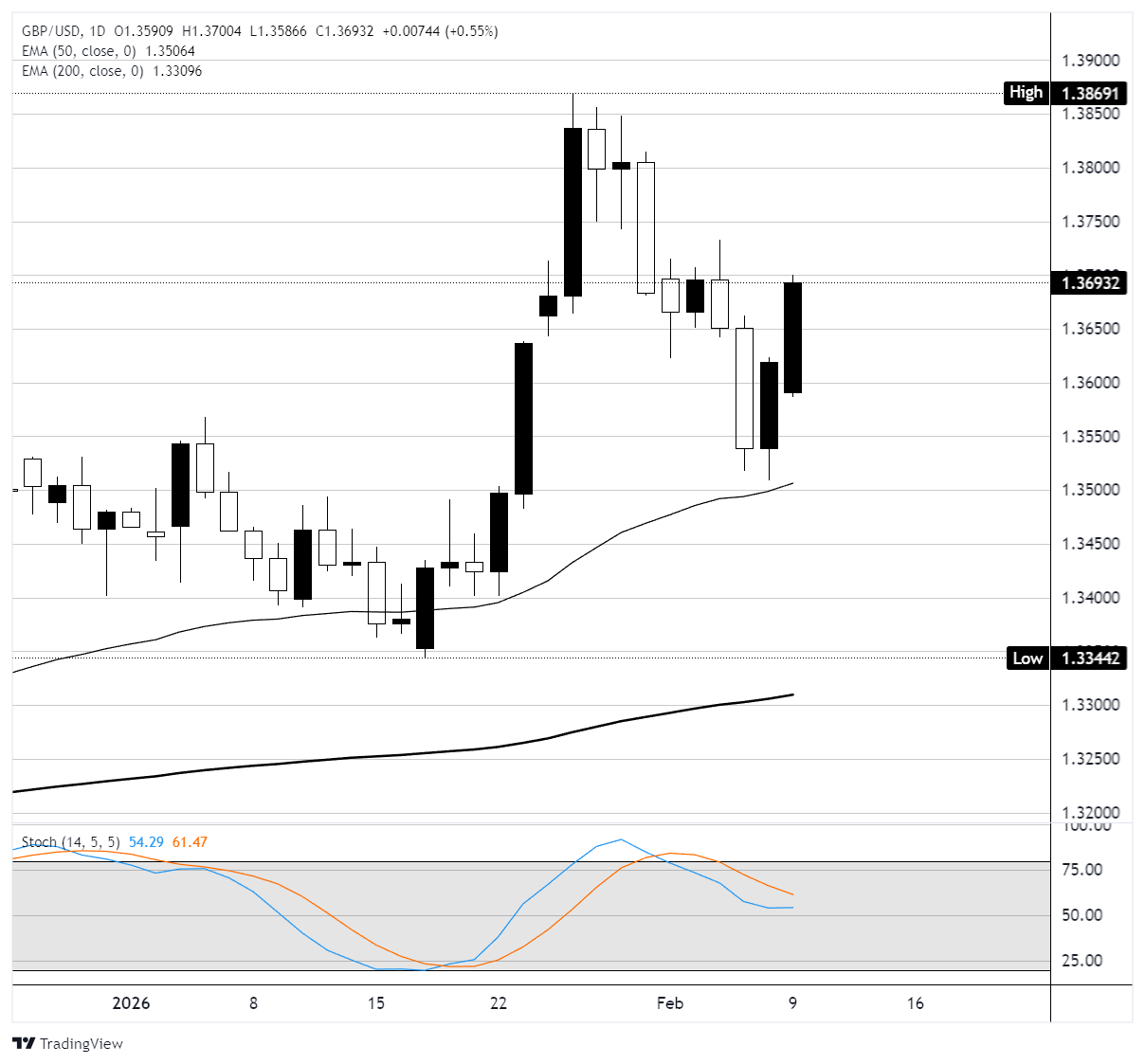
GBP/USD is holding a broader bullish structure on the daily chart, with price trading well above the 50 Exponential Moving Average (EMA) at 1.3507 and the 200 EMA at 1.3310, confirming the intermediate uptrend that has been in place since the November 2025 low near 1.2300.
- GBP/USD gained another 0.55% on Monday, extending into a firm two-day recovery.
- Key trouble spots remain for Cable bulls, and key US labor data looms large in the midweek.
GBP/USD is holding a broader bullish structure on the daily chart, with price trading well above the 50 Exponential Moving Average (EMA) at 1.3507 and the 200 EMA at 1.3310, confirming the intermediate uptrend that has been in place since the November 2025 low near 1.2300. However, the pair pulled back sharply from its January high of 1.3869 after the Bank of England (BoE) held rates at 3.75% in a dovish 5-4 vote split, with four Monetary Policy Committee members pushing for an immediate 25 basis point cut. Monday's session saw a modest recovery, with price bouncing from Friday's close near 1.3600 to trade around 1.3695, forming a bullish daily candle that reclaimed ground above the 1.3690 level. This area aligns roughly with the late-January consolidation zone between 1.3690 and 1.3770 that previously acted as support before last week's breakdown. UK political uncertainty surrounding Prime Minister Starmer's leadership is adding a headwind, but the broader trend of higher highs and higher lows on the daily timeframe still holds above the 50 EMA.
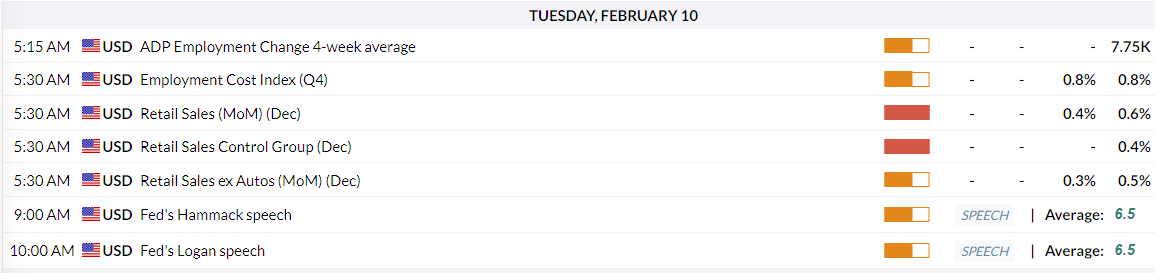
Tuesday's session carries significant event risk from US Retail Sales (Dec) and the Employment Cost Index (Q4), both due at 05:30 GMT, followed by Federal Reserve (Fed) speeches from Hammack and Logan. The Stochastic Oscillator (14, 5, 5) on the daily chart remains tepid in neutral territory after unwinding from overbought conditions, suggesting room for further upside if momentum builds. A sustained push above the 1.3700 handle on Tuesday would target the broken support turned resistance near 1.3770, with a stronger move opening the path toward 1.3870 (the January swing high). On the downside, weaker-than-expected US data could initially support Pound Sterling, but a surprise beat in Retail Sales or hawkish Fed commentary may drive a retest of the 1.3590 low printed last week, with deeper support at the 50 EMA near 1.3507. The 1.3690-1.3700 zone is the near-term pivot; how price reacts here heading into the US data releases will set the tone for the rest of the week.
Economic data releases on Tuesday:
GBP/USD daily chart
Pound Sterling FAQs
The Pound Sterling (GBP) is the oldest currency in the world (886 AD) and the official currency of the United Kingdom. It is the fourth most traded unit for foreign exchange (FX) in the world, accounting for 12% of all transactions, averaging $630 billion a day, according to 2022 data. Its key trading pairs are GBP/USD, also known as ‘Cable’, which accounts for 11% of FX, GBP/JPY, or the ‘Dragon’ as it is known by traders (3%), and EUR/GBP (2%). The Pound Sterling is issued by the Bank of England (BoE).
The single most important factor influencing the value of the Pound Sterling is monetary policy decided by the Bank of England. The BoE bases its decisions on whether it has achieved its primary goal of “price stability” – a steady inflation rate of around 2%. Its primary tool for achieving this is the adjustment of interest rates. When inflation is too high, the BoE will try to rein it in by raising interest rates, making it more expensive for people and businesses to access credit. This is generally positive for GBP, as higher interest rates make the UK a more attractive place for global investors to park their money. When inflation falls too low it is a sign economic growth is slowing. In this scenario, the BoE will consider lowering interest rates to cheapen credit so businesses will borrow more to invest in growth-generating projects.
Data releases gauge the health of the economy and can impact the value of the Pound Sterling. Indicators such as GDP, Manufacturing and Services PMIs, and employment can all influence the direction of the GBP. A strong economy is good for Sterling. Not only does it attract more foreign investment but it may encourage the BoE to put up interest rates, which will directly strengthen GBP. Otherwise, if economic data is weak, the Pound Sterling is likely to fall.
Another significant data release for the Pound Sterling is the Trade Balance. This indicator measures the difference between what a country earns from its exports and what it spends on imports over a given period. If a country produces highly sought-after exports, its currency will benefit purely from the extra demand created from foreign buyers seeking to purchase these goods. Therefore, a positive net Trade Balance strengthens a currency and vice versa for a negative balance.

Oltre un milione di utenti si affida a FXStreet per dati di mercato in tempo reale, strumenti di charting, approfondimenti di esperti e notizie Forex. Il loro calendario economico completo e i webinar formativi aiutano i trader a rimanere informati e a prendere decisioni ponderate. FXStreet conta circa 60 professionisti tra la sede di Barcellona e diverse regioni globali.
Leggi di più








